
At a Glance
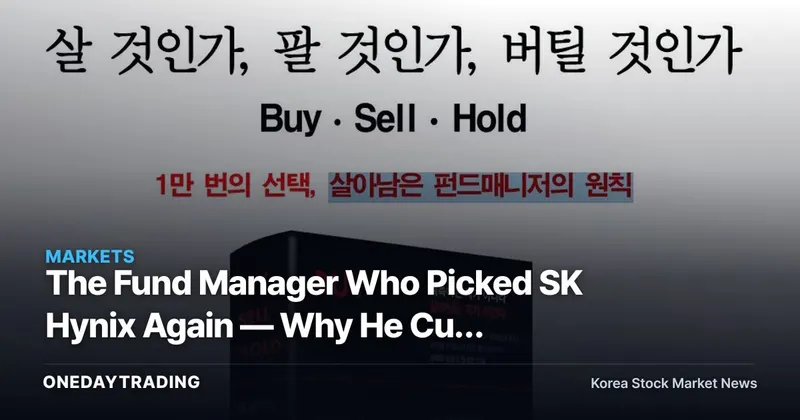
The core message of KCGI Asset Management CEO Mok Dae-gyun's new book isn't a stock pick. It's a book that reframes the buy-sell-hold decisions Korean investors face every day in the language of interest rates, cycles, and leadership rotation.
This news tells investors one thing: in a market chasing sharp-gaining themes, what separates returns isn't what to buy, but when to revise your assumptions.
Why It Matters Now
20 years, 10,000 decisions. What this number really reveals isn't the length of a career, but a way of surviving in the Korean stock market. CEO Mok has lived through the 2008 global financial crisis, the 2011 European debt crisis, the 2014 oil price plunge, the 2020 pandemic, and the recent AI transformation — periods where price moves first and the rationale follows. Markets always construct a plausible narrative. But money flows not to explanations, but to the bottlenecks where profit accumulates.
The most investment-relevant passage in the book is his account of rebalancing the portfolio into SK Hynix at the height of the secondary battery boom. This wasn't a hunch that semiconductors "looked good." In the AI cycle, capital concentrates on GPU, HBM, and memory bottlenecks, and companies holding those bottlenecks have a higher probability of defending both price and volume at once. Secondary batteries, by contrast, face margin pressure before revenue pressure once slowing EV demand, inventory adjustments, and falling raw material costs converge.
In a bull market, even a correct view becomes the wrong position if held too long. When rates fall, growth stock multiples expand first. Then the market winnows the field down to sectors where actual earnings materialize. AI is no different. Once expectations lift the entire semiconductor sector, the stock price is again decided by HBM shipments, customer orders, and the payback period on capital expenditure. What the market has already priced in is the word "AI." What may not yet be fully priced in is who can defend margins while capturing volume.
FAQ
- Is this simply news of a book release? On the surface it's news of a new book, but the content is closer to a framework for Korean investors' portfolio decisions. In particular, the shift in weighting from secondary batteries to SK Hynix is a real-world case study in reading leadership rotation.
- Why is SK Hynix the central case study? Because the path by which AI demand translates into actual revenue runs through memory bottlenecks, especially high-value-added products. It's not the theme but supply constraints and customer orders that create pricing power.
- Should secondary batteries be viewed only negatively? No. But once the stock price has already priced in expectations of a bottom, real-economy indicators — such as a recovery in EV sales, inventory drawdown, and stabilizing cathode material prices — need to follow.
- What's the takeaway for retail investors? Rather than trying to pick the right stock, investors need a framework for admitting when their investment thesis is wrong and making a new decision, rather than clinging to a losing position.
Related Stocks/Sector Impact
- SK Hynix (000660). Cited as the key case study and a direct beneficiary of AI infrastructure investment and HBM demand. What matters isn't the narrative but next quarter's shipments and high-value-added memory margins.
- Samsung Electronics (005930). A fellow beneficiary of the memory industry upturn. However, any re-rating depends on HBM customer qualification, narrowing foundry losses, and the pace of recovery in commodity memory prices.
- LG Energy Solution (373220). A leading name in the secondary battery boom. If slowing EV demand and inventory adjustments persist, a recovery in profitability may lag behind top-line growth.
- Ecopro BM (247540). Sensitive to cathode material prices and customer utilization rates. For materials stocks, margin pressure from falling selling prices needs to be checked before any recovery in sales volume.
- Domestic asset management industry. As undervalued growth stocks and global investment demand grow, differentiation in management capability comes into sharper focus. That said, fund inflows tend to lag market returns and investor sentiment.
Investment Considerations
- Check valuation first. AI and semiconductors are already at the center of the market. Without confirming how much of the expectation is already in the price, even a good company can become a bad buy.
- Build out the counter-scenario. If HBM capacity expansion accelerates faster than expected and eases the supply shortage, or if customer orders are delayed, multiples could compress first.
- Verify any secondary battery rebound with real demand. Determine whether a stock price rebound reflects an actual recovery in EV sales or is simply a bounce from an oversold level.
- The next indicator to watch is earnings. Key data points include quarterly memory shipments and HBM revenue mix at SK Hynix and Samsung Electronics, along with utilization rates and inventory levels at secondary battery makers.
Overall Outlook
CEO Mok Dae-gyun's new book puts the emphasis not on which stocks to buy, but on which questions to ask first. The Korean stock market still has an undervaluation argument going for it. But closing that discount doesn't happen through slogans. It requires profitable bottlenecks, changes in capital allocation, and shareholder returns and governance that satisfy foreign investors — all moving together.
The optimistic scenario is clear: if AI investment continues to translate into real server and memory orders, and high-value-added memory profits centered on SK Hynix hold up, the semiconductor-led market could extend further. The risk lies in the same place. If the market has already assigned a high price to the word "AI," the numbers confirmed in upcoming earnings will be read far more coldly than expectations suggest. Interest rates, the exchange rate, and quarterly HBM shipments will be the triggers for the next judgment call.
SK Hynix: Real-Time Data Snapshot
SK Hynix's most recent closing price was 1,691,000 won (+12.73% versus the previous session), and the signal combining foreign/institutional order flow with news and momentum reads 🟢 Buy-leaning. Foreign investor activity, news flow, and momentum are all positive, making this a name worth watching.
- ▲ News flow — 9 positive catalysts vs. 1 negative catalyst — positive catalysts dominate
Recent related news skews favorable, with 9 positive catalysts versus 1 negative catalyst.
※ Price and foreign/institutional order-flow data are provided by Korea Investment & Securities (KIS) and are as of the time of publication.
This article was automatically summarized and analyzed based on the original news report. View original (Maeil Business Newspaper)