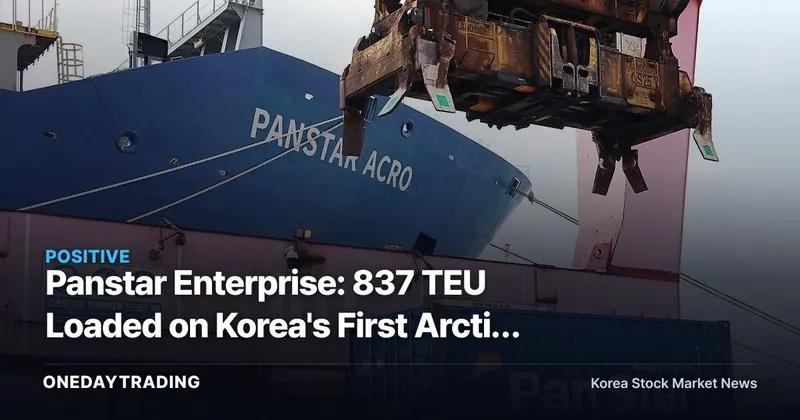

3-Line Briefing
- The Arctic route trial voyage by Panstar Enterprise and Panstarline.com is an event that attaches route-option value to Korean shipping stocks before any near-term freight-rate impact.
- The Panstar Arco departs Busan New Port on August 22, 2026, sails the Northeast Passage to call at Felixstowe (UK), Rotterdam (Netherlands), and Gdansk (Poland), then returns to Busan around October 5.
- The ship is carrying 837 TEU in total — 737 TEU of cargo plus empty containers — falling short of the 1,300 TEU cited in the initial demand survey.
What's Changing
The Arctic route is the shortest sea route between Asia and Europe, opened up by shrinking Arctic sea ice, and splits into the Northeast Passage (north of Russia) and the Northwest Passage (north of North America). What investors should focus on isn't the romance of a new route. It's whether Busan Port can reduce its dependence on the Suez Canal for Europe-bound container logistics, and whether those cost savings flow down to demand for shipping lines, port equipment, and specialized vessels.
The Busan-Rotterdam voyage distance via the Northeast Passage was put at 13,000 km, about 35% shorter than the existing 20,000 km route through the Suez Canal. A shorter distance has a direct impact on fuel costs and vessel turnaround. If the same ship returns faster, available cargo capacity theoretically increases, and in a high-oil-price environment, fuel savings show up on the income statement first.
For now, though, this is a 45-day data-collection exercise, not the opening of a commercial route. The Ministry of Oceans and Fisheries said it will verify the route's economic viability by comparing voyage distance, transit time, fuel consumption, and operating costs. Stock prices tend to price in expectations first. But profit in the shipping industry comes not from expectations but from repeat voyages and load factors.
Numbers in Context
The Panstar Arco is a 2,758-TEU ice-class container ship purchased from HMM. It is set to enter the Northeast Passage around August 30 and pass through Arctic waters around September 7. The Arctic-sea leg of the voyage spans about 6,400 km. The vessel carries a crew of about 20, and the captain and navigating officers have completed polar-navigation training.
Viewed through the lag between order backlog, utilization, and margin, this news leaves a longer tail for shipbuilders than for shipping lines. For the Arctic route to become a recurring service, it will require not standard container ships but ice-class performance, low-temperature operating equipment, specialized insurance, and port support systems. That doesn't mean Korean shipbuilders have already secured new orders, but as route validation accumulates, an investment case for specialized-spec vessels and port infrastructure begins to take shape.
Stocks to Watch: Beneficiaries and Laggards
- Panstar Enterprise: A direct party, alongside Busan Metropolitan City and Panstarline.com, to the agreement on operating the Arctic route and boosting related industries. The key value here is the brand exposure and route data accumulated from this trial voyage.
- HMM: Cited as the previous owner of the Panstar Arco. It isn't the operator of this voyage, but it is linked to the broader trend of Korean container lines gaining more route options to Europe.
- Hyundai Glovis: A logistics operator whose business — auto parts, used cars, and the like — overlaps with this voyage's cargo mix. If the Arctic route becomes a recurring service, it opens the door to considering it as an alternative route for finished-vehicle and parts logistics.
- HD Hyundai Heavy Industries: A candidate for medium-to-long-term benefit if orders for ice-class and eco-friendly, high-efficiency vessels increase. Any near-term order disclosure is a separate matter for now.
- Hanwha Ocean: Its polar-navigation specifications and specialized-vessel construction capabilities could be re-rated. Any actual benefit should be counted only once orders for Arctic-route vessels are confirmed.
Risk Check
- Load factor: Total cargo on this voyage came to 837 TEU, below the 1,300 TEU projected in the demand survey. The economics of repeat voyages are determined by load factor before distance.
- Sanctions variable: The Northeast Passage runs north of Russia. The government has explained that it consulted with key relevant countries and resolved insurance issues, but if the sanctions environment against Russia changes, route costs could swing again.
- Seasonality: The Arctic route is affected by sea ice and weather conditions. If it can't be used as a year-round scheduled service, the premium that can be attached to shipping-line valuations remains limited.
- Insurance premiums and safety costs: If costs for ice-class vessels, specialized crew, communication systems, and emergency response eat into the savings, distance reduction alone won't be enough to claim a margin improvement.
Bottom Line
The departure of Korea's first container ship on the Arctic route is a positive catalyst for Panstar Enterprise and the shipping/shipbuilding value chain, but the next move in the stock will be determined by the operating cost, fuel consumption, and load-factor data to be released after the ship's return in October.
Frequently Asked Questions
What are the Arctic route-related stocks?
Among Arctic route-related stocks, Panstar Enterprise, the direct operator of the voyage, should be considered first. Next come container line HMM, Hyundai Glovis in auto logistics, and HD Hyundai Heavy Industries and Hanwha Ocean, which carry expectations tied to ice-class and specialized vessels.
When does the Panstar Arco return to Busan?
The Panstar Arco departs Busan New Port on August 22, 2026, and is scheduled to return to Busan around October 5. Its intermediate port calls are set for Felixstowe, UK, on September 9; Rotterdam, Netherlands, on September 11; and Gdansk, Poland, on September 15.
How much shorter is the Arctic route than the Suez Canal route?
According to the Ministry of Oceans and Fisheries, the Busan-Rotterdam distance via the Northeast Passage is 13,000 km — about 35% shorter than the existing 20,000 km route through the Suez Canal, making fuel-cost and transit-time savings the key points to verify.
Panstar Enterprise: Real-Time Data
Panstar Enterprise's most recent closing price is 1,100 won (+1.66% from the previous day), and the signal combining foreign/institutional investor supply-demand (order flow) with news and momentum reads 🟢 Buy-leaning. Foreign investors, institutional investors, and momentum are all positive, making it worth watching.
- ▲ Dual buying — foreign investors +100 million won and institutional investors +0 won, buying in tandem
- ▲ Trend alignment — short- and medium-term uptrend alignment (+1.7% today · +8.4% for the week · +17.9% for the month)
※ Price and foreign/institutional investor supply-demand (order flow) data are provided by Korea Investment & Securities (KIS) and are current as of publication.
This article is automatically summarized and analyzed content based on the original news report. View original (Yonhap News Industry)