
At a Glance
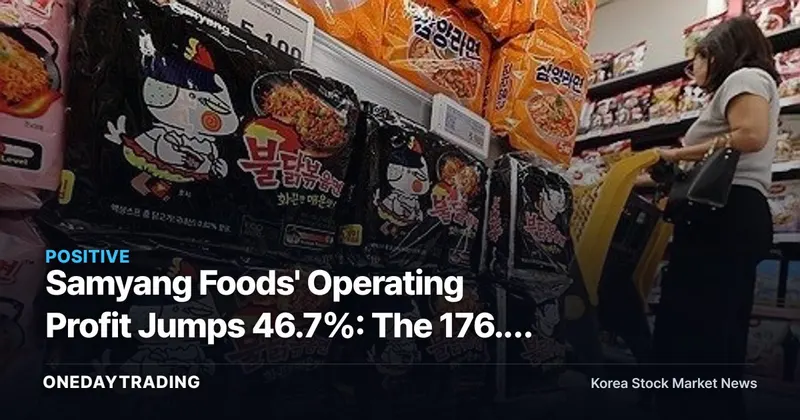
Samyang Foods posted consolidated operating profit of 176.2 billion won in the second quarter (April–June). That's up 46.7% from the same period last year. Korea's domestic ramen market itself is stagnant amid demographic decline and slowing consumption, so when a ramen maker's quarterly profit jumps by nearly half, it means that growth came from somewhere other than the domestic market.
Why It Matters Now
The press release offers just one number: 46.7%. In consumer-goods analysis, that figure shouldn't be taken at face value, because the true picture of profit from a single pack of ramen only emerges once you break it down into at least three components: sales volume, selling price, and cost. For several years now, the axis dividing Samyang Foods' earnings has been exports, not domestic sales. Whether this 46.7% is sustainable depends entirely on whether overseas volume — led by the Buldak (Hot Chicken) series — actually grew, or whether a weaker won inflated dollar-denominated overseas revenue upon conversion. If it's volume-driven growth, that momentum should carry into the next quarter. But if it's an optical illusion created by the exchange rate, an equally sharp reversal will follow the moment the won strengthens.
Raw material price trends for inputs like palm oil and flour are another variable. If sales volume grew even as costs stabilized, the margin improvement is structural. But if the cost decline was temporary, the base effect will fade starting next quarter and the growth rate itself could slow. The 46.7% increase may also partly reflect a low base in the year-ago quarter — meaning last year's second-quarter results need to be examined alongside this figure to gauge its true significance.
FAQ
- Does the 176.2 billion won operating profit meet market expectations? — Whether it deviates from the consensus estimate will need to be confirmed through analyst reports following the earnings release.
- How can you tell whether the profit increase is due to volume or the exchange rate? — Look at the gap between revenue growth and operating profit growth, together with changes in the share of overseas revenue.
- Does this affect domestic ramen competitors? — The direct earnings impact is limited, but it serves as a reference point for the competitive share dynamics in the overseas spicy-ramen category.
- When is the next checkpoint? — The regional and channel-level revenue breakdown due alongside the third-quarter earnings release will determine the true nature of this 46.7% figure.
Related Stocks and Sector Impact
- Samyang Foods — the company at the center of this earnings report. Whether valuations get reassessed depends on whether the profit growth is structural (volume-driven) or an exchange-rate effect.
- Nongshim — Korea's No. 1 domestic ramen maker, competing with Samyang Foods for share in the overseas spicy-ramen category.
- Ottogi — a ramen and food company with a domestically focused portfolio, offering a useful comparison since its earnings trajectory could diverge from export-driven growth stocks.
- Food raw materials (palm oil and wheat) — a key variable in ramen production costs, with international grain and oil price trends feeding directly into next quarter's margins.
Investment Considerations
- Without checking the base for this 46.7% growth rate (the year-ago quarter's results), investors risk overestimating the pace of growth.
- Given the high share of exports, shifts in the KRW/USD exchange rate level are a key variable that could change the direction of next quarter's earnings.
- The market may have already priced in a substantial portion of the expected earnings improvement, so it's worth checking whether valuation pressure exists by comparing actual results against consensus after the earnings release.
- Rather than concluding a long-term growth story from a single quarter's profit growth rate, it's safer to confirm the trend using at least two to three consecutive quarters of data.
Overall Outlook
The optimistic scenario is one where overseas volume growth genuinely continues, making this 46.7% the starting point of a structural improvement in earnings power. Conversely, if a substantial portion of this increase rests on exchange-rate and base effects, the growth rate could slow noticeably starting next quarter. What will separate these two scenarios is the regional revenue mix and the KRW/USD exchange rate level revealed in the third-quarter results.
Samyang Foods: A Real-Time Data Snapshot
Samyang Foods's most recent closing price was 1,270,000 won (+4.18% from the previous day), and the composite signal combining foreign/institutional order flow with news and momentum reads 🟢 Buy-leaning. Foreign investors, institutional investors, and momentum are all positive, making this a stock worth watching.
- ▲ Sustained order flow — Foreign investors have been net buyers for 5 straight days (+2.64 billion won)
- ▲ Dual buying — Foreign investors (+2.64 billion won) and institutional investors (+300 million won) buying together
※ Price and foreign/institutional order-flow data are provided by Korea Investment & Securities (KIS) and reflect the time of publication.
This article was automatically summarized and analyzed based on the original news report. View Original (Yonhap News Securities)