
At a Glance
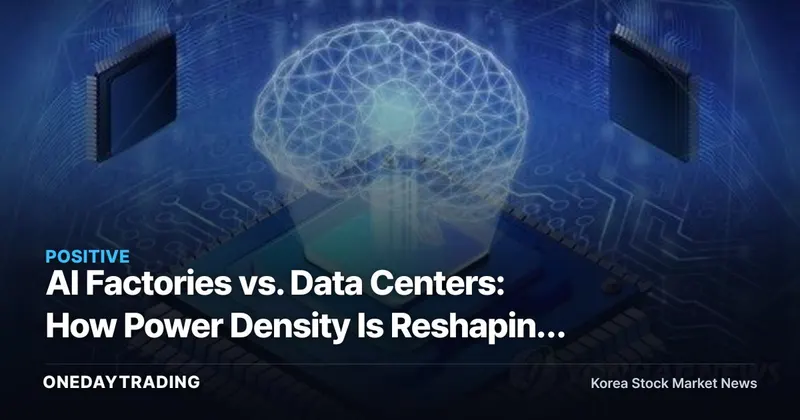
The growing use of the term "AI factory" isn't just marketing—it reflects a genuine shift in design philosophy. While a data center is essentially a space for storing and serving general-purpose computation, an AI factory is closer to a plant that densely stacks GPUs and accelerators to produce tokens (inference output). This distinction fundamentally changes the specifications of the memory, power, and cooling components that go into servers, and that change in turn becomes the demand curve for semiconductor, power-equipment, and cooling-related stock (ticker)s.
Why It Matters Now
Traditional data centers fill racks with general-purpose CPU-based servers, prioritizing stability through air cooling and redundant power supply. AI factories, by contrast, are judged on training and inference throughput itself. Because GPUs are packed as densely as possible into a single rack, power density per rack rises far above that of conventional data centers, and air cooling alone can no longer handle the heat load—making liquid cooling a baseline requirement rather than an option. This is where the component supply chain diverges. HBM, stacked alongside the GPUs, becomes the bottleneck where bandwidth and the number of stacked layers directly determine computing performance, while power supply must be redesigned at the rack and hall level rather than per server.
This structural shift matters to investors because demand is shifting from server unit counts to power and memory density per rack. Even with the same server shipment volume, a transition to AI-factory-grade specifications simultaneously increases both the unit price and volume of HBM, power semiconductors, substrates, and cooling components. That said, it would be risky to read this trend purely as structural demand growth. If Big Tech's capex cycle turns down, the pace of rack expansion would slow in tandem, and valuations that have already priced in the AI-factory transition remain exposed to correction pressure until actual utilization rates are confirmed.
Frequently Asked Questions
- What is the fundamental difference between an AI factory and a data center? - A data center stores and serves general-purpose computation, whereas an AI factory is optimized for mass-producing tokens (inference and training output) through a GPU-dense structure.
- Why does the cooling method become an investment point? - As power density per rack rises sharply, air cooling can no longer dissipate the heat, driving up demand for liquid-cooling components as well.
- What does this mean for domestic semiconductor companies? - There is significant room for growth in HBM stacking demand and high-spec packaging volume, but this remains an expectation that needs to be confirmed by actual orders and utilization rates.
- What are the risks? - Because investment tied to AI factories depends on Big Tech capex, a downturn in the capex cycle could likewise slow demand for related components.
Related Stock (Ticker)s and Sector Impact
- SK hynix - AI-factory servers require greater HBM capacity and more stacked layers per GPU, directly linking to order volumes for this company, which sits at the top of the HBM supply chain.
- Samsung Electronics (005930) - One of the few comprehensive semiconductor companies holding HBM, foundry, and packaging capabilities simultaneously, positioning it to respond to the shift toward high-spec AI-factory specifications.
- ISU Petasys - Demand for high-layer-count PCBs used in GPU servers scales with density per rack rather than server unit counts.
- LS ELECTRIC, HD Hyosung Heavy Industries - As power supply must be redesigned at the rack and hall level, this is a phase of rising orders for power equipment such as transformers and distribution gear.
- Cooling-related stock (ticker)s such as Sinsung E&G - As liquid cooling becomes a baseline specification, supply opportunities for related components and systems are expanding.
Investment Considerations
- Benefits related to AI factories hinge on the pace of Big Tech's capex execution, so investors should first check the capex guidance disclosed in upcoming quarterly earnings.
- Expectations are already substantially priced into HBM, cooling, and power-equipment stock (ticker)s, so confirmation through actual indicators—order announcements, shipment volumes—is necessary.
- The shift to liquid cooling is an area still undergoing standardization, and winners may be determined as a particular method becomes the industry standard.
- Power equipment has a long lag between order placement and revenue recognition, so it is more reasonable to judge based on order backlog trends rather than short-term earnings.
Overall Outlook
The fact that the term "AI factory" is becoming entrenched can be read as a signal that AI infrastructure investment is settling in as a distinct asset class rather than a one-off trend. In that case, demand for HBM, power equipment, and cooling components may track a structural expansion cycle rather than a server replacement cycle. At the same time, a scenario that runs counter to this optimistic outlook should also be considered. If verification of returns on Big Tech's AI investment is delayed or capex adjustments emerge, expectations for AI-factory-related component demand could be lowered faster than anticipated. The next indicators to watch are the quarterly capex guidance from major Big Tech firms and the next-quarter shipment and yield announcements from HBM suppliers.
SK hynix in Real-Time Data
SK hynix's most recent closing price is 1,842,000 won (-11.53% versus the previous session), and the signal combining foreign/institutional supply-demand (order flow) with news and momentum reads 🔴 Caution. With foreign investors, institutional investors, and momentum all negative, caution is warranted right now.
- ▼ Dual-side selling — Foreign investors −KRW 873.4 billion · institutional investors −KRW 1.164 trillion, selling in tandem
- ▼ Trend alignment — Short- and medium-term downtrend alignment (-11.5% today · -15.7% over 1 week · -26.9% over 1 month)
Recent related news skews favorable, with 4 positive catalysts versus 3 negative catalysts.
※ Price and foreign/institutional supply-demand (order flow) data are provided by Korea Investment & Securities (KIS) and reflect the time of publication.
This article was automatically summarized and analyzed based on the original news source. View Original (Yonhap News Industry)