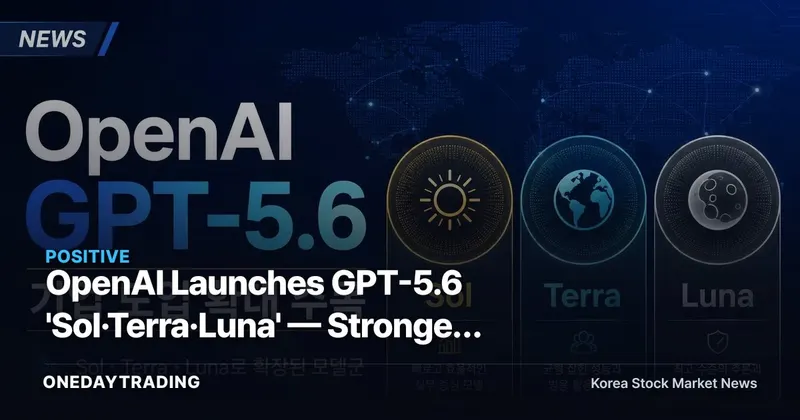

OpenAI has unveiled its next-generation 'GPT-5.6,' arriving not as a single model but as a three-tier model family — Sol, Terra, and Luna. The core message is unambiguous: smarter AI, stronger safeguards. More than a performance upgrade, the release reads as a strategic move that goes beyond benchmark bragging and targets the fundamental question of commercialization — can enterprises actually deploy this with confidence?
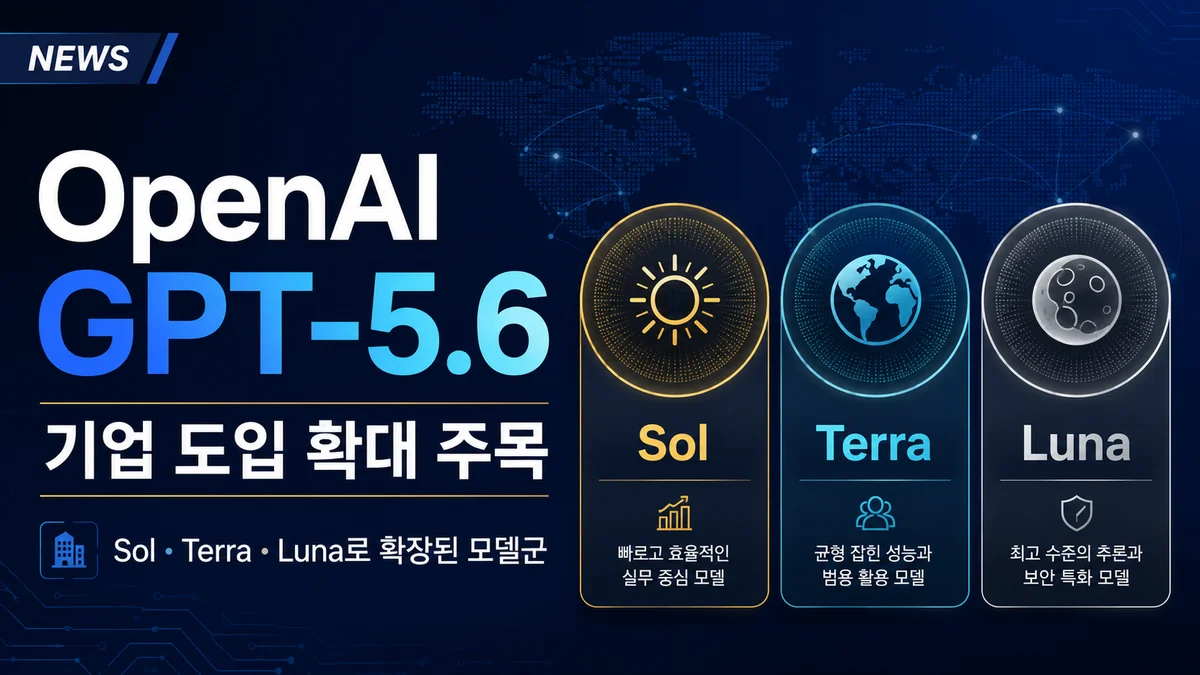
Three Models for Three Use Cases — Separating Cost, Speed, and Performance
Splitting the family into three tiers is not a branding exercise — it is the economics of running AI at industrial scale. Not every API call needs the most powerful model available.
- Sol — A fast, efficient task-oriented model designed for high-volume, repetitive workloads where response speed and per-call cost are paramount.
- Terra — A balanced, general-purpose model built to handle the bulk of standard enterprise and developer traffic as the workhorse of the lineup.
- Luna — A model specialized for top-tier reasoning and security, suited for high-stakes and sensitive tasks where accuracy and safety justify the premium.
This tiered structure enables intelligent routing — lightweight queries go to leaner models; only demanding tasks escalate to the top tier. That is the mechanism that bends the per-unit cost curve for both OpenAI and its customers, and it signals a broader shift in the global model race: the competitive battleground is moving from raw performance to performance-per-dollar and speed.
Why Safeguards Are the Key to Enterprise Adoption
No matter how capable a model is, enterprise contracts do not materialize without controllability. Governance, reliability, and risk concerns have been the single biggest barrier keeping advanced AI locked in pilot programs. If GPT-5.6 delivers meaningfully stronger safeguards alongside improved predictability, the addressable market expands into regulated and security-sensitive industries that have so far held back. Converting experiments into recurring, mission-critical use is what monetizes the entire infrastructure stack underneath — that is the real lever here.
Investment Angle: AI Semiconductors and HBM
As model generations advance and enterprise adoption broadens, training and inference compute demand scales in lockstep. For domestic investors, the most direct beneficiary link runs through AI memory. SK Hynix and Samsung Electronics (005930), the leading suppliers of high-bandwidth memory (HBM), are seen as first-order beneficiaries of rising AI accelerator demand. On the global compute axis, accelerator leader NVIDIA and Microsoft — OpenAI's largest partner and the distributor of cloud (Azure) and Copilot access — sit closest to the value chain. As model competition intensifies, the structural bias of capital flowing toward AI infrastructure is likely to persist, at least for the foreseeable future.
Key Watchpoints
- Per-tier pricing and release timing — How low Sol-tier unit costs fall will determine how quickly adoption broadens at the base.
- Benchmarks and system cards — Independent evaluations and safety documentation will validate the "performance + safeguards" claim.
- Latency and throughput — Critical variables for the spread of agentic, task-level, and consumer applications.
- Enterprise reference cases — New deployments in regulated industries will be the clearest signal that safeguards have translated into revenue.
In sum, GPT-5.6 confirms that the AI model cycle remains in acceleration — and signals that value is increasingly accruing not just to frontier models themselves, but to the broader ecosystem of compute, distribution, and safety tooling surrounding them. As the details of Sol, Terra, and Luna come into focus, that is the lens worth keeping.