
Key Takeaways
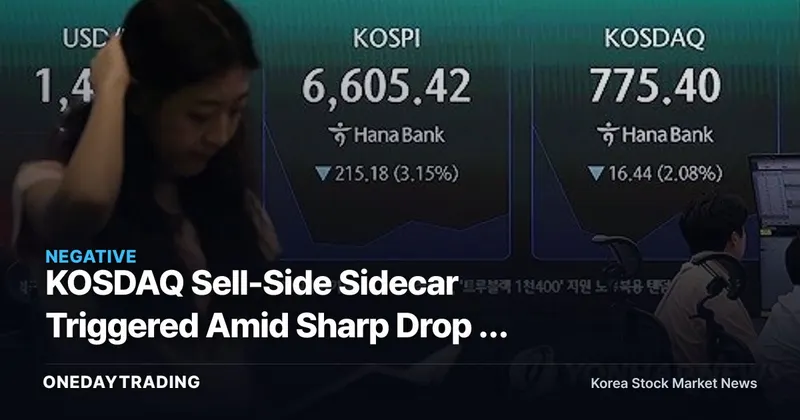
A sell-side sidecar was triggered in the KOSDAQ market. After KOSDAQ 150 futures fell more than 6% from the previous closing price and the KOSDAQ index itself dropped more than 3% — with both conditions holding for at least one minute — the exchange suspended the effect of program sell orders for five minutes. A sidecar is not a device that halts the decline itself; it is simply a brake that temporarily interrupts the phase in which program trading accelerates the drop. The real point to watch is whether selling resumes once this five-minute suspension lifts, or whether the decline settles down.
What Happened
A KOSDAQ sell-side sidecar is automatically triggered when the KOSDAQ 150 futures price falls more than 6% below the previous closing price while the KOSDAQ 150 index also drops more than 3%, with both conditions persisting for one minute. Once triggered, the effect of program sell orders is suspended for five minutes, and the mechanism can only be activated once per day. Compared with the KOSPI sidecar, which requires a 5% move in futures and a 1% move in the cash index, the KOSDAQ's trigger threshold is set relatively lower — a reflection of KOSDAQ's greater volatility relative to KOSPI and the outsized impact a single burst of program trading volume can have on the index.
The fact that a sidecar was triggered is itself an unusual event, but it does not necessarily mean the market's direction will reverse. Only program sell orders are frozen for five minutes; ordinary sell orders from retail and institutional investors continue to be executed as normal. Ultimately, this mechanism merely pauses the decline to give market participants a moment to catch their breath — it does not resolve the underlying cause of the drop.
Background and Context
A decline sharp enough to trigger a sidecar tends to emerge not from a negative catalyst specific to a single stock, but from macro variables that shake the index as a whole. When a sharp drop in U.S. equities, valuation concerns in leading industry sectors such as semiconductors and secondary batteries, a sudden shift in the exchange rate, or an unexpected macroeconomic data release combine to push program selling heavily in one direction, the conditions for a sidecar trigger are met. At this point, it is too early to pin the origin of this sharp drop on a single factor. However, whether program selling amplified the decline, or whether genuine selling demand emerged first with program trades following, can be gauged in large part from the price action in the five to thirty minutes after the sidecar is lifted.
Impact on the Market and Individual Stocks
- Large-cap KOSDAQ 150 constituents — Top-market-capitalization KOSDAQ 150 stocks in sectors such as secondary batteries, biotech, and gaming carry a high proportion of program trading, so price swings tend to be especially large during the sidecar's activation and release phases.
- KOSDAQ venture funds and small/mid-cap stocks — Deteriorating market sentiment triggered by a sharp index drop tends to spread first, and more severely, to small and mid-cap stocks with relatively thin liquidity.
- Stocks with a high share of margin loans and unsettled credit trades — If the sharp drop triggers forced margin-call liquidations, additional selling could carry over into the next trading day, and this possibility should be kept in mind.
- Large-cap KOSPI stocks — Whether the KOSDAQ sell-off spills over into the KOSPI will be the key gauge of whether this correction is a KOSDAQ-specific event or a broader market risk-off move.
Investor Checkpoints
- First, check whether the decline in KOSDAQ 150 futures and the cash index narrows or widens in the five minutes immediately after the sidecar is lifted.
- Track whether net selling by foreign investors and institutional investors grows or shrinks between the intraday reading and the close, to identify which players are driving this sell-off.
- Check whether a KOSPI sidecar or circuit breaker is also triggered the same day to determine whether the decline is confined to the KOSDAQ or has spread across the broader market.
- Watch the closing direction of U.S. equities and the KRW/USD exchange rate level heading into the next trading day to assess whether this sharp drop is linked to external variables.
Outlook
The optimistic scenario is one in which the sidecar merely breaks the lopsided wave of program selling, bargain-hunting demand flows in, and the intraday decline is reversed. It's worth noting that a sidecar trigger has not always been a precursor to a sustained downtrend in the past. Conversely, the risk scenario is one in which selling pressure fails to ease even after the sidecar is lifted, compounded by forced liquidations stemming from insufficient margin collateral ratios. In that case, the decline may not end in a single day and could carry over into the next trading session. Ultimately, the key question is whether this sharp drop is a temporary imbalance driven by program trading, or a trend-driven correction led by genuine selling demand. The answer will come not from the sidecar itself, but from the trading value and supply-demand (order flow) data that follow once it is lifted.
This article is automatically summarized and analyzed content based on the original news report. View Original Article (Yonhap News, Securities)