
3-line briefing
- WTI’s break above $90 matters more for stock multiples, through rising U.S. Treasury yields, than for short-term profits at refiners.
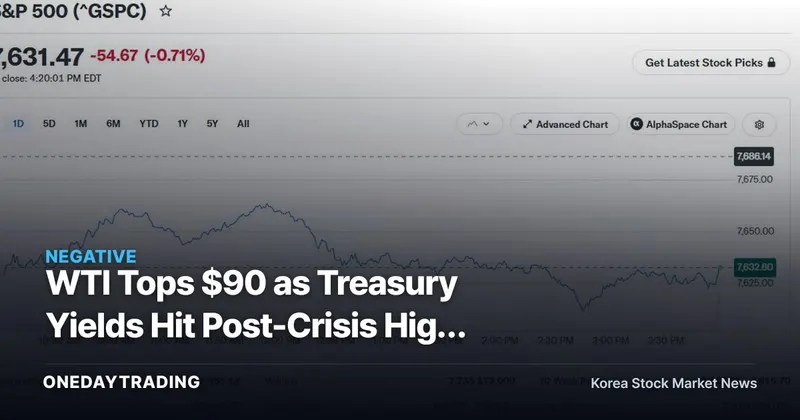
- According to a Maeil Business Newspaper securities report, the three major New York indexes fell on the 1st, and U.S. Treasury yields climbed to their highest level since the financial crisis.
- Attacks on two tankers passing through the Strait of Hormuz and the U.S. resumption of strikes on Iran are supply shocks that simultaneously move energy prices, the exchange rate, and shipping costs.
What changes?
WTI is West Texas Intermediate crude, the benchmark crude futures price traded in the U.S. and one of the reference points for global refining, airline, and chemical costs. The key point in this move is not just that oil rose. Oil prices pushed inflation expectations higher again, Treasury yields compressed valuations, and that pressure showed up first in the drop in the three major New York indexes.
For Korean investors, the implications split two ways. Refiners can see near-term earnings improve if crude inventory values rise and refining margins hold up. By contrast, airlines, shipping, and chemicals feel the fuel and raw-material burden first. Once WTI moves above $90, the market tends to price a higher discount rate for growth stocks from a renewed rise in rates faster than it prices energy stocks' earnings.
The Strait of Hormuz is a key route for Middle Eastern crude shipments. The attack on two tankers and the U.S. military response create cost channels first: higher insurance premiums, route detours, and shipping delays, before any physical supply disruption. Those costs can flow through to refiners and petrochemical companies' input costs, airlines' fuel bills, and imported inflation, eventually adding pressure on the won.
Numbers and context
Three numbers stand out in this report: WTI broke above $90, the attack targeted two tankers transiting the Strait of Hormuz, and U.S. Treasury yields reached their highest level since the financial crisis. When oil prices and rates rise in the same direction, the stock market typically separates cash-generating companies from those with heavier debt and cost burdens, even within the industry sector.
The view that refiners automatically win is only half right. S-Oil and SK Innovation can expect inventory revaluation gains, but if demand slows and refining margins weaken, the oil-price increase stays behind as working-capital pressure rather than margin expansion. The market has already priced in the benefit from the oil surge; what it has priced in less fully is the second-round pressure that higher rates put on chemical, airline, and growth-stock multiples.
Beneficiaries and losers
- S-Oil: Rising crude prices can boost inventory revaluation gains. But if refining margins hold, it signals earnings improvement; if margins weaken, the stock reaction tends to be short-lived.
- SK Innovation: The refining unit benefits from higher oil prices, but the battery and chemical units are more sensitive to rates and cost pressure. The business mix is both an advantage and a discount factor.
- GS: The value of the refining subsidiary may come into focus. Because of the holding-company discount, the stock may reflect higher oil prices more slowly than pure refiners.
- Korean Air: Higher fuel costs directly raise operating expenses. If international-fare pass-through holds, the hit is smaller; if demand weakens, margin pressure grows.
- LG Chem: Higher prices for naphtha and other petrochemical feedstocks can squeeze chemical spreads. If product-price pass-through lags, quarterly earnings become more volatile.
Risk check
- If the Middle East conflict ends as a one-off, the oil premium could fade quickly.
- If U.S. Treasury yields stay elevated, valuation pressure on growth stocks and cyclical names will outweigh the benefit to refiners.
- If the won weakens further, crude import costs rise again through the exchange rate.
- If refining margins fail to keep up with higher oil prices, refiners' earnings improvement may be limited to inventory revaluation gains.
Bottom line
WTI at $90 is a short-term positive catalyst for refiners, but if government bond yields stay at post-crisis highs, Korean stocks are more likely to price in higher discount rates and cost pressure than energy upside.
FAQ
Why does a break above WTI $90 matter for Korean stocks?
Because it simultaneously hits import prices, the won exchange rate, and corporate costs. Since Korea relies heavily on crude imports, higher oil prices translate into inventory gains for refiners and cost burdens for airlines and chemicals.
Do refiners always rise when oil rises?
S-Oil and SK Innovation can earn inventory revaluation gains during oil upcycles. But if refining margins shrink, higher crude prices shift from a profit driver to a working-capital burden.
Which stocks are hurt by rising U.S. Treasury yields?
When U.S. Treasury yields rise to their highest since the financial crisis, tech names with long-duration growth expectations and cyclical stocks with heavy debt loads are hit first. In Korea, keep an eye on sectors sensitive to discount rates and costs, such as growth, airlines, and chemicals.
WTI Crude Oil IndicatorAs of 2026-09-02
| Period trend | 1 week +10.17% 1 month +12.94% |
|---|
Index, commodity, and exchange-rate figures are based on global markets and reflect values at publication time.
S-Oil Key MetricsAs of 2026-09-02
| Period return | 1 week +8.43% 1 month +19.17% |
|---|---|
| Supply-demand (order flow) | foreign investors +4.2 billion won net buying institutional investors +4.2 billion won net buying |
| Recent news tone | positive catalyst 5 · negative catalyst 6 |
Price and flow data are real-time values from Korea Investment & Securities (KIS), and the supply-demand (order flow) and news-tone aggregates are calculated in-house by One Day Trading.
Upcoming schedule
- 09.10Futures and options simultaneous expiryMediumQuadruple witching — watch for volatility and supply-demand (order flow) disruption
- 09.16FOMC policy rate decisionHighFed policy announcement — direction for rates and the dollar
- 10.08Index options expiration dayLowKOSPI200 options expiration
- 10.22Bank of Korea Monetary Policy BoardHighBenchmark interest rate decision meeting
This article is automatically summarized and analyzed based on the original news report. View original (Maeil Business Newspaper Securities)