
Three-Line Briefing
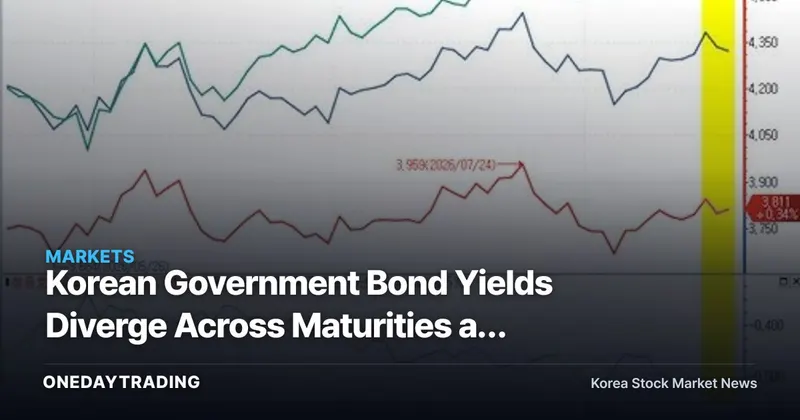
- On the 20th, Korean government bond yields closed mixed, with short-term and long-term maturities moving in opposite directions.
- Foreign investors' net selling of government bond futures added upward pressure on yields in that segment.
- The market smoothly absorbed the US Treasury's bond buyback volume, easing concerns for now about a sharp global rise in long-term rates.
What's Changing
The divergence between short- and long-term Korean government bond yields shows the market answering two different questions in two different ways. Short-term yields are more sensitive to the Bank of Korea's next monetary policy path, while long-term yields respond more to fiscal burden concerns and global bond supply-demand (order flow). When both segments move in the same direction, it signals a clear consensus; when they move in opposite directions, it means policy expectations and supply-demand (order flow) factors are pulling against each other. Right now, the market looks closer to the latter case.
Adding to this, foreign investors turned net sellers of government bond futures. Foreign investors' futures selling is typically read as a leading indicator that reflects directional bets ahead of the cash market. Their tilt toward selling can be interpreted as foreign investors placing more weight on upside risk to domestic yields than on further room for declines. However, whether this represents a pure directional bet or technical flows tied to FX hedging or arbitrage will only become clear once cumulative net trading trends are observed.
At the same time, the fact that the market absorbed the US Treasury's bond buyback without significant disruption is itself a source of relief. Buybacks are a process in which the Treasury purchases low-liquidity issues — stock (ticker) — to help smooth market functioning, and the fact that this volume was absorbed without issue suggests that genuine demand for US Treasuries remains solid. This sense of relief likely served as a buffer, preventing a sharp, corresponding rise in domestic long-term yields.
Numbers in Context
What the market is really watching now is the temperature gap between domestic monetary policy expectations and rate variables originating from the US. Domestically, the timing of the Bank of Korea Monetary Policy Board's next decision looms as a variable; internationally, upcoming US Treasury auctions and remarks from Fed officials remain in play. Whether foreign futures selling is a one-off adjustment or the early stage of a trend reversal will likely become clearer at the next events on both fronts.
Beneficiary and Impacted Stocks (Tickers)
- Banks, insurers, and other financial industry sector names: If long-term yields stay relatively firm, valuation burden on bond holdings persists, but a widening short-to-long-term spread also brings expectations of improved loan-deposit margins and investment margins.
- High-valuation growth stocks: If expectations tilt toward lower short-term policy rates, these stocks move into a favorable zone where discount-rate pressure eases. However, this effect is offset if long-term yields rise in tandem.
- Dividend stocks, REITs, and other fixed-income alternative assets: If long-term yield volatility increases, the appeal of their spread over dividend yield can weaken, creating pressure for capital outflows.
- Bond-type products and the asset management industry: If volatility rises due to foreign futures selling, bond funds could face heavier near-term redemption pressure and valuation losses.
Risk Check
- It remains unclear whether foreign investors' futures selling reflects a directional bet or technical, arbitrage-driven flows — subsequent cumulative net trading data will need to be checked.
- Whether the smooth absorption of the US Treasury buyback reflects temporary relief or a sustained recovery in demand will be determined by the results of the next auction.
- The short-term yield path could be recalibrated depending on the Bank of Korea Monetary Policy Board's schedule and the tone of its statements.
- If the mixed short-/long-term trend persists, it could simultaneously shake margin expectations for the financial industry sector and valuation expectations for growth stocks.
Bottom Line
The mixed short- and long-term yields mean the market hasn't yet reached a conclusion — not that there is no direction at all. The two key signals, foreign futures activity and US Treasury auctions, are likely to resolve one way or the other within the next few days, and the outcome will determine whether financial stocks or growth stocks come out ahead.
This article is automatically summarized and analyzed content based on the original news report. View original (Yonhap News Agency, Securities)