
Summary
POSCO International's issuance of electronic bills of lading is not an event that will change a general trading company's margins overnight, but a shift in the cost structure that reduces the capital turnover burden in trade operations.
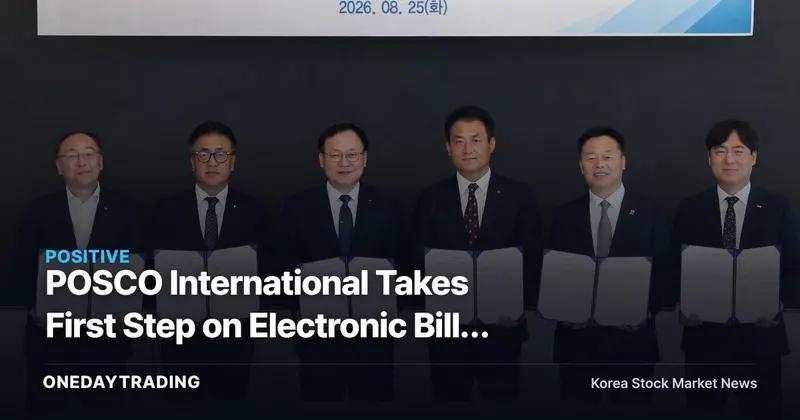
An electronic bill of lading is a trade document that processes the rights to seaborne cargo and the right to claim delivery through a digital ledger and authentication procedures instead of paper documents. According to Maeil Business Newspaper's corporate coverage, POSCO International began issuing electronic bills of lading with POSCO Flow and global partners at POSCO Center in Seoul on August 25, 2026.
What Happened
The first number the market should look at is not the share price, but the date. The fact that POSCO International issued an electronic bill of lading on August 25, 2026 signals that trade digitalization has moved from slogan to execution. What this really points to is not revenue expansion for a general trading company, but an attempt to reduce working-capital friction caused by document waiting times and the dispatch of originals.
A paper bill of lading serves as proof of rights in trade settlement and cargo delivery. If documents arrive late, cargo can be delayed even when it is already at port, and if financial-institution verification is delayed, the payment cycle is pushed back as well. Electronic bills of lading focus on reducing transaction verification time by replacing this bottleneck with digital authentication and transmission.
For POSCO International, this has two implications. First, it creates room to lower recurring documentation costs in physical trade across steel, energy, and food. Second, if logistics data linked to POSCO Flow accumulates, supply-chain management capabilities could be reflected in corporate value more than simple brokerage.
Structural Background
Valuations for general trading companies are typically driven by commodity prices, the exchange rate, and trading volume. Digital trade infrastructure is a different axis. Even with the same volume handled, if the time needed for document verification, submission to financial institutions, and cargo-delivery confirmation is reduced, the first visible difference is more likely to come through working-capital turnover than gross margin.
What the market has already priced in is POSCO Group's presence in physical supply chains. What is harder to say has been fully priced in is the internal efficiency created when trade documents, logistics, and settlement data are connected. Still, electronic bills of lading cannot be completed by POSCO International alone. Shipping companies, banks, insurers, and overseas counterparties must adopt the same standards for the effects to flow through to the numbers.
Stock (Ticker) and Industry Sector Impact
- POSCO International: If document processing time in trade transactions falls, there is room for improvement in inventory and accounts-receivable turnover. The effect should appear first in cost reductions and cash-flow stability rather than revenue growth.
- POSCO Holdings: At the group level, digital control over steel, raw-material, and energy supply chains would be strengthened. However, the share-price response of the listed holding company is likely to be linked only to a limited extent when POSCO International's earnings contribution is confirmed.
- Hyundai Glovis: For the logistics industry, pressure to shift to electronic documents is increasing. If shippers begin demanding digital bills of lading, IT responsiveness among transport and forwarding companies will become a factor in order-winning competitiveness.
- Samsung SDS: The digitalization of trade and logistics documents increases demand for enterprise platforms and secure authentication. Actual beneficiaries should be verified through disclosures of specific project wins and customer expansion.
Bullish vs. Bearish Scenarios
The bullish scenario is one in which electronic bills of lading do not stop at pilot issuance for a specific transaction, but spread to recurring transactions. If POSCO International applies them across multi-item trade in steel, energy, and food, documentation-delay costs can fall, and logistics data can be connected with finance and insurance procedures. Under these conditions, the market is more likely to re-rate the general trading company as a supply-chain operating platform rather than a simple trading house.
The bearish scenario is slow standards adoption. With electronic bills of lading, if just one counterparty country, shipping company, or bank still requires paper, parallel processing costs remain. In the early phase of the transition, system build-out costs and internal training costs may be recognized first, while profitability improvement may lag. If the share price reacts first to the phrase digital transformation, valuation pressure can emerge before earnings are verified.
Investor Action Points
- Investors should check whether working capital, accounts receivable, and inventory-related indicators improve in POSCO International's next quarterly earnings.
- Disclosures and press releases should be compared to see whether the application of electronic bills of lading expands beyond steel into energy and food transactions in the second half of 2026.
- Investors should watch whether participation by banks, shipping companies, and insurers increases. If participants remain limited, the cost-saving effect of digital documents will also be limited.
- If the won-dollar exchange rate becomes volatile enough to overwhelm trade margins, the share-price explanatory power of electronic-document efficiency will decline.
Frequently Asked Questions
Why is POSCO International's electronic bill of lading important?
POSCO International's electronic bill of lading represents a process change that shifts trade-rights documents from paper to digital. For investors in general trading companies, the more important judgment criterion is whether it can reduce payment delays, cargo-delivery delays, and document-management costs, rather than whether it expands revenue.
Will electronic bills of lading be reflected immediately in POSCO International's earnings?
It is hard to say that the effect of electronic bills of lading will be immediately and significantly reflected in operating profit solely because they were issued on August 25, 2026. The impact will be confirmed in working-capital turnover and cost items when the adoption rate in recurring transactions rises and banks, shipping companies, and counterparties accept the same process.
Is this a positive catalyst for POSCO International's share price?
It is a conditional positive catalyst for POSCO International's share price. If electronic bills of lading move beyond pilot transactions and spread to multiple products and overseas counterparties, a supply-chain efficiency premium could be attached. If standards adoption is slow, however, it will remain only a short-term share-price theme.
POSCO International in Real-Time Data
POSCO International's recent closing price is 52,500 won (-2.60% versus the previous day), and the traffic-light signal combining foreign investors and institutional investors supply-demand (order flow), news, and momentum is 🔴 Caution. With foreign investors and momentum negative, caution is warranted for now.
※ Price data and foreign investors/institutional investors supply-demand (order flow) data are provided by Korea Investment & Securities (KIS) and are as of the publication time.
This article is automatically summarized and analyzed based on the original news report. View Original Article (Maeil Business Newspaper Corporate)