
At a Glance
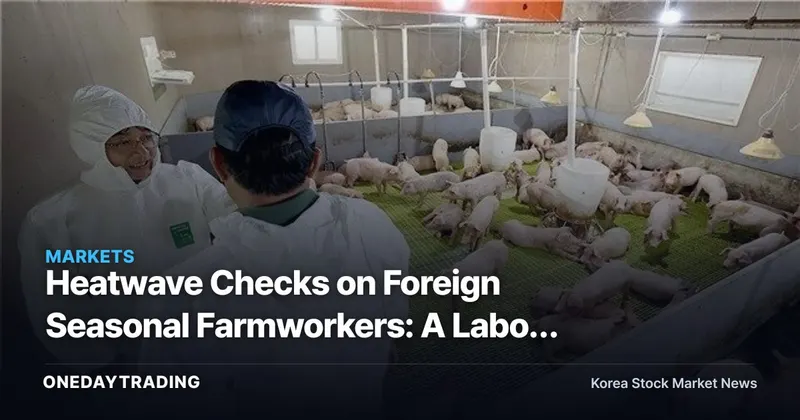
On the 9th, the Ministry of the Interior and Safety visited Yesan County in South Chungcheong Province to inspect working conditions for foreign seasonal farmworkers and check on livestock damage. What this really signals is that rural heatwave response has risen from a simple safety-administration issue to a leading variable for food inflation and agricultural production costs.
Water, shade, and rest come at a cost. But without them, a bigger cost follows. Work stoppages, production disruptions, delayed harvests, and potential livestock losses all feed into crop (produce) prices with a lag.
Why It Matters Now
Markets tend to view crop prices purely through the lens of weather. But on the ground, heat cuts working hours, and shorter working hours affect both yield and quality. Foreign seasonal farmworkers are already a core pillar filling the labor gap during peak farming season. The fact that the Ministry of the Interior and Safety personally examined on-site working conditions signals that extreme heat has entered the category of disaster response.
For investors, the key transmission channel is inflation rather than interest rates. When crop prices rise, perceived inflation reacts first. If perceived inflation turns sticky, expectations for a benchmark interest rate cut get pushed back. A delayed rate cut, in turn, slows the valuation recovery of food and beverage, retail, and domestic-consumption stocks (tickers). That is how a single shade canopy in a rural field ends up connected to consumer-stock multiples.
Conversely, there is a part the market has not yet fully priced in. The cost of heatwave response falls on small farms before it falls on large corporations. As adjustments to working hours, rest facilities, cold-water supply, and safety personnel increase, costs rise in the short term. If these costs can be passed through to farm-gate prices, food companies bear the raw-material burden; if pass-through is difficult, farm profitability takes the hit first.
FAQ
- What is the core point of this inspection? The Ministry of the Interior and Safety confirmed on-site farm working conditions and livestock damage for foreign seasonal farmworkers in Yesan County, South Chungcheong Province. The essential on-site requirements boil down to water, shade, and rest.
- Why does this connect to the stock market? A reduction in usable working hours for agricultural labor can lead to delayed harvests and lower quality. This, in turn, touches food raw-material costs, consumer inflation, and interest-rate expectations in sequence.
- Are there beneficiary industry sectors? It is difficult to pinpoint a direct beneficiary. That said, labor-saving farm machinery, automation equipment, and smart-farm gear may carry a medium- to long-term demand narrative.
- What is the biggest risk? The more heatwave response becomes institutionalized, the higher safety costs climb. The burden falls first on farms with weak cost pass-through power and on the lower end of the food value chain.
Related Stocks (Tickers) and Sector Impact
- Farm machinery. As dependence on foreign seasonal farmworkers grows, demand for labor-saving equipment could see structural growth. That said, it is premature to conclude an immediate revenue increase from this inspection alone.
- Smart farms. As heat, labor shortages, and production-stability concerns grow simultaneously, the need for automated irrigation, temperature/humidity control, and livestock-barn management systems rises.
- Food and beverage. Rising crop prices show up first as raw-material cost pressure. Brands capable of passing on price increases have some defense, but slower pass-through leads to margin pressure.
- Retail. Volatility in fresh-food prices affects the purchase costs and promotional spending of large supermarkets and online grocery players. Consumers are highly price-sensitive.
- Livestock. The inclusion of a livestock-damage check shows that heatwave risk is not just a crop issue. Costs of managing rearing environments are a key variable.
Investment Considerations
- Watch on-the-ground costs, not just policy announcements. What matters is how much rest facilities, cooling, and adjusted working hours actually translate into real costs for farms.
- Check crop price indicators. Watch the lag between farm-gate prices and consumer prices after a heatwave. Once prices rise, they can be slow to come back down.
- Be wary of chasing short-term themes. Farm machinery and smart farms have a structural rationale, but this single piece of news alone does not create earnings visibility.
- Weather variables tend to repeat. When heat warnings, rainfall shortages, and livestock-loss statistics worsen together, inflation pressure intensifies further.
Overall Outlook
This inspection by the Ministry of the Interior and Safety looks like a rural safety measure, but for the market it reads as a subtle leading indicator of inflation. The optimistic scenario is clear. If basic measures like water, shade, and rest take hold on the ground, they can reduce work disruptions and livestock losses and lower crop price volatility. In that case, cost uncertainty for food and beverage and retail companies would also ease.
The trigger for the opposite scenario is a prolonged heatwave. If working hours shrink and livestock losses rise, safety costs turn into supply disruptions. At that point, the market would need to refocus not on crop prices themselves but on inflation expectations and the interest-rate path. The indicators to watch next are the duration of heat advisories, farm-gate prices, livestock-loss tallies, and the fresh-food component of consumer prices.
This article was automatically summarized and analyzed based on the original news report. View original (Yonhap News Industry)