
3-Line Briefing
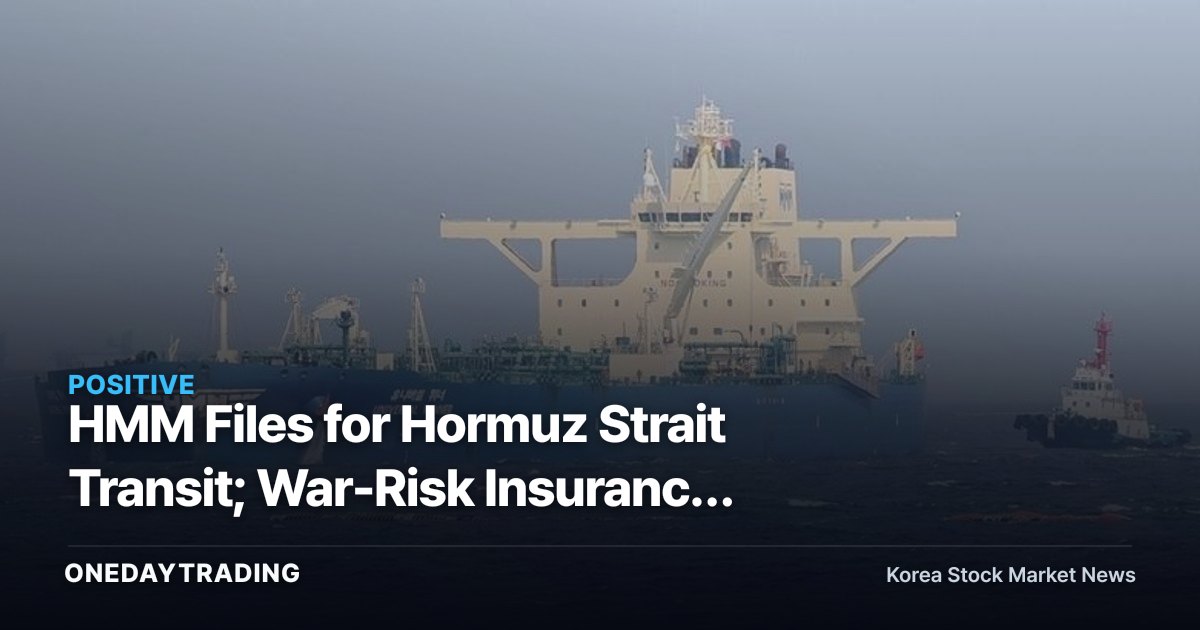
- HMM has completed its application for transit through the Strait of Hormuz, filing individually as a carrier under Iran's per-carrier application process.
- The crux is not the voyage itself but the burden of war-risk insurance premiums; the timing of transit is being weighed by comparing costs against freight rates.
- Whether vessels stranded within the strait resume operations will determine concerns over Middle East route freight rates and shipping disruptions.
What Is Changing
The Strait of Hormuz is a critical chokepoint through which a substantial share of the world's seaborne crude oil passes. Iranian authorities beginning to accept transit applications, and HMM completing its filing, means a procedural threshold has been cleared — logistics that had halted over blockade fears can begin to flow again. That said, the essence of this matter lies not in whether transit is approved but in the cost structure.
On routes where geopolitical tensions run high, war-risk premiums — a special clause within marine insurance — surge sharply. If the premium charged for a single transit erodes the freight revenue of that voyage, a carrier may choose to delay operations even after receiving approval. The fact that HMM is weighing the timing of operations despite having completed its application suggests this profit-and-loss calculation has not yet clearly swung positive.
From an investor's standpoint, the key splits in two directions. If operations normalize, the disruption premium fades and freight rates move toward stabilization; if the premium burden prolongs detours and delays, freight rates on the Middle East and Asia–Europe routes could swing higher again. In other words, the same piece of news acts as a freight-rate variable for container carriers and a cost variable for refiners and airlines.
By the Numbers and Context
This report conveys the fact that the transit application has been completed and that insurance premiums are the key variable. Since no specific premium rate or freight figure was provided, the market will have to gauge the actual impact through the level of war-risk premiums announced going forward and through freight indicators such as the SCFI (Shanghai Containerized Freight Index). Given how sensitively international oil prices have reacted whenever Hormuz has been threatened, a normalization of transit can also be read as a signal that partly eases the oil-price risk premium.
Beneficiary and Affected Stocks
- HMM: The direct party involved. If transit normalizes, disruptions to Middle East route operations ease and recovery in shipping volumes is positive; however, if surging premiums persist, per-voyage profitability comes under pressure — a double-edged dynamic.
- Korean Air & Asiana Airlines: If easing Hormuz tensions stabilize oil prices, the burden of jet-fuel costs declines, which is favorable for profitability.
- S-Oil, SK Innovation & GS: For refiners, easing concerns over crude supply disruptions improves procurement stability, but falling oil prices cut both ways on refining margins and inventory valuations, making this hard to view as a simple benefit.
- Hyundai Glovis & Pan Ocean: Marine logistics and bulk shipping operators are tied to shifts in cargo flows as routes normalize.
Risk Check
- If war-risk premiums are set higher than expected, the resumption of operations could be delayed even with transit approval, and freight-rate volatility could widen again.
- If the situation in Iran and the region deteriorates again, policy and diplomatic variables persist that could nullify the application and approval process itself.
- The direction of oil prices acts as both a benefit and a burden for refining stocks, making it hard to conclude as a uniform positive catalyst.
- The greater a carrier's exposure to Middle East routes, the higher its earnings sensitivity to changes in insurance and detour costs.
One-Line Conclusion
The completed transit application is a signal that lowers the threshold for logistics normalization, but since the actual resumption of operations and freight-rate stability hinge on the cost variable of war-risk premiums being resolved, this is a phase to watch both premium rates and freight indicators together.
HMM Through Real-Time Data
HMM's latest closing price is 19,600 won (-4.16% from the previous day), and the signal light — combining foreign and institutional investor order flow with news and momentum — is 🟡 Neutral · Wait-and-See. Positive and negative signals are mixed, making this a zone to watch.
- ▼ Trend Alignment — short- and medium-term downward alignment (intraday -4.2% · 1 week -2.2% · 1 month -1.1%)
- ▲ News Flow — 3 positive catalysts vs 0 negative catalysts — positive catalysts dominant
Recent related news is favorable, with 3 positive catalysts and 0 negative catalysts.
※ Price and foreign/institutional investor order-flow data are provided by Korea Investment & Securities (KIS), as of the time of publication.
This article is content automatically summarized and analyzed based on the original news report. View Original (Maeil Business Newspaper, Corporate)