
Summary
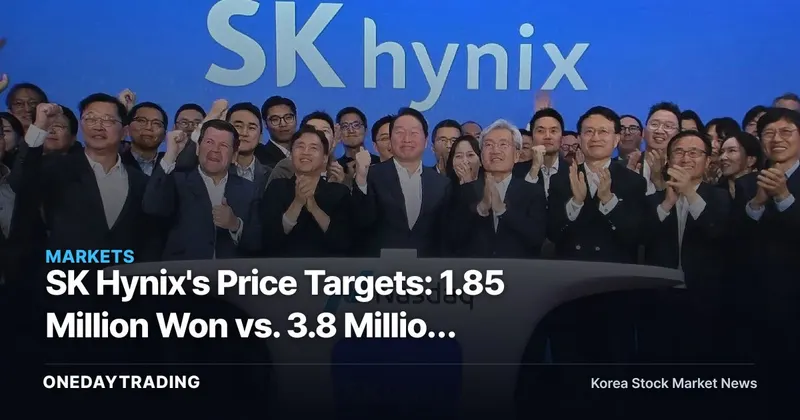
Two brokerage reports on SK Hynix, released just five days apart, set price targets of 1.85 million won and 3.8 million won — a gap of more than double. The sheer scale of that divergence, from analysts looking at the very same company, shows just how far apart views on the current HBM and DRAM cycle have become. Because this is a valuation debate over a stock (ticker) that ranks among the largest by market capitalization on the KOSPI, the fallout wasn't confined to Hynix alone.
The Full Story
The two reports, published just five days apart, looked at the same financial statements and the same industry data yet arrived at opposite conclusions. The report with the 3.8-million-won target effectively argued that the stock still has substantial room to run even from current levels, while the one with the 1.85-million-won target judged that valuations have already entered overheated territory. With the two figures 1.95 million won apart — a ratio of more than double — the market immediately fixated on which side was right. But the real question worth examining is at which stage of assumptions the two reports actually diverged.
Memory semiconductor valuation ultimately comes down to the product of three variables: HBM supply capacity (how many layers are being mass-produced at what yield), customer order volume (next quarter's orders from AI accelerator makers including Nvidia), and the multiple the market assigns to the earnings those two variables generate. A twofold gap in price targets means the assumptions diverged in opposite directions on at least one of these three — in practice, likely on more than one. The optimistic camp most likely assumed that HBM4 mass-production yields would rise on schedule and that the added capex capacity would translate fully into sales, while the conservative camp likely judged that those expectations were already priced in and trimmed the remaining upside accordingly.
Structural Background
Such extreme divergence in price targets is nothing new. The memory industry is cyclical, swinging between phases where utilization rates and prices surge together and phases where both fall in tandem amid inventory adjustments — and the closer the market gets to an inflection point, the wider the gap between analysts' views tends to grow. Still, the fact that a gap of more than double surfaced within just five days reads as a signal that market consensus on the direction of the current cycle has yet to converge.
Impact on Stocks and Sectors
- SK Hynix: As one of the largest stocks by market capitalization on the KOSPI, the price-target debate itself translates directly into index volatility. The key will be whether commentary on HBM revenue mix and yields in the next earnings release lends support to one scenario or the other.
- Samsung Electronics (005930): As a peer in the same memory segment, the Hynix valuation debate is mirrored directly in expectations for Samsung's HBM market-share recovery.
- Hanmi Semiconductor and other HBM back-end equipment stocks: Since the two reports assume different sizes for Hynix's capex expansion, it will take an actual equipment order disclosure to confirm which assumption was correct.
- The broader domestic semiconductor materials, parts, and equipment value chain: The wider the price-target gap, the greater retail investors' trading volatility tends to become, which could also widen the short-term price swings of related materials and components stocks.
Bullish vs. Bearish Scenarios
The bullish scenario envisions HBM4 yields stabilizing faster than expected and AI accelerator makers continuing to place orders. In this case, the current share price would not yet fully reflect the next cycle's peak, lending support to the 3.8-million-won thesis. The bearish scenario envisions optimistic expectations already being largely priced in, with supply expanding rapidly amid a capacity race that erodes pricing power. In this case, earnings estimates could fail to keep pace with expectations, and valuation pressure could become a reality. The core of this debate right now is that both scenarios have merit, and neither can be confirmed until the actual numbers come in.
Investor Action Points
- Check commentary on HBM revenue mix and yields in the next quarterly earnings release to gauge which of the two reports' assumptions is closer to reality.
- Watch for disclosures of orders and supply contracts with customers such as Nvidia and other AI accelerator makers. Confirmed order volumes are the fact that takes precedence over the price-target debate.
- Look at capex expansion announcements alongside actual utilization-rate data. An expansion announcement alone doesn't confirm demand.
- Rather than focusing on the price-target gap itself, compare the grounds behind each report's assumptions — yield, volume, and multiple — to determine which is based on more recent data.
SK Hynix by the Real-Time Numbers
SK Hynix's most recent closing price was 1,980,000 won (+7.84% versus the prior session), and the sentiment gauge combining foreign investor and institutional investor supply-demand (order flow) with news and momentum reads 🟡 Neutral / Wait-and-see. With positive and negative signals mixed, this is a range to watch closely.
- ▲ News flow — 7 positive catalysts vs. 3 negative catalysts — positive catalysts lead
Recent related news skews favorable, with 7 positive catalysts versus 3 negative catalysts.
※ Price and foreign/institutional investor supply-demand (order flow) data are provided by Korea Investment & Securities (KIS) and reflect figures as of publication.
This article was automatically summarized and analyzed based on the original news report. View original article (Maeil Business Newspaper, Securities)