
Summary
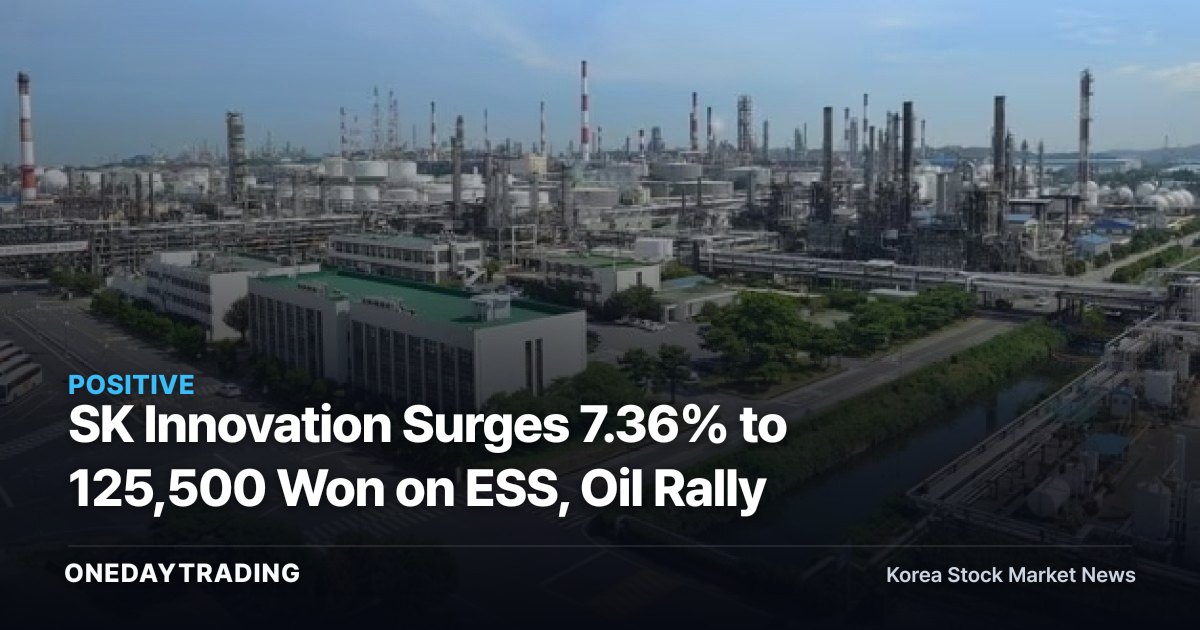
SK Innovation shares closed at 125,500 won on August 31, up 7.36%—more than a simple rebound. With the refining division’s oil sensitivity and SK On’s long-term U.S. ESS supply contract emerging at the same time, the market may have room to lower the discount applied to the company.
The key point is that the earnings timelines for refining and batteries have both shifted. Higher oil prices first lift expectations for refining margins, while ESS orders improve volume visibility in the battery business. The stock has entered a phase in which investors will test whether these two pillars can translate into actual profits.
What Happened
According to a Seoul Economic Daily report, SK Innovation rose 7.36% on August 31 to finish trading at 125,500 won. The catalysts were SK On’s long-term battery-cell supply contract for U.S. ESS projects and higher international oil prices.
ESS systems store electricity on the grid to smooth supply-demand fluctuations. Not all batteries are the same. ESS projects are larger and contracts run longer than in the automotive market, so once an order is secured, revenue visibility improves. However, actual shipments and earnings recognition usually follow later than the disclosure, so the market will now focus more closely on whether volumes continue.
For refining, the direction of oil prices does not automatically determine the stock’s direction. Input costs, product prices, inventory effects and refining margins must move together. Even so, a rising oil-price environment at least strengthens expectations that the industry is passing its trough. That is why the day’s share-price reaction looked less like a battery-only story and more like a simultaneous re-rating of refining and batteries.
Structural Background
In a high-interest-rate environment, multiples for capital-intensive industries are compressed first. Refining requires large facilities and inventories, while batteries face heavy expansion and cash-burn burdens. As a result, even a positive catalyst must flow into earnings quickly for the share-price move to last.
What the market has already priced in is a rebound in oil prices and some expectations for new orders. Less fully reflected are the scale of refining-margin improvement and how quickly SK On’s ESS volumes appear in quarterly earnings. If oil prices remain above current levels, refining profit estimates could change more quickly, but if prices turn lower, the basis for the rebound will weaken first.
Stock and Industry Impact
- SK Innovation: The refining cycle and SK On’s ESS volumes are being reflected simultaneously. The stock has greater elasticity than when only one side moves, but any delay in earnings confirmation could also trigger a rapid pullback.
- S-Oil: Its high sensitivity to international oil prices and refining margins makes it a benchmark for an industry-sector re-rating. When SK Innovation moves, expectations can easily spread across refining stocks.
- GS: With a holding-company structure that includes significant refining and energy exposure, an industry rebound could translate into valuation improvement. However, the discount will only continue to unwind once refining margins are confirmed in the numbers.
- LG Energy Solution: Continued investment in North American ESS could raise order expectations across major battery makers. Actual awards, however, vary by project, so disclosures must be monitored.
Bull vs. Bear Scenarios
If oil prices hold at current levels, earnings estimates for the refining division will be raised more quickly. If SK On’s U.S. ESS supply leads to follow-on orders, expectations for narrower losses in the battery business will also build. In that case, the market is likely to view the move not as a simple theme trade but as the beginning of an earnings recovery.
Conversely, if oil prices turn lower again, refining-margin expectations will cool first. Even with a long-term ESS supply contract, delayed shipments would prompt the market to focus again on the battery business’s cash burn. In that case, the share-price rebound could prove driven mainly by supply-demand (order flow).
Investor Action Points
- Check how much the operating profit estimate for the refining division is raised in the next quarterly earnings report.
- Watch for additional disclosures on SK On’s U.S. ESS orders and whether the shipment schedule continues.
- If international oil prices and refining margins turn lower together, the short-term rally could lose momentum.
- Also monitor how the next Bank of Korea Monetary Policy Board meeting and the U.S. rate path change the discount rate.
Frequently Asked Questions
Why did SK Innovation shares rise 7.36%?
There were two main reasons. SK On’s long-term battery-cell supply contract for U.S. ESS projects increased volume visibility for the battery business, while higher international oil prices lifted expectations for the refining division’s industry conditions. One is an order catalyst; the other is a margin catalyst.
Why is SK On’s ESS contract important?
ESS batteries are used for power-grid projects, which are large in scale and have long contract periods. That improves revenue predictability more than a one-off headline. However, the impact on actual earnings appears later depending on shipment and recognition timing.
What should investors watch next?
Investors should see how much refining margins improve in the next earnings release and whether SK On secures additional North American ESS orders. If oil prices turn lower again, the rebound thesis will weaken; if supply contracts continue, the re-rating could last longer.
SK Innovation Key MetricsAs of 2026-09-01
| Period returns | 1 week +8.72% 1 month +22.99% |
|---|---|
| Trading value · Trading volume | 118.2 billion won · 877,953 shares |
| Supply-demand (order flow) | Foreign investors +18 billion won net buying (3 consecutive days) Institutional investors +36.6 billion won net buying |
| Recent news tone | Positive catalysts 3 · Negative catalysts 5 |
Price and supply-demand (order flow) data are live figures from Korea Investment & Securities (KIS); supply-demand and news-tone tallies are calculated internally by One-Day Trading.
Supply-Demand and Momentum Assessment🟢 Buying Prevails
Foreign investors, institutional investors and momentum are positive, warranting attention.
- ▲Supply-demand continuityForeign investors net bought for 3 consecutive days (+18 billion won)
- ▲Dual buyingForeign investors +18 billion won · Institutional investors +36.6 billion won in simultaneous buying
- ▲Trend alignmentShort- and medium-term upside alignment (today +8.4% · 1 week +8.8% · 1 month +23.1%)
- ▼News flowPositive catalysts 3 vs negative catalysts 5 — negative catalysts prevail
Upcoming Dates to Watch
- 09.10Simultaneous futures and options expiryModerateQuadruple witching — watch for volatility and supply-demand disruption
- 09.16FOMC policy-rate decisionHighU.S. Federal Reserve policy announcement — interest-rate and dollar direction
- 10.08Index-options expiryLowKOSPI200 options expiry
- 10.22Bank of Korea Monetary Policy BoardHighBenchmark interest rate decision meeting
This article is automatically summarized and analyzed based on the original news report. View original article (Seoul Economic Daily)