
At a Glance
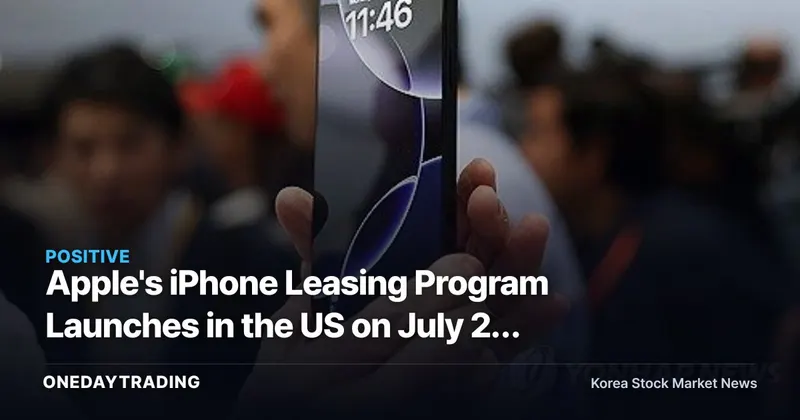
Innovative features aren't the only variable in iPhone sales. Apple Upgrade, set to launch in the US on July 28, looks less like a simple leasing option and more like a redesign of the sales channel meant to absorb a potential September iPhone price hike through a monthly installment structure.
For investors, the key issue isn't the lease itself but average selling price (ASP) and replacement cycles. It's a move to change the payment method before a high sticker price suppresses demand, protecting the take-up rate of premium models.
Why It Matters Now
Apple is reported to have already raised prices on its major devices other than the iPhone, including the iPad and MacBook. The backdrop is cost pressure from rising memory and storage component prices, driven by expanded AI data center investment. Passing rising component costs onto consumer prices risks denting shipment volumes, while absorbing them squeezes margins. Apple Upgrade is designed as a buffer between the two.
The program's structure resembles an auto lease. Through US Apple Stores and online, most iPhone, Mac, iPad, and Apple Watch models will be available for monthly payments, and users can trade up to a new device before the term ends, pay off the balance early, or keep the device after the term expires. The financing partner is Swedish fintech Klarna. New enrollments in the existing iPhone Upgrade Program and standard iPhone financing are expected to be discontinued as the new service rolls out.
From a tech-stock perspective, what matters more is what's included and what's excluded. Unlike the current iPhone Upgrade Program, the new program does not bundle AppleCare by default. Reports indicate the Apple Watch SE, entry-level iPad, iPhone 16, MacBook Neo, and corporate/education purchases are also excluded. Apple chose to lower the monthly burden on higher-priced products rather than discount lower-priced ones — a signal that it intends to protect its premium mix.
FAQ
- Why is a lease-style program a stock-price variable? Raising sticker prices helps near-term revenue but can cool demand. Lowering the perceived price through monthly installments raises the odds of defending the sales mix of higher-priced models.
- How is this different from the existing iPhone Upgrade Program? The existing program was iPhone-centric and bundled AppleCare. The new program extends to Mac, iPad, and Apple Watch, but AppleCare is no longer included by default.
- Where's the connection for Korean investors? If iPhone replacement cycles shorten while the share of Pro models holds up, second-half order visibility could improve across the camera module, display, and substrate supply chains.
- Should this be read as an immediate earnings improvement? No. The US launch comes first, and credit screening and monthly payment terms will determine the actual enrollment rate. September's new product pricing and early order volumes are more direct confirmation signals than the program announcement itself.
Related Stocks (Tickers) and Sector Impact
- Apple. Lowering resistance to price hikes can protect both premium model sales and services touchpoints at the same time. That said, the exclusion of AppleCare means the add-on revenue conversion rate needs to be watched separately.
- LG Innotek. The more the iPhone Pro lineup's sales share holds up, the better it is for defending demand for high-spec camera modules. The key variable is the Pro mix, not shipment volume.
- BH. Demand for premium smartphone substrates is sensitive to the new-product cycle. If installment-based sales pull forward replacement demand, second-half order volatility could ease.
- LG Display. If sales of high-priced iPhones hold up, that's positive for the OLED panel supply chain. However, panel unit prices and volume allocation still depend on Apple's supplier-diversification strategy.
- Klarna. Not a Korea-listed company itself, but it enters Apple's hardware payment ecosystem as the financing partner. Credit risk management is a key variable for the program's sustainability.
Investment Considerations
- Watch the enrollment rate. Even with low monthly payments as the headline, the sales-boosting effect will be limited if credit screening, residual-value assessment, and early-upgrade conditions are strict.
- Price hikes are a double-edged sword. If September iPhone prices rise, the average revenue per unit goes up, but consumer replacement demand could be delayed. The program only softens the shock — it doesn't eliminate it.
- Check the effect of unbundling AppleCare. Dropping it from the default package can make the monthly payment look lower. But if the attach rate for warranty services falls, expectations for services revenue come down as well.
- For Korean component makers, order confirmation comes first. Even if Apple's sales strategy looks positive, the actual benefit needs to be verified through component orders, utilization rates, and inventory levels starting from late in the third quarter.
Overall Outlook
Apple Upgrade is a defensive sales technique for a period of hardware price increases. Even without sufficient feature innovation, changing the payment structure can lead consumers to choose more expensive models. In that scenario, a positive path opens up: ASP defense for Apple, and stable second-half volumes for Korea's iPhone supply chain.
The opposite scenario is just as clear. If the lease terms aren't attractive to consumers, or if the September price hike is larger than expected, the monthly installment structure alone won't be enough to stop a demand slowdown. Yoon Jae-ho's next checkpoints are the actual terms and conditions on July 28, September's new-product price list, and Pro model lead times right after launch. Order wait times will speak before the narrative does.
This article is auto-summarized and analyzed content based on the original news report. View original (Yonhap Infomax)