
At a Glance
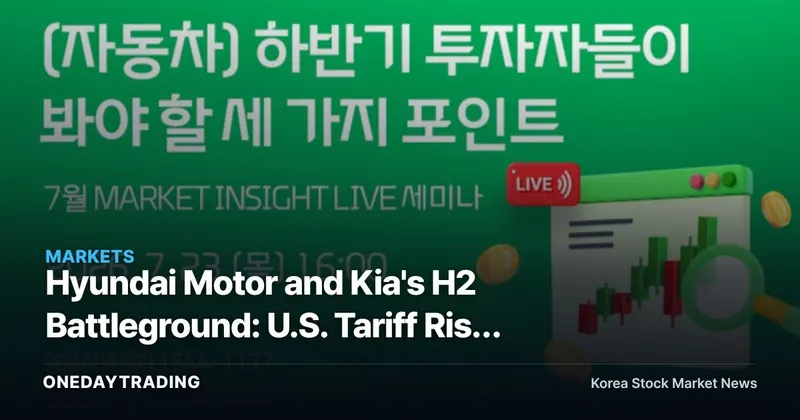
Daishin Securities will hold an online seminar on second-half automotive investment strategy on its YouTube channel, Daishin TV's Market Insight Live, on the 23rd. What's worth noting isn't the seminar itself, but the fact that the auto sector has moved back to the forefront of research coverage at this particular moment. Automakers and parts suppliers posted a mixed performance throughout the first half, caught between U.S. tariffs and hybrid demand, and the second half is the period in which that direction gets confirmed in the earnings numbers.
Why It Matters Now
The auto industry sector is one that should be read through volume, not narrative. Vehicle sales units, factory utilization rates, and parts suppliers' order backlogs move first, and margins follow one or two quarters later. Right now the market wants an answer to two questions. First, how much of the burden from U.S. import tariffs on vehicles is being offset by Hyundai Motor and Kia's expanding local production in the U.S. Second, how much of the gap left by slowing EV demand is being filled by hybrids.
Hybrids have been the pillar supporting automakers' earnings over the past few years. The issue is how quickly production capacity can be ramped up in a supply-constrained market, and that question feeds directly into costs and margins. On the other side, as the EV chasm drags on, battery and parts makers' utilization rates aren't rising as fast as hoped. Ultimately, the key to second-half automotive investment strategy comes down to which of these two forces proves itself in the numbers faster and more decisively.
Frequently Asked Questions
- When and where is this seminar held?: It will take place on July 23 via Market Insight Live on the Daishin TV YouTube channel.
- Why an auto seminar right now?: Because the first-half earnings season is wrapping up, and this is the point when second-half sales plans and tariff response strategies are taking concrete shape.
- How much do tariffs actually affect automaker profits?: The impact varies widely by company, depending on the share of local production, whether higher costs are passed through to sale prices, and how much incentives are scaled back.
- Will strong hybrid demand continue?: The key factors are how quickly the backlog of waiting demand shrinks and how fast automakers can expand hybrid production lines.
Related Stocks and Sector Impact
- Hyundai Motor / Kia: With a high share of sales coming from the U.S., both are directly exposed to shifts in tariff policy, while also standing as the biggest beneficiaries of strong hybrid lineup sales.
- Hyundai Mobis: A key parts supplier whose business is tied to automakers' production volumes and utilization rates; investors should watch the lag between order backlog growth and its translation into revenue.
- Thermal management parts makers such as Hanon Systems: Directly tied to demand for thermal management systems used in both hybrids and EVs, these stocks are affected by shifts in automakers' sales mix.
- Battery materials and cell makers: If EV demand recovers slowly, normalization of utilization rates will be delayed, pushing back the timing of any earnings improvement.
Investment Considerations
- Tariff details can change depending on negotiations and executive orders, making it difficult to definitively predict the scale of margin damage.
- Viewing strong hybrid sales purely as a spillover benefit from delayed EV adoption risks overlooking the opposite risk — that production capacity expansion itself could fall behind.
- Forecasts presented in seminars or reports are reference material only; actual investment decisions should be based on each company's quarterly earnings and disclosures.
- Parts makers' share prices often react later than automakers', so investors should factor in this lag when timing their entry.
Overall Outlook
The optimistic scenario has hybrid demand staying resilient while tariff costs are offset by expanded local production and price pass-through. In that case, automakers' second-half profits could show a steadier trend than in the first half. Conversely, if tariff negotiations drag on or expanded incentives block price pass-through, margin pressure could persist longer. The indicators to watch are clear: monthly automaker sales figures due from August onward, tariff-related cost line items that will surface in U.S. subsidiaries' third-quarter earnings reports, and the rise or fall in parts suppliers' order backlogs.
Hyundai Motor: Real-Time Data Snapshot
Hyundai Motor's latest closing price is 391,500 won (-1.88% versus the previous session), and the signal light combining foreign investors' and institutional investors' supply-demand (order flow) with news and momentum reads 🟡 Neutral / Wait-and-see. Positive and negative signals are mixed, making this a stretch worth watching closely.
- ▼ Trend Alignment — Short- and medium-term downtrend alignment (1-day -1.9% · 1-week -11.8% · 1-month -36.1%)
- ▲ News Flow — 3 positive catalysts vs. 0 negative catalysts — positive catalysts dominate
Recent related news is favorable, with 3 positive catalysts and 0 negative catalysts.
※ Price and foreign/institutional investor supply-demand (order flow) data are provided by Korea Investment & Securities (KIS) and are current as of publication.
This article is automatically summarized and analyzed content based on the original news report. View original (Maeil Business Newspaper, Securities)