
Key Takeaways
The rise of Samsung Electronics and SK Hynix in global market-capitalization rankings is not merely a matter of share-price swings — it reads as a signal that the market is recalibrating how it views the memory and HBM cycle. Surpassing symbolic benchmarks such as Tesla and Micron could serve as a catalyst that spreads warmth across foreign investor order flow and the entire semiconductor materials-parts-equipment value chain.
That said, this trend leans heavily on a single driver — AI memory demand — and therefore carries a double-edged quality: should demand weakness or supply expansion become visible, it could reverse at the same pace.
What Happened
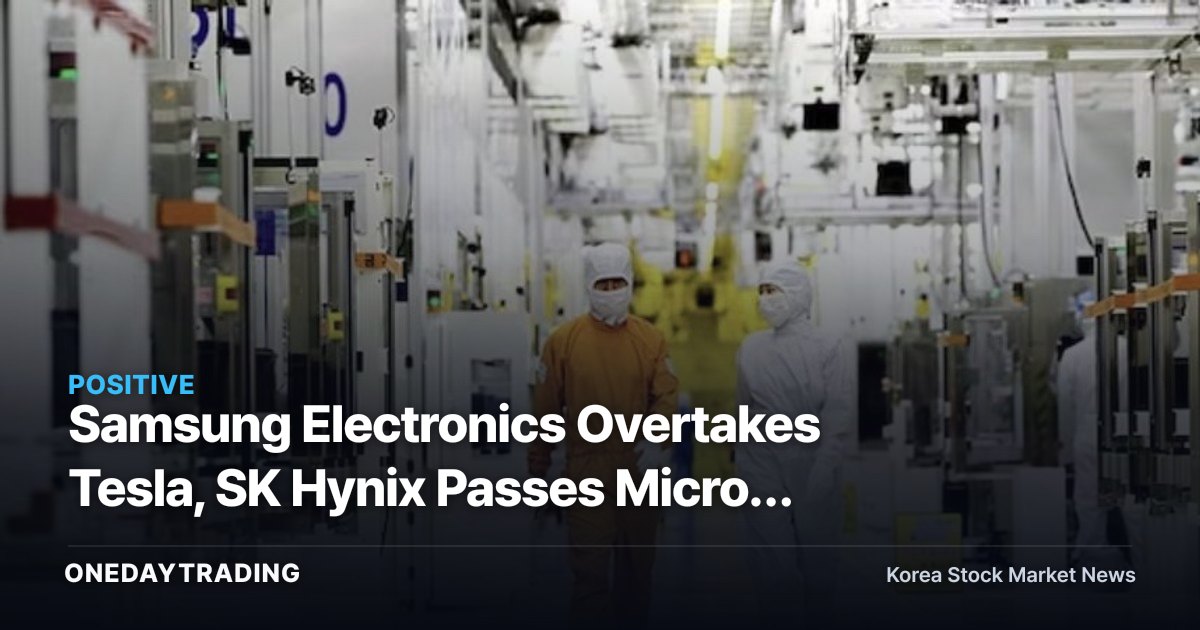
In the global market-capitalization rankings, Samsung Electronics has overtaken Tesla, the bellwether EV stock, to reach 12th place, while SK Hynix has recorded 15th place, passing U.S. memory maker Micron. The two flagship Korean semiconductor stocks have simultaneously surpassed their symbolic peer companies.
In particular, the gap in market capitalization between the two stocks — and against their global rivals — has been highlighted as widening further amid the semiconductor rally. Given the weight of semiconductors within the Korean equity market, this is a shift directly tied to the underlying strength of the KOSPI index itself.
Background and Context
The essence of this ranking shift lies in the overlap between surging demand for high-bandwidth memory (HBM) used in AI accelerators and a rebound in prices for conventional DRAM and NAND. While Tesla has seen its multiple come under pressure from slowing EV demand and price competition, memory has passed through its loss-making phase and entered a price-upcycle, with expectations of improving earnings now reflected in share prices.
SK Hynix's relative edge over Micron shows that its leading competitiveness in HBM mass production and customer acquisition is being recognized by the market as a premium. In other words, even within the same memory sector, the proportion of high-value AI-oriented products has become the key variable separating valuations.
Impact on the Market and Stocks
- SK Hynix: Recognized for its preemptive customer acquisition and mass-production competitiveness in HBM, leading the valuation premium within the memory sector. The stock with the strongest direct exposure to expanding AI server investment.
- Samsung Electronics: Strong earnings leverage from the memory price rebound, with progress in foundry and HBM catch-up offering additional room for re-rating. Its broad business portfolio provides relatively more of a buffer against volatility.
- Hanmi Semiconductor: A flagship materials-parts-equipment stock supplying core back-end equipment such as HBM bonding tools, with revenue directly linked to the HBM capacity-expansion cycle.
- Semiconductor materials and components stocks: Rising memory utilization rates feed through into greater demand for front-end materials and components, producing a trickle-down effect across the entire value chain.
- KOSPI index: With the two large caps carrying a heavy market-cap weighting, they directly influence the index's direction. A key conduit for inflows of foreign net buying.
Investor Checkpoints
- Check the HBM revenue mix and the trend in DRAM/NAND average selling prices (ASP) in quarterly earnings releases to gauge the durability of the price cycle.
- Capital expenditure (CAPEX) guidance for AI data centers from North American Big Tech — a leading indicator of memory demand.
- Foreign net buying flows, supply-demand (order flow) in the semiconductor sector, and the won-dollar exchange rate level (a variable for export profitability).
- The pace of HBM supply expansion and rival entry — a signal of fading price momentum should the market tip into oversupply.
Outlook
As long as AI infrastructure investment continues, earnings improvement and valuation re-rating centered on high-value memory may remain valid for the time being. The more firmly the technological and customer advantages in HBM take hold, the greater the room for the market-cap gap with global rivals to widen further.
Conversely, the weakness of this scenario is its concentration on a single axis — AI demand. Should a moderation in Big Tech investment, oversupply from memory capacity expansion, currency and interest-rate variables, and the valuation burden of already sharply risen share prices all coincide, the depth of any correction could turn steep. Rather than the ranking gains themselves, a reasonable approach is to track, through indicators, which way the balance of demand, price, and supply is tilting.
SK Hynix Through Real-Time Data
SK Hynix's most recent closing price is 2,764,000 won (+2.94% versus the previous day), and the signal light — combining foreign and institutional investor order flow with news and momentum — is 🟡 Neutral / Wait-and-See. With positive and negative signals mixed, this is a zone to watch.
- ▲ Trend Alignment — Short- and mid-term upward alignment (intraday +2.9% · 1 week +31.6% · 1 month +50.2%)
- ▲ 52-Week Position — In the 52-week upper band at 95% — record-high territory
- ▲ News Flow — 26 positive catalysts vs. 7 negative catalysts — positives in the lead
Recent related news is favorable, with 26 positive catalysts and 7 negative catalysts.
※ Price and foreign/institutional investor order-flow data are provided by Korea Investment & Securities (KIS), as of the time of publication.
This article is content automatically summarized and analyzed based on an original news report. View original (Maeil Business Newspaper, Securities)