
Key Takeaways
The Bank of Korea’s return to a 3.00% benchmark interest rate is a signal that banks may be able to defend their net interest margins, but for KOSPI growth stocks, it is a factor that pushes valuation discount rates higher again.
What this really says is not that rate-cut expectations are building to prevent an economic downturn, but that the BOK has shifted its center of gravity toward tightening in an environment where both growth and core inflation remain resilient. The market has already priced in two consecutive months of rate hikes. What it has not fully priced in yet is the period in which a 3% rate pressures both corporate earnings and equity multiples at the same time.
What Happened
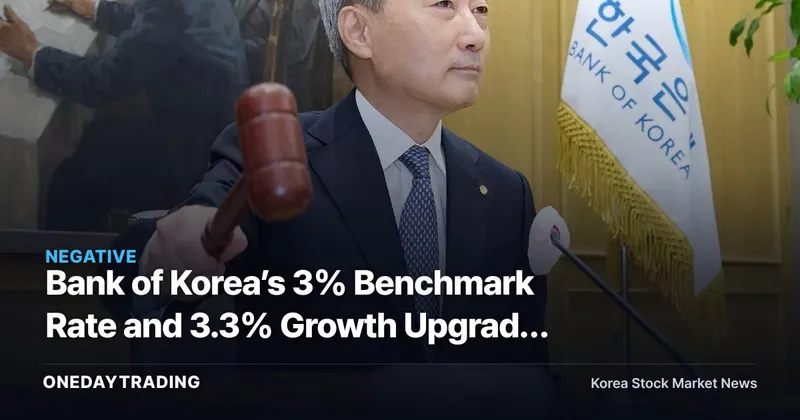
According to Maeil Business Newspaper, the Bank of Korea raised its benchmark interest rate by 0.25 percentage point, from 2.75% to 3.00% annually. It marks the second straight monthly hike, and the first return to the 3% range in one year and nine months. The benchmark interest rate is the policy rate the Bank of Korea applies in transactions with financial institutions, and it serves as the starting point for lending rates, deposit rates, bond yields, and equity discount rates.
The BOK moved because of growth and inflation. Its growth forecast for this year was raised from 2.6% to 3.3%. When the economy is stronger than expected, a central bank loses the case for cutting rates quickly. If core inflation is also firm, a rate hike becomes less a move to restrain the economy and more a policy signal aimed at breaking inflation expectations.
In the stock market, the 3.00% figure is not just a rate level. When the risk-free rate rises, the present value of future earnings falls. Growth stocks in internet, biotech, and secondary batteries, whose earnings are concentrated further in the future, are valued at lower price-to-earnings multiples even when their earnings outlooks remain unchanged.
Background and Context
The core of this decision is the 3.3% growth rate. Raising the growth forecast by 0.7 percentage point from 2.6% means demand in the Korean economy is stronger than the BOK expected. If any of exports, investment, or consumption is holding up, the pace of disinflation slows.
The market prices in how long rates stay elevated more than the direction of rates itself. If inflation does not fall quickly after the benchmark interest rate rises to 3.00%, bond yields will remain in a high range. At that point, market leadership changes. Industry sectors that absorb high rates as a cost separate from those that can turn high rates into income.
Impact on Markets and Stocks
- KB Financial Group and Shinhan Financial Group: A benchmark interest rate hike is reflected first in loan-rate repricing, which helps defend net interest margins. However, if interest burdens rise for households and small and midsize businesses, delinquency rates and credit costs become lagging risks.
- Hana Financial Group and Woori Financial Group: Expectations for improved loan-deposit margins support the lower end of bank-stock valuations. But if competition for deposit rates intensifies, funding costs also rise, limiting the scale of margin improvement.
- NAVER and Kakao: Platform stocks are valued by discounting long-term growth cash flows to present value. In a 3.00% benchmark interest rate environment, multiple expansion slows even if advertising and commerce earnings hold up.
- Construction and Real Estate Finance: The rate burden is transmitted directly to project financing and the presale housing market. If unsold housing inventory increases or presale-price burdens grow, construction-company cash flows and financial-sector provisions can come under pressure at the same time.
- The won and foreign investor supply-demand (order flow): A rate hike can be a factor that helps defend against won weakness. If the won stabilizes, foreign investors gain a reason to remain in large-cap stocks, but if broad dollar strength resumes, the effect will be short-lived.
Investor Checkpoints
- Next Monetary Policy Board meeting: Investors should check whether the BOK keeps the door open to additional hikes or signals a wait-and-see stance at 3.00%.
- Core inflation: Core inflation matters more than headline inflation. If core inflation does not slow, rate-cut expectations will struggle to remain embedded in stock prices for long.
- Bank delinquency rates: Bank stocks are strong in the early phase of rate hikes, but once rising delinquency rates are confirmed, credit costs eat into earnings improvement.
- Growth-stock earnings releases: For platform stocks such as NAVER and Kakao, operating margin and cost control become more important than revenue growth in defending valuation multiples.
Outlook
The optimistic scenario is clear. If the 3.3% growth forecast translates into actual corporate revenue growth and core inflation starts slowing from the next quarter, the market will buy earnings improvement before focusing on the rate burden. In that case, bank stocks could benefit from earnings stability, while large export stocks could attract supply-demand (order flow) support from won stability.
The trigger for the opposite scenario is inflation. If core inflation does not come down even with the benchmark interest rate at 3.00%, bond yields will rise again. In that case, the market will interpret the growth-forecast upgrade not as a positive catalyst, but as evidence for continued tightening. If the rally in the KOSPI has been driven not by stronger fundamentals but by expectations that discount rates would fall, that expectation can be overturned by a single line in the BOK’s statement.
Frequently Asked Questions
Is the Bank of Korea’s 3% benchmark interest rate a positive catalyst for bank stocks?
The Bank of Korea’s 3.00% benchmark interest rate can act as a short-term positive catalyst for bank stocks such as KB Financial Group and Shinhan Financial Group. That is because loan-rate repricing helps defend net interest margins. However, if delinquency rates rise, higher credit costs will weaken the share-price response.
Why is a benchmark interest rate hike a negative catalyst for growth stocks?
A benchmark interest rate hike raises the discount rate used to convert future earnings into present value. Companies such as NAVER and Kakao, where long-term growth expectations account for a large part of the share price, may receive lower multiples even under the same earnings outlook.
What should investors watch in the Bank of Korea’s next rate decision?
At the next Monetary Policy Board meeting, the key will be the BOK’s assessment of core inflation and whether it maintains its 3.3% growth forecast, rather than just the possibility of another rate hike. If the BOK continues to emphasize inflation pressure, the market’s rate-cut expectations will be pushed further out.
KB Financial Group in Real-Time Data
KB Financial Group’s latest closing price was 168,500 won (+1.14% from the previous day), and the signal light based on foreign investor and institutional investor supply-demand (order flow), news, and momentum is 🟡 neutral, wait-and-see. Positive and negative signals are mixed, making this a zone to monitor.
- ▼ Supply-Demand (Order Flow) Continuity — foreign investors net sold for 6 consecutive days (−1.4 billion won)
- ▲ Trend Alignment — short- and medium-term upside alignment (same day +1.1% · 1 week +5.3% · 1 month +2.0%)
- ▼ News Flow — positive catalyst 3 vs negative catalyst 7 — negative catalysts dominate
Recent related news is negative, with 3 positive catalyst items and 7 negative catalyst items.
※ Price and foreign investor/institutional investor supply-demand (order flow) data are provided by Korea Investment & Securities (KIS) and are based on the time of publication.
This article is automatically summarized and analyzed content based on the original news report. View original article (Maeil Business Newspaper Economy)