
Summary
The investment significance of Korea Southern Power’s four-legged robot project lies not in deploying a single robot, but in expanding the scope of industrial robots to hazardous-equipment inspections. For now, however, only the start of development and plans for field trials have been confirmed. To turn the technology into revenue, the robot must withstand the dust, moisture, and high temperatures found at power plants and secure follow-on purchase contracts.
The market is likely to price in the robot-adoption narrative first. What remains difficult to reflect in valuations is the number of units to be supplied, contract value, mass-production schedule, and potential rollout to additional power plants. This news marks the start of commercialization, not its completion.
What Happened
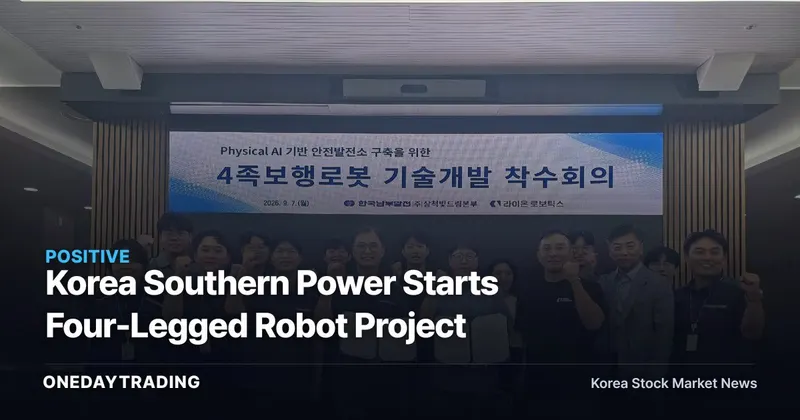
According to a September 8, 2026 report by Maeil Business Newspaper, Korea Southern Power’s Samcheok Bitdream Headquarters held a “Four-Legged Robot Technology Development Kickoff Meeting” with Lion Robotics on September 7. The two parties plan to develop equipment tailored to the power plant’s specialized operating environment, then verify its inspection performance and applicability in field trials.
A four-legged robot independently controls the joints in each of its four legs, allowing it to navigate stairs, uneven surfaces, and spaces containing obstacles. The new system will incorporate a battery designed for extended operation, along with walking and control technologies. Its development objective is to enable remote monitoring of equipment in areas that are difficult for people to access.
The initial trials will take place at the coal-handling facilities and indoor coal storage yard at Samcheok Bitdream Headquarters. Both areas pose significant access risks for workers and feature variables such as dust, moisture, and high temperatures. More important than walking successfully on a flat test site is whether the sensors, communications, and drive system can complete their missions under these conditions.
Why Power Plant Trials Are Challenging
A power plant inspection robot is more than a mobile platform. The battery determines its operating time, while the joints and drive system govern its ability to clear obstacles. Sensors assess equipment conditions, and the control software and communications network transmit collected information to remote operators.
In this setup, commercialization depends more on the reliability of the entire system than on the peak specifications of individual components. Field uptime will decline if dust contaminates sensors, communications fail, or the battery runs out midway through an inspection route. If workers ultimately have to re-enter the area, the case for adoption based on improved safety and operational efficiency also weakens.
The Gap Between Technology Development and Revenue
The point at which this news could affect earnings is repeat orders following the trials. If evidence accumulates that the robot can detect equipment abnormalities early and reduce workers’ exposure to hazardous areas and the burden of unplanned inspections, equipment sales could generate additional demand for maintenance, sensor replacements, and control software.
However, the materials provided do not disclose development costs, unit prices, the number of units to be deployed, or when the trials will end. The amount of revenue Lion Robotics may generate from the project also remains unknown. This is where the narrative and the numbers diverge. For the project to support an investment case, investors need the value and delivery schedule of a paid contract, not merely a technology-development meeting.
Impact on Stocks and Industry Sectors
- Industrial robots: It is encouraging that industrial robots are gaining a new use case—inspecting unstructured, hazardous areas—beyond repetitive manufacturing tasks. However, the addressable market cannot be estimated until the trials convert into purchases.
- Robot components and sensors: The system requires long-duration batteries, joint drive systems, environmental-perception sensors, and remote-control technology. Because the source article does not identify any component suppliers, there is no basis for linking the project to a specific listed beneficiary.
- Power equipment operations: If remote inspections identify equipment abnormalities early, they could reduce worker exposure time and address gaps in inspection coverage. The scale of the benefit will depend on actual detection performance and the frequency of false alarms.
Bull vs. Bear Scenarios
In the bull case, the robot maintains sufficient continuous operating time, mobility stability, and remote-inspection reliability at the coal-handling facilities and indoor coal storage yard. If the trials lead to additional orders, the commercial viability of power plant-specific robots will be validated in financial terms for the first time. Expanding the deployment area would also improve the economics of using the same platform across multiple hazardous facilities.
Conversely, the outlook changes if battery life or obstacle-clearing performance falls below operational requirements. If frequent false alarms and communications failures force personnel to conduct repeat inspections, robot operating expenses would be added to existing inspection costs. If listed robotics stocks move without confirmed involvement in the project, investors should distinguish theme-driven trading from earnings-based gains.
Investor Action Points
- Check whether Samcheok Bitdream Headquarters discloses numerical data on continuous operating time, mission completion rates, and obstacle-clearing performance in subsequent announcements.
- After the trials, compare regulatory filings and official announcements for the number and value of units under purchase contracts, delivery timing, and deployment at other power plants.
- Watch for disclosures on the accuracy of equipment-abnormality detection, the frequency of false alarms, and the rate of remote communications failures.
- When assessing related listed companies, isolate only those whose supply relationships with Lion Robotics or component deliveries have been officially confirmed.
Frequently Asked Questions
Where will Korea Southern Power deploy the four-legged robot?
Korea Southern Power plans to initially deploy it at the coal-handling facilities and indoor coal storage yard at Samcheok Bitdream Headquarters. The trials will assess safety and equipment-inspection capabilities in an environment featuring dust, moisture, high temperatures, stairs, uneven surfaces, and obstacles.
Is Lion Robotics a listed company?
The materials provided describe Lion Robotics as a South Korean robotics company but do not state whether it is listed or provide a stock ticker. This project alone does not provide sufficient evidence to identify any specific listed company as a direct beneficiary.
How can investors assess the commercialization of power plant inspection robots?
Key measures include continuous operating time and mobility stability in harsh environments, equipment-abnormality detection accuracy, and remote communications reliability. Paid purchase contracts following the trials and orders from additional sites must also be confirmed before the technology can be considered to have translated into revenue.
This article contains automatically summarized and analyzed content based on the original news report. View original article (Maeil Business Newspaper—Companies)