
Key Takeaways
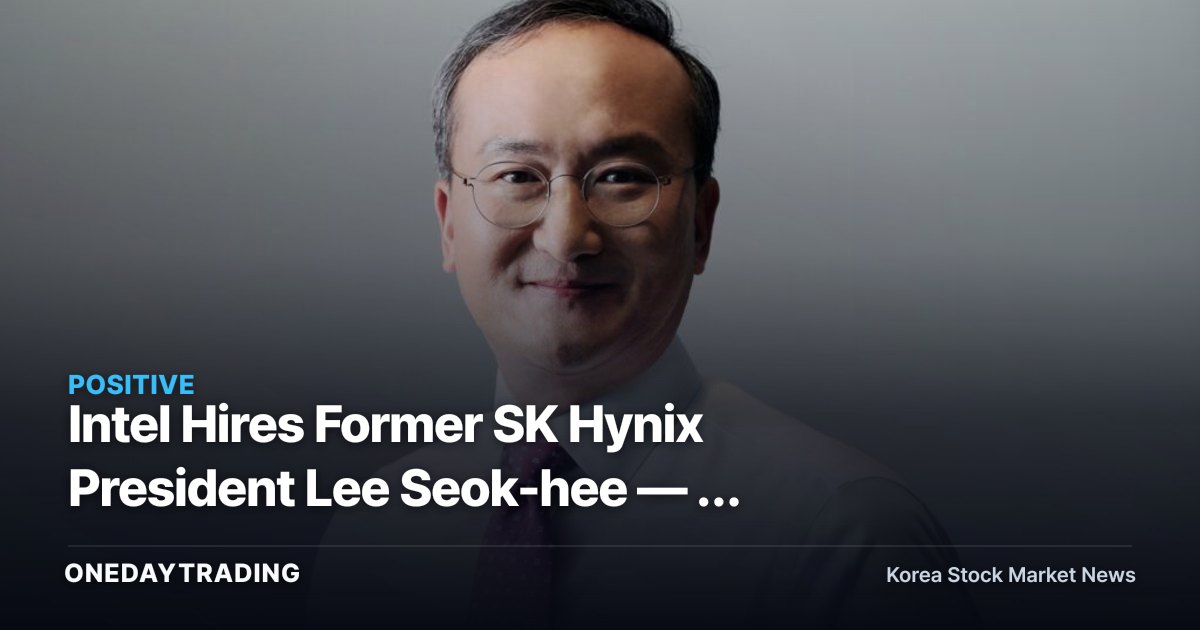
Intel has appointed Lee Seok-hee, former president of SK Hynix, as a senior vice president of Intel Foundry, putting him in charge of the Advanced Packaging division. Bringing in a figure who led HBM development and advanced process technology at a memory powerhouse signals that Intel sees packaging as the decisive battleground in the race to win AI chip contract manufacturing. For Korean investors, this is a development to read both as a concern over the outflow of SK Hynix's talent and technology, and as a variable that could reshape the foundry and packaging landscape currently led by Samsung Electronics and TSMC.
What Happened
Intel has appointed Lee Seok-hee, former CEO of SK Hynix, as a senior vice president of Intel Foundry and entrusted him with the advanced packaging business. An engineer-turned-executive, Lee led DRAM and NAND mass production and the advancement of HBM technology at SK Hynix, accumulating hands-on experience in both memory and advanced process technology.
The key point is that the area Intel recruited him for is not simply manufacturing, but packaging. In recent AI accelerators, 2.5D and 3D packaging technology — which integrates compute chips (GPUs and ASICs) and HBM into a single package — has emerged as the bottleneck that determines performance. Intel holds its own packaging technologies in Foveros and EMIB, but it has trailed TSMC's CoWoS in mass-production yield and customer acquisition.
Against this backdrop, bringing in talent who understands HBM best is interpreted as an intent to absorb the design and yield know-how of memory-logic combined packaging and attract external customers (fabless firms).
Background and Context
Intel is chasing TSMC and Samsung Electronics in the contract manufacturing market by spinning off and expanding its foundry business, but it remains deep in the red. Meanwhile, as AI data center investment grows, demand for advanced packaging is exploding to the point of supply shortages. Packaging is an area where a latecomer can relatively easily close the gap through talent and investment, making it an ideal arena for Intel to concentrate its resources.
SK Hynix is the number-one player that effectively leads supply to Nvidia in the HBM market. The very fact that a key executive has moved to a rival camp shows how the competition for technical talent is intensifying in Korea, a memory superpower.
Impact on the Market and Stocks
- Intel (INTC): Strengthening packaging competitiveness provides justification for expanding external foundry orders. However, it will take time to translate into earnings, making this closer to a mid-to-long-term strategic variable than short-term momentum.
- SK Hynix: The departure of key talent has a limited impact on near-term earnings, but it is a burden in the long-term competitive picture in that SK Hynix's lead in HBM and packaging technology could narrow.
- Samsung Electronics: Its position, caught between TSMC and Intel in the foundry business, grows more complex. If packaging competition intensifies, the pressure to differentiate its integrated memory-foundry strategy will increase.
- TSMC: Intel has effectively thrown down the gauntlet against CoWoS's dominant position, but the still-wide gap in mass-production yield and customer trust serves as a defensive moat.
- Domestic back-end and materials companies: The trend of expanding advanced packaging investment could create downstream demand opportunities for partners involved in bonding equipment, substrates, and testing.
Investor Checkpoints
- Whether Intel's quarterly earnings releases disclose foundry-division orders and customers, and mention packaging revenue
- SK Hynix's next-generation HBM (HBM4) mass-production schedule and whether it maintains its share with major customers such as Nvidia
- The scale of TSMC's CoWoS capacity expansion and any signs of packaging volume being diverted to Intel and Samsung
- Policy variables such as Korea-U.S. semiconductor subsidies and tariffs, and the strength of U.S. government support for Intel Foundry
Outlook
In an optimistic scenario, Intel could use talent with HBM know-how to raise packaging yields, secure external AI chip customers, and create a turning point for reducing its foundry losses. Conversely, packaging competitiveness is an area completed not by a single person but by the accumulation of equipment, yield, and customer trust, making it hard to expect results in the short term. Considering Intel Foundry's structural losses, TSMC's first-mover advantage, and the time required for customer validation, this hire should be viewed as a signal of a directional shift, while actual changes in market share will be confirmed over a span of years.
This article is automatically summarized and analyzed content based on the original news report. View original (Maeil Business Newspaper, Corporate)