
At a Glance
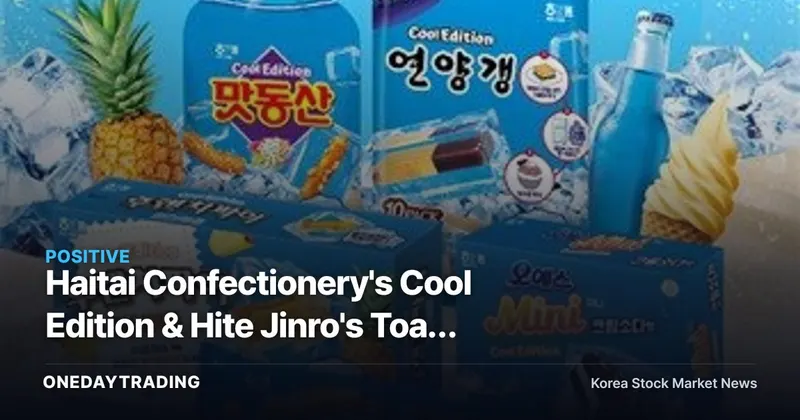
Haitai Confectionery has launched five Cool Edition products that reimagine perennial bestsellers — Home Run Ball, O:Yes, French Pie, Yeon Yanggaeng, and Matdongsan — as frozen treats, while Hite Jinro has rolled out a Toad character marketing campaign in partnership with K-pop stars. Both companies are pursuing seasonal marketing timed to the summer peak season, employing the classic playbook of leveraging existing brand equity to lift revenue without new capital expenditure on equipment.
Why It Matters Now
From an investor's perspective, these new product launches are less a catalyst for an immediate shift in total revenue and more a signal gauging the marketing stamina and brand velocity of food and beverage companies. The key is not the new products themselves, but rather the repackaging of existing lines — a structure that raises average selling price and turnover without the burden of new production lines. With raw material costs and capital expenditure remaining limited, the ability to absorb summer demand without margin erosion is the key point to watch.
Snack products in particular are highly sensitive to weather and seasonality. The freeze-and-eat concept blurs the line with the ice cream category in an attempt to defend average transaction values during summer, while the beverage brand's character and K-pop collaborations are designed to stimulate demand among consumers in their 20s and 30s and drive merchandise purchases to deepen brand loyalty. That said, limited-edition marketing of this kind risks remaining a short-lived talking point, making the critical question whether it translates into actual sales data.
Frequently Asked Questions
- Does a new product launch automatically mean an earnings improvement? — The direct link is not straightforward. For repackaged products, the key metric is incremental revenue relative to marketing spend, and the real impact must be confirmed through the food and beverage segment's revenue changes in next quarter's earnings.
- Is there no cost pressure? — Since existing lines are being used, new equipment costs are minimal, but raw material prices — cocoa, sugar, grains — along with the exchange rate remain the primary drivers of margin.
- What is the strategic intent of the beverage collaboration? — Tying the Toad IP to K-pop is an effort to boost soju brand preference through merchandise buzz and social media virality, and is primarily aimed at defending market share.
- Will this be reflected in the share price immediately? — A single new product is unlikely to move the share price significantly; quarterly earnings and market share trends are far more important.
Related Stocks & Sector Impact
- Crown Haitai Holdings — As the listed parent company of Haitai Confectionery & Foods, it is directly linked to summer snack revenue and brand value should the Cool Edition perform well.
- Hite Jinro — Toad IP marketing will influence the company's ability to defend soju market share and expand its consumer base among those in their 20s and 30s.
- Food & Beverage Sector Overall — Intensifying seasonal marketing competition could lead to higher marketing expenditure, becoming a short-term cost headwind for the sector.
- Convenience Stores & Distribution Channels — The turnover of limited-edition new products is tied to convenience store shelf revenue, creating indirect ripple effects for retail distribution stocks.
- Raw Materials — Fluctuations in cocoa, grain, and sugar prices remain a variable affecting confectionery margins.
Key Investment Considerations
- Buzz around new products and actual sales performance are separate matters — monitor segment-level revenue changes in the next quarterly earnings.
- Check whether rising marketing expenditure is compressing operating profit margins.
- The impact of raw material prices and the KRW/USD exchange rate level on confectionery and beverage input costs.
- Summer seasonal tailwinds are transient — the second-half new product pipeline and market share trends must also be monitored in tandem.
Overall Outlook
The bull scenario has repackaged summer products driving revenue turnover without margin erosion, supporting food and beverage segment earnings through the peak season. The bear case is one where limited-edition marketing generates nothing more than short-lived buzz without converting to sales, or where rising raw material and marketing costs inflate expenses while profitability stagnates. The key metrics to watch are next quarter's food and beverage segment revenue growth rate and operating profit margin, alongside cocoa and grain input costs and exchange rate movements.
Crown Haitai Holdings: Real-Time Data Snapshot
Crown Haitai Holdings' most recent closing price was ₩5,290 (down 3.29% from the prior session). The composite signal factoring in foreign investor and institutional investor supply-demand (order flow), news, and momentum reads 🟡 neutral — wait and see. Positive and negative signals are mixed, suggesting a period of observation.
- ▲ Supply-Demand (Order Flow) Continuity — Foreign investors have been net buyers for three consecutive sessions (+0 billion won)
- ▼ Trend Alignment — Short- and mid-term downtrend alignment (day: -3.3% · 1 week: -7.0% · 1 month: -17.9%)
- ▼ 52-Week Position — Within 2% of the 52-week low
※ Price and foreign investor/institutional investor supply-demand (order flow) data are provided by Korea Investment & Securities (KIS) and are current as of the time of publication.
This content is an automated summary and analysis based on the original news article. View original (Yonhap News)