
Key Takeaway
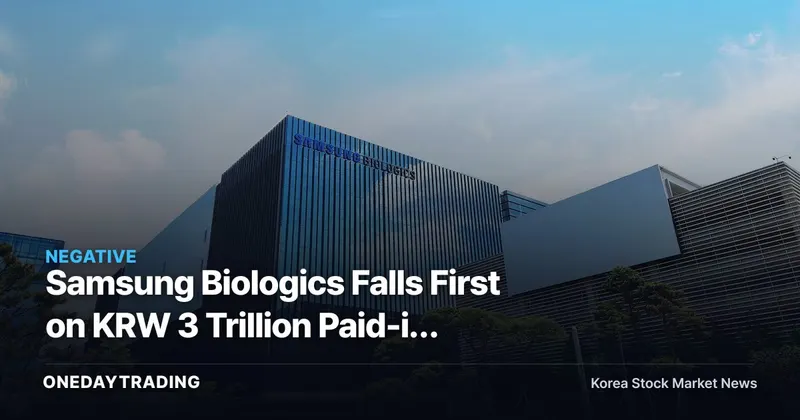
Samsung Biologics’ KRW 3 trillion paid-in capital increase is not about needing cash, but about broadening its business portfolio by acquiring a peptide CDMO. A CDMO earns revenue by developing and manufacturing clients’ drugs on their behalf, but the market is calculating per-share dilution from 2.27 million new shares and a 15% discounted issue price before it looks at growth potential.
The core issue here is valuation. The multiple on an antibody-led CDMO is not sustained by capacity expansion alone; the KRW 2.7062 trillion acquisition budget and KRW 294.8 billion expansion budget must translate into actual revenue and margins to defend it.
What Happened
On August 28, Samsung Biologics’ board approved a shareholder rights paid-in capital increase worth KRW 3 trillion in total. Of the funds raised, KRW 2.7062 trillion will be used to acquire Switzerland’s PolyPeptide Group, while the remaining KRW 294.8 billion will go toward expanding the second Bio Campus in Songdo, Incheon.
The planned new shares total 2.27 million, with an indicative issue price of KRW 1,322,000 per share. The company described this as a three-pillar expansion strategy extending from antibodies and mRNA to ADCs and now peptides. On paper, it looks like an aggressive investment, but capital markets usually price in dilution and supply-demand (order flow) pressure first.
Even with a shareholder rights offering followed by a public offering of unsubscribed shares, existing shareholders’ stakes shrink when new shares are added. A discounted issue price improves fundraising efficiency, but it weighs on the stock in the short term.
Background and Context
Samsung Biologics is not buying PolyPeptide just to get bigger. Peptides are a modality gaining importance in obesity, diabetes, and rare-disease treatments, and they create a different customer base from the company’s existing antibody-focused business.
The strategy aims to expand capacity and diversify the portfolio at the same time. The company said it plans to complete Plant 5 in 2025, then sequentially bring Plants 6 through 8 online, lifting total capacity to 1.385 million liters by 2032. The second Bio Campus alone is expected to reach 720,000 liters.
Still, the market separates what is already priced in from what is not. Some of the expansion plan is already reflected in expectations, but how much utilization and margin the peptide CDMO business will actually bring after the acquisition remains unproven.
Impact on the Market and the Stock
- Samsung Biologics: In the short term, dilution and the discounted issue price are a heavy burden. If integration goes smoothly, however, the deal could earn a strategic premium over the medium to long term by reducing reliance on antibodies.
- Korean bio CDMO industry sector: The key valuation driver is being reframed as customer diversification and plant utilization, not just capacity. Orders and utilization need to be confirmed before multiples can move higher.
- Bio equipment and process value chain: The Songdo second Bio Campus expansion should create demand for equipment and process validation. That said, the main point of this case is capital raising rather than order growth.
- Peer comparison: Unlike companies such as Celltrion that have a high share of in-house products, Samsung Biologics’ CDMO model means customer mix and utilization affect earnings more directly.
Investor Checklist
- November subscription schedule: Watch how well the shareholder rights offering and public offering of unsubscribed shares are absorbed. Weak demand could keep the overhang in place for longer.
- PolyPeptide integration speed: If closing and organizational integration are delayed, the timing of revenue contribution will slip as well.
- Second Bio Campus utilization: For the 720,000-liter expansion to matter, quarterly utilization and order backlog need to follow.
- Exchange rate and rates: A weaker KRW/USD exchange rate is positive for export-oriented businesses, but higher capital costs can pressure the valuation multiple on large acquisitions and expansions.
Outlook
The bullish case is clear. If the peptide CDMO acquisition succeeds and the 1.385 million-liter expansion by 2032 leads to high utilization, Samsung Biologics could be re-rated as a modality platform rather than just an antibody-focused CDMO.
The risks are equally clear. A paid-in capital increase is a growth investment, but for shareholders the first effects are dilution and cash outflow. If post-acquisition integration stalls or order growth does not follow, the market is likely to price in the financing burden longer than the growth story.
The next things to watch are the Monetary Policy Board, the KRW/USD trend in the 1,300 range, and the November subscription take-up rate. All three will move capital costs and valuation multiples at the same time.
Frequently Asked Questions
Why is Samsung Biologics’ paid-in capital increase a burden on the stock?
As 2.27 million new shares are issued, existing shareholders’ ownership and earnings per share are diluted. In particular, a 15% discount to the issue price is a condition the market does not favor in the short term, so supply-demand (order flow) pressure comes first.
Why is the PolyPeptide acquisition necessary?
PolyPeptide has strength in peptide CDMO, and Samsung Biologics can broaden its portfolio beyond antibodies. As the obesity and diabetes treatment markets grow, the strategic value of this modality rises.
What needs to be seen for this paid-in capital increase to turn into a medium- to long-term positive catalyst?
The key is whether the acquisition and expansion translate into earnings. Valuation defense depends on confirmed revenue contribution from PolyPeptide, utilization at the second Bio Campus, and the next quarter’s order announcements.
Samsung Biologics in Real Time
Samsung Biologics’ latest closing price is KRW 1,486,000 (-6.78% from the previous day), and the traffic-light signal based on foreign investors, institutional investors, news, and momentum is 🔴 Caution. Caution is warranted now because foreign investors, institutional investors, news, and momentum are negative.
- ▼ Heavy dual selling — foreign investors sold KRW 22.7 billion and institutional investors sold KRW 12.1 billion
Recent related news is negative, with 0 positive catalyst items and 2 negative catalyst items.
※ Price and foreign investors/institutional investors data are provided by Korea Investment & Securities (KIS) and are current as of publication.
This article is automatically summarized and analyzed based on the original news report. View original article (Maeil Business Newspaper Securities)