
Summary
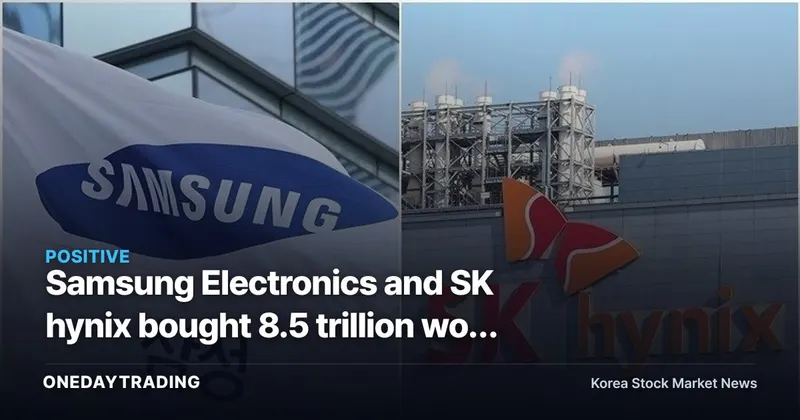
The share buybacks by Samsung Electronics and SK hynix are not simply about defending share prices. They are a supply-demand (order flow) event that reduces the float in large-cap semiconductors and supports the valuation floor. The fact that 46 trillion won remains after 8.5 trillion won was bought in just six days sends a clear signal to the market: this is not a one-off event.
What the market priced in first was the speed of the initial buying. What is still not fully reflected is the durability of the remaining 46 trillion won. As long as the buying continues, net buying by other corporate entities will help support large-cap KOSPI names. But if the pace slows, that effect will fade quickly.
The Background
According to Yonhap News, Samsung Electronics and SK hynix bought 8.5 trillion won worth of treasury shares over the past six days. In the market, this demand absorbs selling pressure. On the accounting side, it is recorded as net buying by other corporate entities, and for investors it appears as money that can immediately change the direction of trading value, even if it is not direct end-user demand.
The key figure is the remaining 46 trillion won. The fact that this is larger than the 8.5 trillion won already executed means the shares may continue to face direct company buying demand at certain price levels. The market reads this number separately from earnings, but the real issue for valuation is the pace of buying and the execution period. If the pace slows, it acts as support. If it speeds up, it provides short-term supply-demand (order flow) momentum.
This matters because of the weight Samsung Electronics and SK hynix carry in KOSPI. Their buybacks affect not only individual stock supply-demand (order flow), but also index sentiment and semiconductor ETF flows. It is less a case of KOSPI rising outright and more a structure in which the companies are directly absorbing selling in the large-cap semiconductor names.
Structural Backdrop
Share buybacks do not directly lift EPS. Instead, they reduce the number of shares outstanding, spreading the same earnings across fewer shares. That is why, in a falling-rate environment, they often coincide with multiple expansion, while in a period where rate pressure still remains, their main role is to defend the downside. When the semiconductor industry sector is caught between AI optimism and earnings confirmation, buybacks cannot replace the growth narrative, but they can narrow the valuation discount.
Put differently, a company buying back shares does not automatically improve industry conditions. SK hynix still needs confirmation on HBM and the memory cycle, while Samsung Electronics needs visibility on both commodity memory and foundry profitability. Share buybacks are not a thermometer; they are a support. They can underpin the share price, but they cannot change the earnings direction.
Stock and Industry Impact
- Samsung Electronics: Buybacks are a direct way to reduce the discount applied to a large-cap stock. They can soften price shocks even when foreign investors’ flows weaken.
- SK hynix: In a period of elevated AI memory expectations, buybacks fill the supply-demand (order flow) gap. However, multiple expansion will remain limited unless HBM shipments and yields are confirmed.
- Semiconductor suppliers and materials names: If the sector bellwethers stay firm, the psychological discount on equipment and materials stocks also narrows. But this effect ultimately has to be validated by actual investment and orders from Samsung Electronics and SK hynix.
- KOSPI large-cap ETFs: Buybacks from the two heavily weighted names are quickly reflected in ETF returns and market sentiment. Even on weak KOSPI days, if the large-cap semiconductor names hold up, the index falls less than expected.
Bullish vs Bearish Scenarios
- Bullish: If execution is fast and memory prices plus HBM shipments improve at the same time, the buybacks overlap with earnings expectations and push multiples higher. If KRW/USD stabilizes below 1,400 won, foreign investors’ flows are less likely to swing sharply.
- Bearish: If the market has already priced in the buyback expectation and execution slows, the effect weakens quickly. If rate hikes re-accelerate or the exchange rate surges, the buyback is only a shield, not a catalyst for a trend reversal.
Investor Takeaways
- Watch the next buyback disclosure for execution speed and remaining capacity.
- Track whether Samsung Electronics and SK hynix turn to foreign net buying, alongside KOSPI supply-demand (order flow).
- Check whether the buyback effect is translating into earnings through variables such as HBM shipments, DRAM prices, and foundry utilization.
- Watch whether KRW/USD at 1,400 won, the next central bank meeting, and CPI data shake large-cap multiples again.
Frequently Asked Questions
Why do Samsung Electronics and SK hynix share buybacks affect the stock price so quickly?
When the number of shares floating in the market falls, the per-share value looks higher even if earnings stay the same. For stocks with a large KOSPI weight, changes in supply-demand (order flow) are reflected both in the index and in the industry mood.
Does the fact that 46 trillion won remains mean they are still buying at the same pace now?
No. The remaining amount only shows the capacity to buy. The actual price impact depends on the pace and duration of execution. Whether the company buys all at once or in installments makes a difference to the pressure felt by the market.
Is this news more important than the semiconductor cycle itself?
No. Buybacks change supply-demand (order flow), but they do not replace the industry cycle. Ultimately, Samsung Electronics still needs confirmation on commodity memory and foundry, while SK hynix needs confirmation on HBM and memory prices in the next set of earnings.
Samsung Electronics in real time
Samsung Electronics' recent closing price is 260,250 won (-2.16% from the previous session), and the traffic light signal combining foreign investors' and institutional investors' flows with news and momentum is 🟡 neutral, wait-and-see. Positive and negative signals are mixed, so this is a level to watch.
- ▲ News flow — 11 positive catalyst vs 5 negative catalyst — positive catalyst dominates
Recent related news has been favorable, with 11 positive catalyst items and 5 negative catalyst items.
※ Price and foreign investors/institutional investors flow data are provided by Korea Investment & Securities (KIS) and are based on the time of publication.
This article is automatically summarized and analyzed based on the original news report. View original article (Yonhap News Securities)