
3-Point Briefing
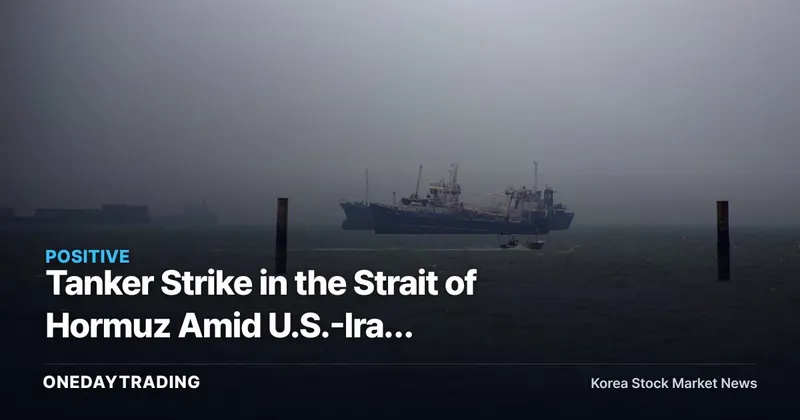
- A tanker was struck in the Strait of Hormuz while the U.S. and Iran were pursuing a 60-day ceasefire.
- Any disruption to this chokepoint — through which a significant share of the world's seaborne crude oil passes — would place upward pressure on international oil prices as well as freight rates and insurance premiums.
- Domestically, refinery and shipping stocks emerge as potential short-term beneficiaries, while airline and chemical stocks with large fuel cost exposures face headwinds.
What Changes
The significance of this incident lies not merely in the strike itself, but in the fact that a critical crude oil transit route came under threat precisely when a ceasefire was supposed to be holding. The Strait of Hormuz is effectively the only viable corridor for Middle Eastern crude and LNG heading to Asia. Even without an actual blockade, a ship strike alone reshapes how shipowners and insurers perceive risk — driving up war-risk insurance premiums and charter rates.
From an investor's perspective, the key variables are frequency and duration. If this is an isolated incident, any oil price move is likely to be a short-term spike. But if the ceasefire deteriorates and attacks recur, a structural Middle East risk premium will become embedded in oil prices. South Korea imports 100% of its crude and relies heavily on the Middle East, making uncertainty at this chokepoint a direct concern for the trade balance and import-driven inflation.
Numbers and Context
The timing of the attack — occurring during a 60-day window in which both sides agreed to seek a resolution — has heightened market vigilance. However, the publicly available information at this stage centers on the fact of the strike and the ceasefire backdrop; specific figures such as the scale of any traffic disruption or the magnitude of oil price moves require further confirmation. At this point, it is more prudent to map the range of risk scenarios and position accordingly, rather than anchor to any definitive price move.
Stocks to Watch: Beneficiaries and Headwinds
- S-Oil, SK Innovation, and GS — refiners are directly exposed to inventory valuation gains and refining margin swings in a rising oil price environment. However, whether they benefit depends on the direction of margins; a rise in crude prices does not automatically translate to higher profits.
- HMM and Pan Ocean — shipping stocks (tickers) may respond positively through longer voyage rerouting and higher freight and charter rates, which expand ton-miles.
- Korea Gas Corporation (KOGAS) is exposed to geopolitical variables affecting LNG import routes and is subject to the impact of its feedstock cost-linkage structure.
- Hanwha Aerospace and LIG Nex1 — defense stocks (tickers) tend to attract thematic investor interest when Middle East tensions appear likely to persist.
- Korean Air and Asiana Airlines are among the most exposed to rising oil prices given jet fuel's large share of operating costs. Chemical stocks (tickers) with high naphtha cost exposure, such as Lotte Chemical, face similar headwinds.
Risk Checklist
- If the incident proves to be a one-off and oil prices quickly retrace, stocks (tickers) that rallied on beneficiary expectations may face profit-taking pressure.
- Inventory valuation gains at refiners can reverse into losses if oil prices turn lower, making this a highly volatile earnings item.
- If higher oil prices and freight rates are passed through as costs, they could dampen demand across consumer and industrial sectors, creating a headwind for the broader equity market.
- Any diplomatic de-escalation signals — such as ceasefire progress — could rapidly unwind the geopolitical risk premium.
Bottom Line
Uncertainty at the Strait of Hormuz sends two opposing signals simultaneously: short-term momentum for refinery and shipping stocks (tickers), and cost pressure for airlines and chemicals. The first priority is to monitor international oil price trends, ceasefire continuity, jet fuel prices, and war-risk insurance premium movements — and to determine whether this event is a one-time occurrence or the beginning of a recurring pattern.
This content was automatically summarized and analyzed based on the original news source. View original article (CNBC)