
Investment Implications of TSMC’s Texas Plan
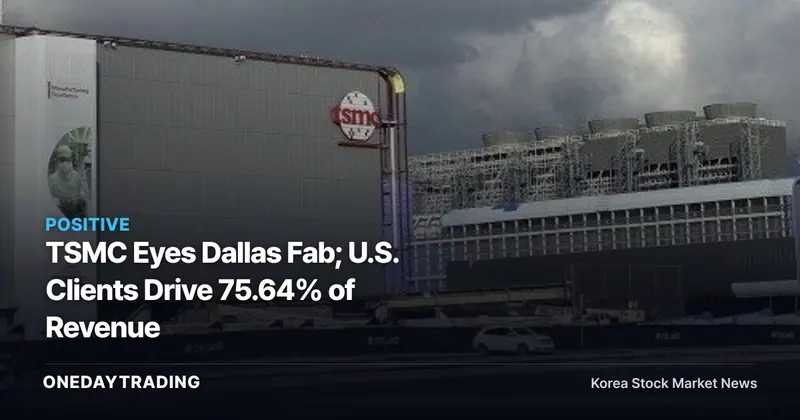
Whether TSMC’s U.S. manufacturing footprint will expand from Phoenix, Arizona, to Dallas, Texas, has emerged as a new variable in the semiconductor supply chain. Yonhap News Agency’s securities desk reported on 2026-09-29, citing Taiwanese media, that TSMC is prioritizing the Dallas area as a candidate site for its second U.S. wafer fab. Investors should distinguish between the broader direction of expanding U.S. production and the individual investment proposal, which has yet to be finalized.
A wafer fab produces chips by processing the disc-shaped substrates that form the foundation of semiconductor manufacturing. The plant’s location and production process therefore determine not only capacity but also which regional customer demand it will support. If the Dallas review leads to an actual investment, TSMC’s U.S. manufacturing base would be distributed across multiple regions.
What the 75.64% U.S. Customer Revenue Share Means
U.S. customers accounted for 75.64% of TSMC’s revenue in the first half of this year. NVIDIA, Intel, AMD and Apple were identified as major customers. This figure suggests that the Texas review may reflect an effort to align manufacturing locations with the company’s customer mix, rather than merely expand its physical footprint.
Viewed as a foundry supply chain running from customers to contract manufacturing and then downstream production infrastructure, the effect of expanding U.S. plants on earnings depends on connecting customer demand with local capacity. If the U.S. customer share holds, the case for local investment gains strength. Conversely, if customer demand and the scale of investment are misaligned, capacity expansion alone will not guarantee results.
How the Phoenix Plan Differs From the Dallas Candidate Site
TSMC has announced plans to build up to 10 wafer fabs, two packaging plants and one research and development center in Phoenix. Total investment in the Phoenix area was stated at $265 billion, or about 360 trillion won. The key difference is that the Phoenix plan has already been announced, while the Dallas proposal remains at the candidate-site review stage.
Details not yet confirmed include the Texas plant’s precise location, construction and operating schedule, final investment amount and production process. TSMC has not issued an official statement, and its board has not made a final investment decision. There is therefore no basis yet for quantifying production volumes or the impact on individual customers.
Key Issues Surrounding TSMC’s Texas Investment
- Investment stage: The Dallas area has reportedly emerged as the leading candidate, but the plan has not yet received board approval.
- Customer linkage: With NVIDIA, Intel, AMD and Apple identified as major customers, responding to U.S. demand is central to the decision.
- Manufacturing footprint: Adding a Texas candidate site to the existing Phoenix plan would divide TSMC’s U.S. wafer production base across multiple regions.
- Factors to verify: The final investment amount, production process, and construction and operating schedule must be disclosed before actual supply capacity can be assessed.
Related Stocks (Tickers) and Semiconductor Supply-Chain Impact
- TSMC: If the investment is approved, the central change would be an expansion of its U.S. manufacturing base. Because the process and scale remain undecided, only the strategic direction can be assessed at this stage.
- NVIDIA, Intel, AMD and Apple: As identified major TSMC customers, these companies provide the direct link to expanded local production. No customer-specific volumes or order sizes were disclosed.
- Vanguard International Semiconductor (VIS) and NXP: Their joint venture, VisionPower Semiconductor Manufacturing Company (VSMC), is establishing a separate production base in Singapore, illustrating the broader supply-chain expansion by TSMC affiliates.
The Execution Timeline Illustrated by Singapore’s VSMC
VisionPower Semiconductor Manufacturing Company (VSMC) held an opening ceremony for its first 12-inch wafer fab in Singapore. The plant will begin producing 40–130 nanometer process products in 2027 and plans to increase monthly wafer output to 55,000 units by 2029. Unlike the Texas proposal, this project has specified both its production process and target timeline.
Vanguard International Semiconductor (VIS) invested $2.4 billion, or about 3.3 trillion won, in the VSMC plant, while NXP contributed $1.6 billion, or about 2.2 trillion won. Vanguard will manage the operation. VSMC is also considering a second semiconductor plant in Singapore, but no decision or schedule has been finalized.
What Investors Should Check, in Order
- First, the board decision: The starting point is whether the candidate-site review results in actual investment approval.
- Second, the site and investment amount: The precise location and final amount must be disclosed before investors can evaluate the Phoenix plan separately from the Texas proposal.
- Third, the production process: Investors will need a confirmed process announcement to assess which customer demand the plant would serve.
- Fourth, the construction and operating schedule: This is the final indicator of when production capacity could become operational.
Board Approval Must Come Before a Plant Announcement
Under the bullish scenario, TSMC approves the Dallas investment and then discloses the site, process and schedule. That would connect its 75.64% U.S. customer revenue share with expanded local production under a single execution plan. The alternative scenario is a delayed board decision or a failure to define the investment scope, in which case the Texas proposal would be difficult to incorporate into supply-capacity estimates.
What is known today is the candidate site for a second U.S. wafer fab and the existing Phoenix plan. What remains unconfirmed is investment approval and production specifications for the Texas plant. The next assessment should hinge not on the prominence of the reports, but on TSMC’s board decision, confirmed process and operating timeline.
TSMC Key MetricsAs of 2026-09-29
| Period Returns | 1 Week +1.74% 1 Month +5.99% |
|---|---|
| Recent News Tone | positive catalyst 1 · negative catalyst 0 |
Price and supply-demand (order flow) data are real-time figures from Korea Investment & Securities (KIS), while supply-demand (order flow) and news-tone aggregates are calculated independently by OneDayTrading.
Supply-Demand (Order Flow) and Momentum Assessment🟢 Buying Advantage
News and momentum indicators are showing positive signals.
- ▲Trend AlignmentShort- and medium-term bullish alignment (Today +0.5% · 1 Week +1.7% · 1 Month +6.0%)
- ▲52-Week PositionAt 88% of the 52-week range — near record-high territory
This article was automatically summarized and analyzed from the original news report. View the original article (Yonhap News Agency — Securities)