
At a Glance
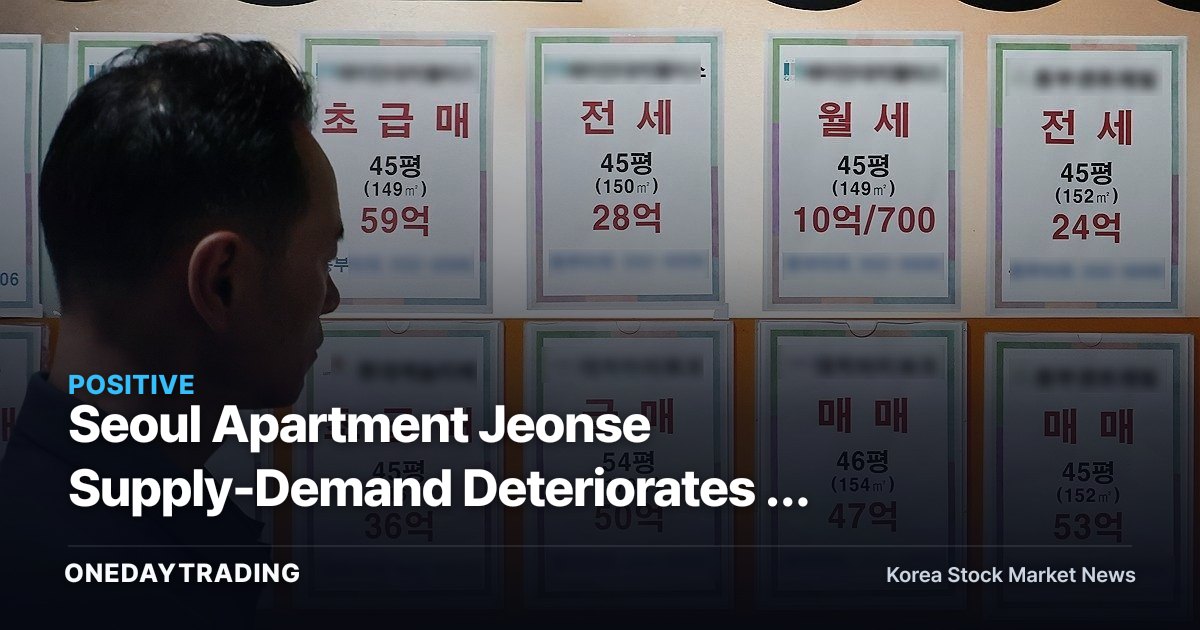
Signs of a supply shortage are strengthening once again in Seoul's apartment lease market. The jeonse supply-demand index has climbed into demand-driven territory, and the trend of roughly half of tenants extending their existing contracts because they cannot find a new home goes beyond a simple housing issue — it feeds into the housing supply cycle and becomes an earnings variable for the construction, REIT, and banking sectors.
Why It Matters Now
The jeonse supply-demand index is benchmarked at 100, and the higher it rises above that level, the more demand exceeds supply. A renewed rise in this indicator signals that rental listings are shrinking while pent-up tenant demand is building. The phenomenon of half of tenants choosing to stay put rather than move is evidence that listing turnover is stalled, and such stagnation typically translates into a gradual rise in jeonse prices.
From an investment standpoint, the key is the structure in which jeonse prices underpin the floor of sale prices. When jeonse prices rise, the gap narrows, increasing the incentive for genuine and investment demand to shift toward purchases — and this, with a lag, affects the new-supply (presale) market and construction firms' order environment. At the same time, growth in jeonse loan balances directly touches banks' interest income, while rising rents directly affect the dividend resources of residential REITs.
That said, behind the supply shortage lie a decline in new-build move-in volume and a credit crunch in real estate project financing (PF). In other words, the jeonse crunch is better read not as a short-term positive catalyst for construction firms, but as a medium-to-long-term signal that heightens the need for future supply expansion.
Frequently Asked Questions
- Does a rising jeonse supply-demand index always mean home prices will rise? No. Rising jeonse prices are a factor that supports the floor of sale prices, but depending on interest rates, household-loan regulations, and the economy, purchase demand can be suppressed — producing a decoupling in which only jeonse rises while sales stagnate.
- Why can't tenants move? It is largely because new-build move-in volume has fallen and substitute listings are scarce, so the deposit for a new place to move to has become higher. This is a phase in which extending an existing contract via the lease-renewal request right becomes the rational choice in terms of cost.
- Is this an immediate positive catalyst for construction stocks? Not directly. The supply shortage is actually the result of the recent contraction in move-ins and construction starts, so there is a lag before it is reflected in earnings via a recovery in orders and presales.
- How do jeonse loans affect banks? Rising jeonse prices increase demand for jeonse-deposit loans, which is favorable for interest income — but the effect can be limited depending on the intensity of household-debt regulation.
Impact on Related Stocks and Sectors
- Major construction firms The supply shortage signaled by the jeonse crunch could connect to medium-to-long-term presale and redevelopment demand, but PF burdens and rising costs weigh on short-term earnings.
- Residential REITs Rising rents are favorable for rental income and dividend resources. However, the interest-rate level is the key variable for REIT valuations.
- Banks and finance Growth in jeonse-deposit loan balances is positive for interest income, but total-volume regulation of household lending caps the upside.
- Furniture and interiors A contraction in moving demand is negative for moving- and remodeling-linked consumption, as slower listing turnover becomes a short-term earnings burden.
- Real estate brokerage and proptech Transaction stagnation is a direct headwind to brokerage-based revenue.
Points to Watch When Investing
- Whether rising jeonse prices spill over into sale prices must be viewed alongside interest rates and lending regulations; in a phase where only jeonse rises while trading volume dies, both construction and brokerage stocks can underperform.
- For construction stocks, the earnings trigger to confirm is not the supply shortage itself but the performance of new presales and the pace at which PF contingent liabilities are resolved.
- For REITs, the benefit of rising rents can be offset by interest-rate burdens, so check the benchmark interest rate path together with the dividend-yield spread.
- Policy variables are large. The trend in jeonse supply-demand can shift in a short period depending on the direction of lease-system reforms or supply measures.
Overall Outlook
On the optimistic view, tight jeonse supply-demand supports the floor of housing prices and, over time, acts as pressure for supply expansion — creating a favorable environment for construction firms' orders, REIT rental income, and banks' jeonse-loan demand. The opposite scenario is a phase in which high interest rates and lending regulations block the spillover into sales, so only jeonse prices rise while transactions stagnate. In that case, construction and brokerage stocks take the direct hit from weak trading, while REITs face interest-rate burdens. Ultimately, rather than the direction of the jeonse supply-demand index itself, it is which path its rise flows into — sales, presales, or lending — that determines profit and loss by sector.
Hyundai E&C Through Real-Time Data
Hyundai E&C's recent closing price is 128,600 won (-3.45% versus the previous day), and the signal light combining foreign and institutional investor order flow with news and momentum is 🟡 Neutral — Wait and See. With positive and negative signals mixed, it is a phase to watch.
- ▼ Trend Alignment — short- and medium-term downward alignment (intraday -3.5% · 1-week -18.3% · 1-month -7.7%)
Recent related news is favorable, with 4 positive catalysts versus 3 negative catalysts.
※ Price and foreign/institutional investor order-flow data are provided by Korea Investment & Securities (KIS) and are as of the time of publication.
This article is content automatically summarized and analyzed based on the original news. View original (Yonhap News)