
At a Glance
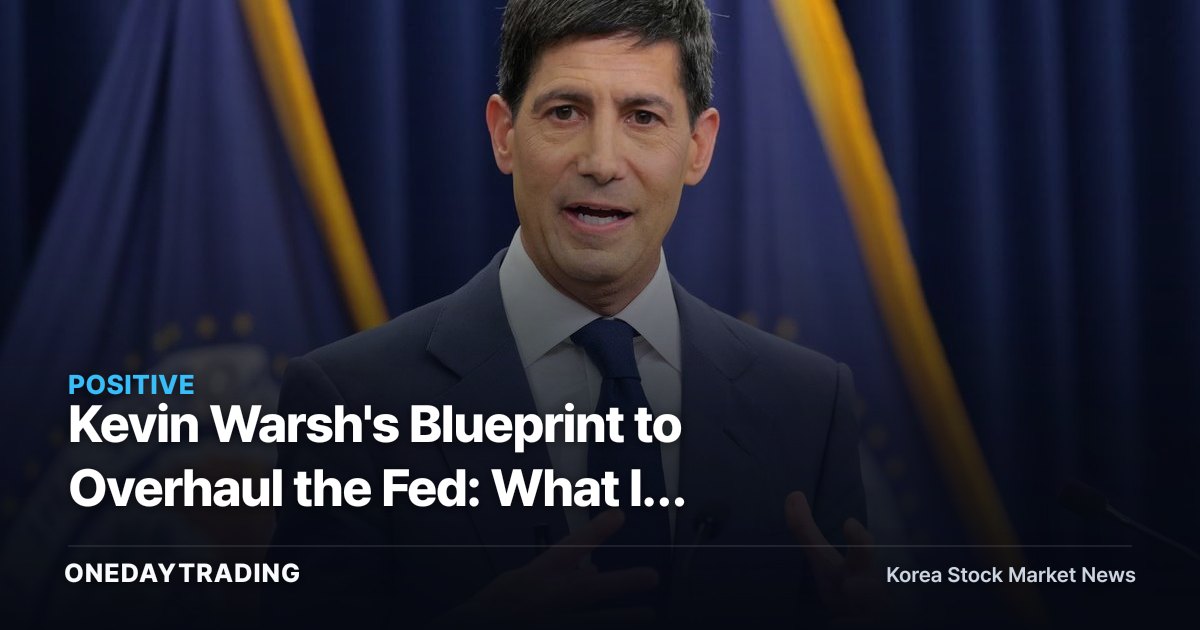
Kevin Warsh, frequently cited as a potential next Fed chair, has laid out a vision to rebuild the way the Fed operates from the ground up. Because this is a structural change that touches not just policy-rate decisions but the organization, its communications, and its regulatory philosophy, the sensible approach for Korean investors is to treat it not as a short-term rate bet but as a signal for reading dollar liquidity and the direction of the exchange rate.
Why It Matters Now
The crux is that Warsh intends to create multiple task forces to essentially re-examine what the Fed does from a blank slate. Two threads are drawing the market's attention. One is a deregulatory, growth-friendly stance: if the burden of bank capital requirements eases and risk appetite revives, there is greater room for global liquidity to flow into emerging markets and Korean equities. The other is the possibility that the center of gravity in monetary policy shifts away from a singular focus on curbing inflation toward employment and growth.
From Korea's standpoint, the channel through which this change lands most directly is the rate differential and the exchange rate. If expectations strengthen that the Fed is leaning dovish, the strain from the Korea–U.S. rate gap eases and the won gets some breathing room; conversely, if concerns grow that the Fed's independence is being undermined, an inflation premium could attach to long-term U.S. yields and the dollar could actually strengthen. The tricky part of this issue is that the same individual could bring about diametrically opposite outcomes.
Another variable that is easy to overlook is the change in communication style. Warsh is reported to be looking to overhaul how the Fed delivers its messages to markets, and if the weight given to the dot plot or forward guidance shifts, the very way the market forecasts rates could be shaken, potentially amplifying volatility.
Frequently Asked Questions
- Is Warsh a dove or a hawk? He was classified as a hawk in the past, but his recent tone references both deregulation and room for rate cuts, making him hard to pin down to one camp. So rather than the direction, watch the pace of organizational and rule changes.
- Is this an immediate positive catalyst for Korean equities? Expectations of expanded liquidity are favorable, but if the controversy over Fed independence spills over into dollar strength, it becomes a headwind for foreign investor flows.
- What should I watch on the exchange rate? You need to track the won–dollar exchange rate, the U.S. 10-year yield, and the Korea–U.S. policy-rate gap together to avoid the trap of relying on a single signal.
- Should I change my positioning now? Since this is still at a stage before being firmed up into concrete policy, it is better to set out response principles for each scenario in advance.
Impact on Related Stocks and Sectors
- Large-cap exporters (Samsung Electronics, SK hynix) Expanded dollar liquidity and a recovery in risk appetite are favorable for foreign investor order flow, but if the direction of the exchange rate diverges, the earnings-translation effect can cut both ways.
- Auto exporters (Hyundai Motor) Since a substantial portion of revenue is settled in dollars, a weak-won environment is favorable for profitability, but if the won strengthens on Fed easing it becomes a burden instead.
- Financials (KB Financial, Shinhan Financial Group) If a deregulatory stance toward U.S. banks lifts global financial sentiment, it could become grounds for a valuation re-rating. That said, expectations of falling rates work in the opposite direction for net interest margins.
- Growth and tech sector Expectations of an easing rate burden are favorable for high-valuation growth stocks, and volatility in domestic IT and platform stocks — which are highly correlated with the U.S. Nasdaq — rises in tandem.
Points to Watch When Investing
- This should be viewed on the premise that it is still a task-force-stage concept, so the lag and uncertainty before actual policy and personnel are finalized are considerable.
- Concerns over a weakening of Fed independence can simultaneously bring about the contradictory outcomes of short-term risk appetite and a rise in long-term rates.
- Assets that have already priced in easing expectations could be exposed to profit-taking pressure precisely when policy is finalized.
- Interpreting the exchange rate and U.S. rates through a single indicator is prone to misjudgment, so multiple indicators should be cross-checked.
Overall Outlook
The optimistic scenario is one in which a deregulatory, growth-friendly stance stimulates global liquidity, drawing foreign investor money back into Korean exporters and financials. The opposite scenario is one in which changes to the Fed's operating principles escalate into a controversy over independence, with U.S. long-term yields and the dollar strengthening together and weighing on emerging-market equities broadly. The checkpoints are clear: the timeline for nominating the next Fed chair, the disclosure of concrete outputs from the task forces, and whether the Fed's next monetary policy meeting brings changes to the rate path and communication style. Until these three become visible, a realistic approach is to have a response framework ready for each scenario rather than committing to a direction.
This article is content automatically summarized and analyzed based on the original news report. View original (CNBC)