
At a Glance
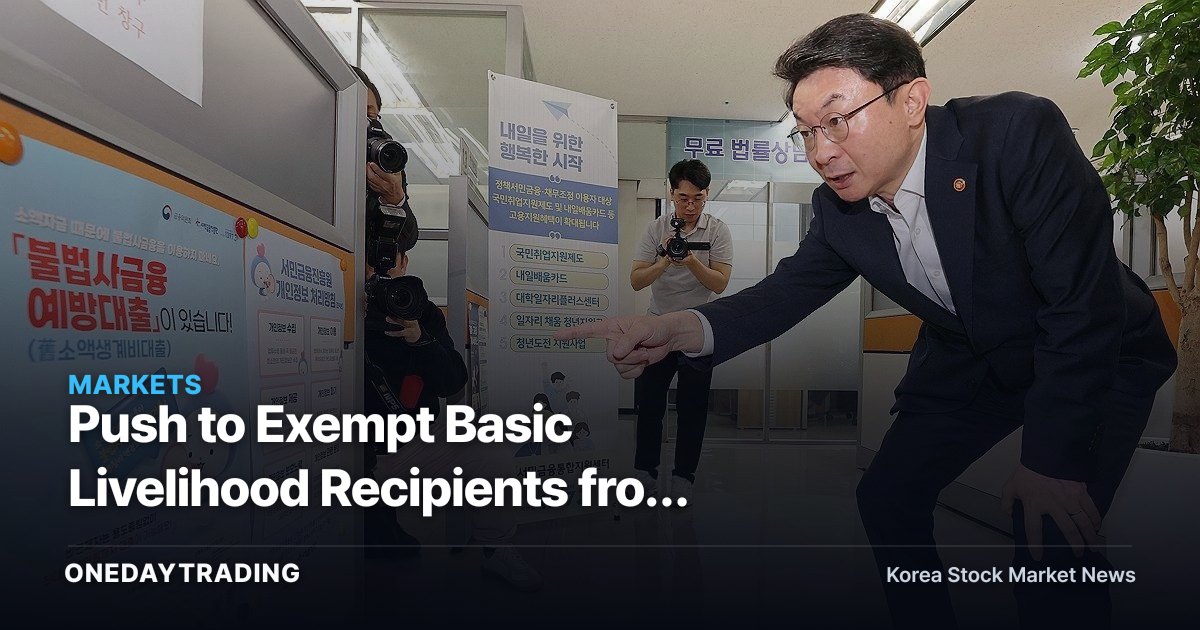
Financial authorities are reviewing a plan to waive credit-score screening on illegal private-lending prevention loans for basic livelihood recipients. The move aims to draw vulnerable groups—those shut out of mainstream lending due to low credit scores—into policy-based finance. In the short term, it should be read less as a direct revenue driver for the consumer-finance market and more as a shift in how policy costs and delinquency risk are shared.
Why It Matters Now
The investment implications of this issue lie less in an immediate positive catalyst for any individual stock (ticker) and more in a reallocation of fund flow—namely, where low-credit, low-income borrowers go to borrow. Until now, demand for quick cash among those in the lower credit-score brackets has flowed to savings banks, card-company cash advances, and money lenders, and—when pushed beyond even those—into illegal private lending. If policy loans that exclude credit-score screening expand, part of this demand shifts into policy-based microfinance.
The crux is that waiving screening could directly lead to wider defaults. When loans are extended based on eligibility criteria rather than repayment capacity, a rise in the delinquency rate is a structurally foreseeable outcome. Whether this burden is absorbed by government finances and policy institutions, or whether private financial firms shoulder part of it through contributions or guarantees, will determine the profit-and-loss direction for each sector. In other words, even under the same policy, the funding design determines who benefits and who bears the cost.
Moreover, if quick-cash demand among vulnerable groups is absorbed into the mainstream system, the size of the money-lending and illegal private-lending markets could contract. This is negative for the new-business environment of licensed money lenders, but in terms of social cost it may be assessed as a positive signal.
Frequently Asked Questions
- Does the credit-score screening exemption apply to everyone? No. The target currently under discussion is limited to specific vulnerable groups such as basic livelihood recipients, and it is supplementary in nature.
- Why try to remove the credit score? Because recipients who face difficulties with income or employment have low scores that block even small amounts of quick cash, and that gap feeds demand for illegal private lending.
- Does it directly affect financial firms' earnings? The direct revenue effect is limited. Policy loans are driven more by social-policy goals than by profit, and the impact on the private sector hinges on how the funding is shared.
- What about delinquency and default concerns? If repayment-capacity screening is weakened, the delinquency rate could rise, making the fiscal burden and recovery structure the key issues.
Impact on Related Stocks and Sectors
- Savings bank sector: If part of the low-credit quick-cash demand shifts to policy loans, the demand base for high-interest small loans could be affected.
- Card and capital companies: Possible changes in the user base for cash advances and small loans. However, the overlap with their core customer segment is limited.
- Licensed money lending: If policy absorption reduces new demand from vulnerable groups, it could weigh on the business environment.
- Policy-based microfinance ecosystem: Financial holding companies and banks that participate in guarantee and contribution structures face both costs and social reputation at the same time.
Points to Watch When Investing
- Because this is an institutional change rather than an earnings catalyst for any individual stock (ticker), one should be wary of reading it straight through to specific stocks.
- Since the profit-and-loss direction depends on whether the funding comes from government finances or private-sector sharing, it is worth confirming the announcement of the detailed design.
- Looser screening could amplify delinquency-rate and credit-cost variables, so the asset-soundness indicators of the relevant sectors should be watched alongside.
- One should distinguish whether the policy is at the review-and-promotion stage or has been finalized and implemented.
Overall Outlook
On the optimistic side, absorbing vulnerable groups' quick-cash demand into the mainstream system is positive in that it reduces harm from illegal private lending and curbs the shadowing of the consumer-finance market. Conversely, lending based on eligibility rather than repayment capacity comes with the costs of delinquency, defaults, and fiscal burden, and if the private-sector sharing structure is designed to be heavy, it becomes a burden for the financial firms involved. The reasonable approach is to gauge the sector-by-sector impact by checking, step by step, the specific funding and guarantee design, the implementation timing, and the trajectory of the policy-loan delinquency rate after implementation.
This article is content automatically summarized and analyzed based on the original news report. View original (Yonhap News Securities)