
Summary
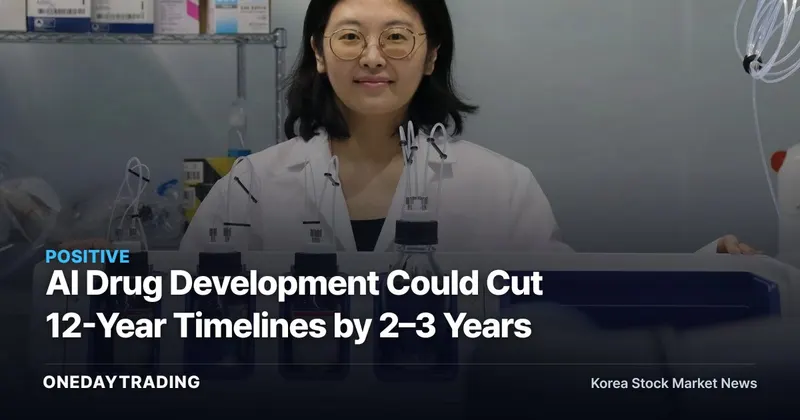
The investment value of AI drug development first emerges from shorter development timelines rather than research-cost savings. The assessment that artificial intelligence can cut the typical 12–15-year drug-development process by 2–3 years means bottlenecks in candidate discovery, preclinical design and clinical-patient selection can all be shortened at once.
However, time savings cited in press releases do not automatically translate into drug revenue. Companies must prove efficacy and safety in clinical trials and secure regulatory approval before generating cash flow. Korean companies have substantial technological potential, but they must close the gap with global pharmaceutical firms in data scale, validated pipelines and funding for follow-on clinical trials.
What Happened
In an industrial interview with Yonhap News, an expert explained that AI is now being used throughout every stage of drug development. The conventional development period is typically 12–15 years, and AI could shorten the overall timeline by 2–3 years. This is not simply research automation; it is an approach that accelerates decision-making from candidate discovery through clinical operations.
The key point for investors is which stages generate the time savings. Even if candidate discovery accelerates, delays in recruiting patients for Phase 1 and Phase 2 trials can extend the overall schedule again. Conversely, if AI identifies patients most likely to respond and screens out high-failure-probability compounds early, companies can reduce both their cash-burn period and the burden of additional capital raisings.
Structural Background
Drug development is a long binary game spanning candidate discovery, preclinical testing, Phase 1–3 trials and regulatory approval. AI reduces the search space by computing molecular structures and disease data, but model accuracy depends on the quality of training data and clinical validation. As a result, company value is determined less by simply owning an algorithm than by whether its predictions prove correct in actual clinical trials.
Korea is considered to have strong potential thanks to medical data from hospitals and research institutions, information and communications infrastructure, and a skilled biotech workforce. However, without better data standardization and anonymization and clearer rules for inter-institutional use, the technology may remain confined to laboratories. Even if government support expands, investors must separately examine each company’s pipeline stage and cash balance.
Stock (Ticker) and Industry Sector Impact
- Pharos iBio: As a company using an AI platform to discover drug candidates, the key issue is whether shorter development timelines lead to actual clinical entry and licensing deals. Clinical data disclosure, rather than preclinical results, is the next hurdle for the stock price.
- Syntekabio: Its business structure combines genomic and AI analysis with drug development, making co-development contracts with pharmaceutical companies crucial to revenue visibility. Investors should focus on recurring revenue and whether milestones are collected, not just on contract size.
- Samsung Biologics: The faster AI accelerates candidate discovery, the earlier manufacturing demand may arise during development. However, contract-manufacturing benefits appear only after customers advance their clinical programs, so short-term earnings and long-term pipelines should be assessed separately.
- SK Biopharmaceuticals: Greater use of AI in in-house drug development could improve research efficiency. However, prescription growth for products already on the market and clinical costs for new pipelines move simultaneously, making it difficult to estimate earnings from AI effects alone.
Bullish vs. Bearish Scenarios
The bullish scenario is one in which AI extends from candidate discovery through clinical-patient selection and Korean companies expand co-development agreements with global pharmaceutical firms. If development is genuinely shortened by 2–3 years, the period available for sales within the patent-protection window increases, allowing companies to run more programs with the same research budget.
The bearish scenario is one in which candidates proposed by models show poor clinical reproducibility or regulators do not sufficiently recognize AI-based evidence. Repeated clinical failures would erase the economic benefits of a shorter discovery period and increase dilution risk from follow-on financing. If clinical success rates do not improve, the high valuations of the AI drug-development theme could be quickly repriced.
If AI prediction accuracy delivers a meaningful and sustained improvement versus clinical control groups, industry profitability will rise. But if clinical dropout rates exceed existing levels, claims of shorter timelines will become a weaker investment argument.
Investor Action Points
- At the next corporate earnings release, check the number of drug candidates entering clinical trials and the time required at each development stage, rather than focusing only on AI-related research-cost savings.
- When reviewing licensing disclosures, separate upfront payments, stage-based milestones and clawback conditions to calculate actual cash inflows.
- Review regulators’ guidelines on AI use and clinical-trial approval schedules, and check whether data-standardization and security costs are increasing.
- Compare cash and cash equivalents with quarterly research-and-development spending to estimate how long clinical schedules can be maintained without another capital raising.
Frequently Asked Questions
How much sooner can AI drug development bring a drug to market?
The interview said AI could reduce the typical 12–15-year development period by 2–3 years. However, this is the technology’s potential reduction; the actual launch date depends on clinical success and regulatory review.
What are the competitive strengths of Korean AI drug-development companies?
Korea’s strengths include simultaneous access to healthcare-institution data, information and communications infrastructure, and biotech research talent. Data standardization and global clinical experience must be strengthened for that potential to translate into licensing deals and product revenue.
What is the most important metric when selecting AI drug-development stocks?
More important than simply owning a platform are clinical stage, patient-recruitment speed, regulatory approval and the cash terms of licensing agreements. Investors should also assess whether cash reserves are sufficient relative to research-and-development spending to gauge dilution risk.
Pharos iBio Key MetricsAs of 2026-09-06
| Period returns | 1 week -3.55% 1 month -4.27% |
|---|---|
| Trading value · Trading volume | 2억원 · 3만 816 shares |
| Supply-demand (order flow) | Foreign investors +4,300만 net buying Institutional investors −100만 net selling |
Price and supply-demand data are real-time values from Korea Investment & Securities (KIS); supply-demand and news-tone aggregates are calculated by OnedayTrading.
Supply-Demand & Momentum Assessment🟢 Buying outweighs selling
Foreign investors and momentum are positive, making the stock worth watching.
Upcoming Dates to Watch
- 09.10Simultaneous futures and options expiryModerateQuadruple witching — watch for volatility and supply-demand disruption
- 09.16FOMC policy-rate decisionHighU.S. Federal Reserve monetary-policy announcement — direction of rates and the dollar
- 10.08Index-options expiryLowKOSPI200 options expiry
- 10.22Bank of Korea Monetary Policy BoardHighMeeting to decide the benchmark interest rate
This article is automatically summarized and analyzed from the original news report. View original (Yonhap News Industry)