
Key Takeaways
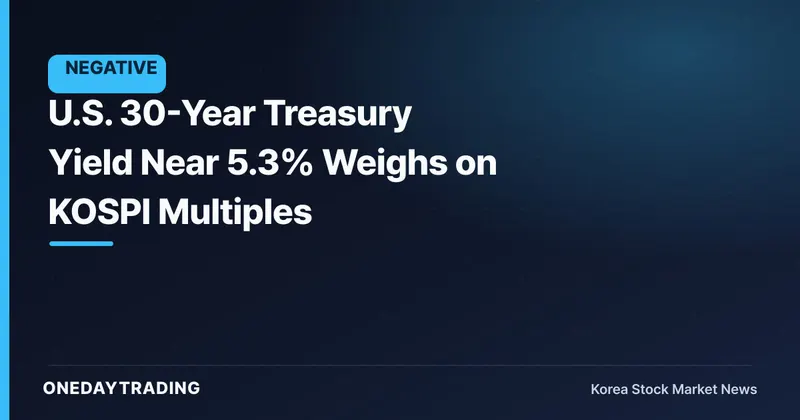
The rise in the U.S. 30-year Treasury yield is a long-duration discount-rate shock for Korean investors, simultaneously pressuring growth-stock valuations and driving relative strength in financial stocks.
In August, the U.S. long-term bond yield climbed to 5.327%, touching its highest level since 2007, before easing to 5.249% on August 24. But what the market is really watching isn't the level itself — it's the downside rigidity of long-term rates.
What Happened
The U.S. 30-year Treasury bond is a U.S. government bond with a 30-year maturity, and its yield serves as the long-term discount rate for global asset prices. When the 30-year yield approaches the mid-5% range, equity markets start discounting far-future cash flows even more heavily than next year's earnings.
According to Investing.com Korea, the key point is that the U.S. 30-year Treasury yield has emerged as the market's central variable. In mid-August, the 30-year yield rose to an intraday high of 5.327%, a level interpreted as the highest since 2007. The yield then eased to 5.249% by August 24 after the U.S. Treasury Department doubled the size of its long-bond buybacks from $2 billion to $4 billion per operation.
What this really signals isn't whether the Fed will cut rates next. Rather than the short-term policy rate, the market is re-pricing the term premium that fiscal deficits, Treasury supply, energy inflation, and AI capex financing needs are attaching to long-term rates.
Background and Context
The U.S. 10-year yield eased to 4.709% on August 24, but what matters more is that the 30-year yield is still holding in the 5.2% range. Even as expectations of a near-term slowdown press down on front-end rates, long-term fiscal burdens and inflation uncertainty are keeping the back end elevated.
This flows into the Korean stock market through two channels. First, the discount rate on won-denominated assets rises, lowering KOSPI's fair-value price-to-earnings ratio. Second, when a stronger dollar and rising long-term rates arrive together, foreign investors tend to cut risk first in long-duration industry sectors such as semiconductors and internet platforms. The DXY's climb to 99.00 on August 24 fits the same pattern.
Impact on the Market and Stocks (Tickers)
- KB Financial Group (105560), Shinhan Financial Group (055550): Rising long-term rates support expectations for banks' net interest margins. However, if the U.S.-driven rate increase spills over into a slowdown and higher credit costs, the effect is less a straightforward positive catalyst and more that of a defensive earnings play.
- Samsung Electronics (005930), SK Hynix (000660): AI chip demand remains intact, but as the long-term discount rate rises, it compresses multiples that price in far-future earnings. In particular, if expanding AI data-center investment is itself boosting corporate bond supply and pushing yields higher, then the demand narrative and the discount-rate burden exist side by side.
- NAVER (035420), Kakao (035720): Platform stocks have long cash-flow recovery horizons, making them sensitive to shifts in the 30-year yield. Share-price momentum weakens more from a downgrade in long-term growth assumptions than it gains from a short-term recovery in advertising and commerce.
- Airlines and refiners: When oil prices and interest rates rise together, transport stocks (tickers) like Korean Air (003490) face higher fuel costs and financing costs at the same time. S-Oil (010950), on the other hand, gains some defensiveness if refining margins hold up, but if demand also slows, higher oil prices won't translate directly into higher profits.
Investor Checkpoints
- Whether the U.S. 30-year yield retests 5.30%: If it breaks back above the mid-August high of 5.327%, equity markets will stop treating the rate shock as a one-off event.
- The effect of the Treasury's expanded buybacks: Watch whether purchasing $4 billion of long bonds per operation stabilizes yields — or instead exposes deeper fiscal strain.
- The won-dollar exchange rate and foreign investor flows: If rising long-term rates coincide with dollar strength, selling pressure from foreign investors on large-cap KOSPI growth stocks will intensify.
- Jackson Hole and U.S. inflation data: More important than the Fed's rhetoric is whether inflation data reignites long-term inflation expectations.
Outlook
The bullish scenario is clear-cut. If the Treasury's long-bond buybacks stabilize market functioning and oil prices decline, the 30-year yield could settle into the low-5% range. In that case, a technical rebound is more likely to appear first in semiconductors and internet stocks — which have fallen further than bank stocks — in the Korean market.
The trigger for the bearish scenario is a retest of 5.30% on the 30-year yield. Above that level, the market starts to question U.S. fiscal health and Treasury supply rather than simple inflation. It wouldn't be KOSPI selling off so much as the discount rate outrunning and dragging down earnings expectations. The next checkpoints are the late-August Jackson Hole commentary, September's U.S. Treasury supply-demand measures, and the direction of the won-dollar exchange rate.
Frequently Asked Questions
Why does the U.S. 30-year Treasury yield matter?
The U.S. 30-year Treasury yield is the benchmark rate for long-term capital worldwide. When the 30-year yield rose to 5.327% in August 2026, equity markets raised the benchmark rate used to discount future earnings back to present value.
Is the rise in U.S. long-term rates a negative catalyst for Korean stocks?
Rising U.S. long-term rates are generally a negative catalyst for growth stocks. Even companies with strong AI demand, such as Samsung Electronics (005930) and SK Hynix (000660), find it hard to escape multiple compression, and platform stocks like NAVER (035420) and Kakao (035720) are even more sensitive to a rising discount rate.
Are bank stocks always better off when rates rise?
KB Financial Group (105560) and Shinhan Financial Group (055550) can see net interest margin expectations improve when long-term rates rise. But if the rate increase leads to an economic slowdown and higher delinquency rates, the extent of earnings improvement is capped by rising credit costs.
KB Financial Group (105560): A Real-Time Data Snapshot
KB Financial Group (105560)'s most recent closing price was 163,100 won (-0.73% from the previous day), and the composite signal combining foreign/institutional investor flows with news and momentum reads 🔴 Caution. Foreign investor activity, news flow, and momentum are all negative, so caution is warranted right now.
- ▼ Order-Flow Continuity — Foreign investors net sellers for 4 straight days (−10 billion won)
- ▼ Trend Alignment — Short- and medium-term downtrend alignment (day -0.7% · 1 week -3.2% · 1 month -7.5%)
- ▼ News Flow — 2 positive catalysts vs. 3 negative catalysts — negative catalysts dominate
Recent related news comprises 2 positive catalysts and 3 negative catalysts, an overall negative mix.
※ Price and foreign/institutional investor flow data are provided by Korea Investment & Securities (KIS) and reflect figures as of publication time.
This article is automatically summarized and analyzed based on the original news source. View Original Article (Investing.com Korean)