
Summary
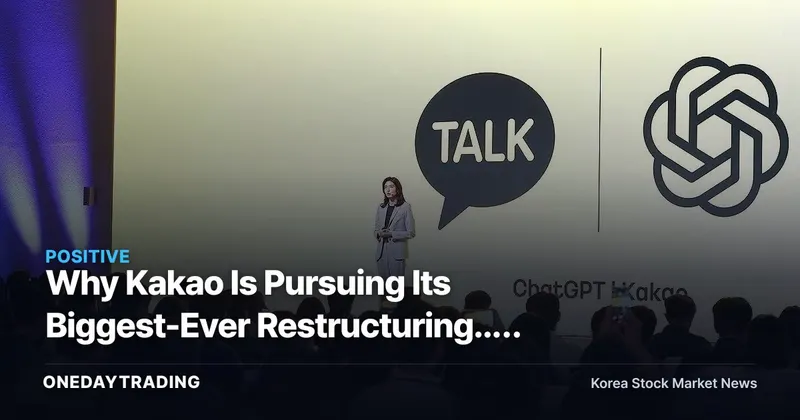
Kakao has announced the largest corporate governance restructuring in its history. The overhaul rests on two pillars: strengthening its artificial intelligence (AI) competitiveness and resolving its chronic undervaluation — the so-called "Kakao discount." What matters now is not the announcement itself, but whether it translates into concrete AI investment metrics and subsidiary earnings figures over the coming quarters.
What Happened
According to a Yonhap News Agency report on the 21st, Kakao unveiled the largest corporate governance restructuring plan in its history. The company cited strengthening AI competitiveness as the driving rationale behind the overhaul. Over the past several years, Kakao has grown in scale by successively listing key subsidiaries such as KakaoBank, Kakao Pay, and Kakao Games, but the parent company's stock price has widely been seen as failing to fully reflect that growth. The market has dubbed this gap the "Kakao discount."
The mechanics of the discount are straightforward. When subsidiaries are separately listed, their business value is reflected first in their own share prices, and only added back to the parent company's stock in proportion to its equity stake. Layered on top of that, Kakao itself — acting as a holding-company-like parent — directly runs AI and platform businesses, meaning investors buying Kakao shares had to shoulder the extra work of separately valuing the AI business and the subsidiary equity stakes. This restructuring is being read as a signal that the company intends to reduce that valuation burden on investors' behalf.
Structural Context
In an AI competition environment, a complex governance structure becomes an execution-speed problem. AI investment — spanning cloud infrastructure spending, large language model development, and service integration — moves faster when capital and decision-making are consolidated in one place. Conversely, when affiliates each have their own boards and shareholders, every AI-related resource allocation requires separate negotiations and explanations to minority shareholders. This is why Kakao has tied its governance restructuring directly to its AI competitiveness in the same breath.
Impact on Stocks (Tickers) and Industry Sectors
- Kakao is the direct party to the restructuring. If governance simplification actually materializes, there is room for subsidiary equity value to be reflected more clearly in the parent's stock price.
- KakaoBank could see heightened attention around major-shareholder eligibility issues or potential changes in equity stake if Kakao's approach to handling its banking stake shifts during the restructuring.
- Kakao Pay, as the payments fintech affiliate, could see its pace of new investment affected if the parent's restructuring shifts capital-allocation priorities.
- Kakao Games is one the market will watch closely as a potential candidate for a sale or stake adjustment if it is classified as a non-core affiliate.
- Naver, while not directly involved, stands as the domestic platform sector bellwether — if Kakao's attempt to resolve its discount succeeds, Naver will inevitably be cited as the comparison benchmark in the broader industry sector discussion of holding-company discounts across platform stocks.
Bull vs. Bear Scenarios
The bullish scenario is one in which the restructuring translates into an actual change in capital allocation. If AI investment budgets are disclosed as clear figures and subsidiary equity cleanup proceeds in stages, the market gains grounds to re-rate Kakao as an AI platform company. In this case, valuation multiple expansion would come alongside a re-rating of subsidiary equity value.
The bearish scenario is one in which the restructuring ends up being nothing more than an organizational announcement. There is precedent for stock prices retreating after governance-related announcements when concrete execution was delayed. AI investment does not turn into revenue simply by being declared. There is typically a lag of at least a few quarters between increased cloud investment and its conversion into service revenue, and there is a risk that restructuring fatigue could weigh on the stock price before that conversion materializes.
Investor Action Points
- Check whether Kakao's next earnings release provides concrete figures on AI-related investment and headcount allocation.
- Watch for disclosures on how stakes in affiliates such as KakaoBank, Kakao Pay, and Kakao Games will be handled.
- If board meetings or shareholder meetings related to the governance restructuring are scheduled, use them to gauge how concrete the execution timeline is.
- Reassess Kakao's relative positioning by comparing the scale and pace of its AI investment against competing platform companies such as Naver.
Frequently Asked Questions
What is the "Kakao discount"?
The Kakao discount refers to the phenomenon in which the stock price of parent company Kakao fails to fully reflect the group's overall value because key subsidiaries such as KakaoBank, Kakao Pay, and Kakao Games are each separately listed. Since subsidiary equity value is added to the parent's stock price only in proportion to its ownership stake, there has been persistent criticism that the market undervalues Kakao's core business relative to its actual worth.
When will this governance restructuring be reflected in Kakao's stock price?
The announcement itself stirs re-rating expectations, but the actual price impact tends to gain momentum once capital allocation and equity cleanup are confirmed through official disclosures. The next quarterly earnings release and affiliate-related disclosures are the first indicators to watch.
How does Kakao's AI competitiveness strategy affect its subsidiaries?
As AI investment priorities become clearer, non-core affiliates could be pushed lower in the capital allocation queue. Affiliates with less direct connection to the AI business, such as Kakao Games, could be floated as candidates for a sale or stake adjustment.
Kakao by the Numbers: Real-Time Data
Kakao's most recent closing price was 35,800 won (-7.49% versus the prior session), and the composite signal combining foreign/institutional supply-demand (order flow) and news/momentum reads 🔴 Caution. Foreign investors, institutional investors, and momentum are all negative, so caution is warranted right now.
- ▼ Dual Selling — foreign investors sold a net 51.3 billion won and institutional investors sold a net 45.3 billion won
- ▼ 52-Week Range Position — near the 52-week low, at the 9% mark
- ▲ News Flow — 2 positive catalysts vs. 1 negative catalyst — positive catalysts lead
Recent related news skews favorable, with 2 positive catalysts versus 1 negative catalyst.
※ Price and foreign/institutional supply-demand (order flow) data are provided by Korea Investment & Securities (KIS) and reflect figures as of publication time.
This article is auto-summarized and analyzed content based on the original news report. View original (Yonhap News Agency, Markets)