
At a Glance
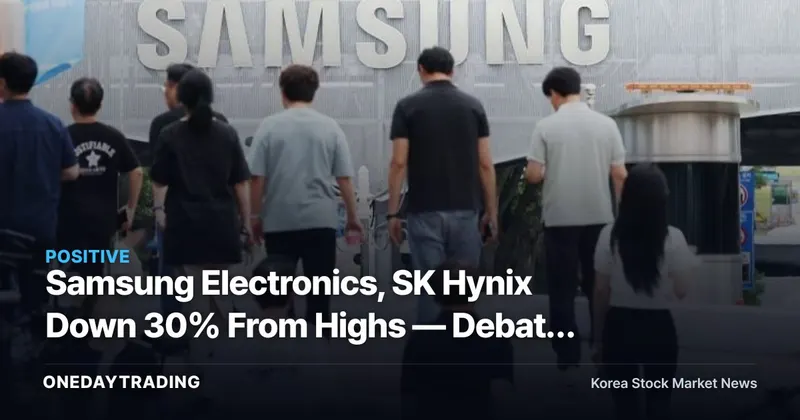
Yoon Jae-ho's Semiconductor Read. The essence of this correction isn't whether the AI memory cycle has turned — it's how much DRAM and HBM profits can absorb concerns over a NAND price slowdown. Samsung Electronics (005930) and SK Hynix (000660) fell 6.48% and 6.67% in a single day, respectively, but the numbers investors should watch are not the stock declines themselves, but commodity DRAM spot prices and the pace of the HBM4 transition.
The rationale behind brokerages maintaining target prices of 600,000 won for Samsung Electronics and 4.2 million won for SK Hynix isn't simply a bet on a rebound. When wafers and process capacity are tied up in HBM production, commodity DRAM supply struggles to loosen — and that constraint is what props up prices.
Why It Matters Now
Samsung Electronics closed at 252,500 won and SK Hynix at 1,791,000 won the previous day. Mirae Asset Securities noted that with semiconductor sector share prices down roughly 30% from their peak on the 20th of last month, much of the potential NAND price decline expected by the end of next year has already been priced in. What the market is really pricing here isn't the substance of the negative catalyst, but its speed. NAND could shift into oversupply in the second half of 2027, but DRAM is a different story given the volume AI servers are absorbing.
The NAND supply-demand outlook is clearly a burden. Forecasts showing a shift from a 10.8% supply shortage in the first quarter of this year to a 1.1% oversupply in the third quarter of 2027 and a 12.2% oversupply in the fourth quarter are more sensitive for Samsung Electronics. Within its memory business, Samsung has heavier NAND exposure, so a decline in NAND ASP (average selling price) would slow the pace of earnings improvement. That said, if share prices have already priced in that warning, the next variable to watch is DRAM margins, not NAND.
HBM isn't a product where simply ramping up output settles the matter. Getting from 1c DRAM-based HBM4 to mass production of HBM4E in the first half of 2028 requires advanced process technology, packaging, and customer qualification to all align simultaneously. Expanding HBM production increases high-value-added output while eating into commodity DRAM capacity — and this same supply constraint is behind the more-than-40-trading-day rally in DDR5 spot prices. Even amid debate over AI capex, infrastructure orders from Google, Amazon, and Meta remain a pillar supporting the floor under memory makers' earnings.
FAQ
- Is this decline a sign of industry collapse? Not yet — it looks more like a valuation correction mixing concerns over a NAND peak-out with pressure from interest rates and oil prices. There isn't sufficient evidence that DRAM prices and HBM demand have turned down simultaneously.
- Why should investors focus on DRAM rather than NAND? NAND has a possibility of shifting into oversupply, but DRAM's commodity supply stays constrained as capacity shifts toward HBM. Pricing power remains with DRAM.
- How do the key variables differ between Samsung Electronics and SK Hynix? For Samsung Electronics, HBM customer qualification and easing NAND pressure are the key issues. For SK Hynix, the key questions are whether its first-mover advantage in HBM holds and whether it can expand volume without eroding margins.
- Are the "600,000-won Samsung" and "4.2 million-won SK Hynix" targets a done deal? No. These target prices are conditional scenarios — they hold only if DRAM price gains, HBM4 yields, and Big Tech capex continue.
Related Stocks and Sector Impact
- Samsung Electronics (005930) Has direct exposure to NAND slowdown concerns, but a recovery in its valuation multiple hinges on its position within the Google AI ecosystem and expectations for HBM4 entry.
- SK Hynix (000660) Its HBM supply lead and strong DRAM pricing are likely to translate into earnings leverage. However, with expectations already elevated, it's more sensitive to any yield setbacks.
- Semiconductor equipment As the transition to HBM4 and 1c DRAM continues, demand for deposition, etching, and inspection equipment should follow. Confirming actual beneficiaries requires checking customers' capex schedules.
- Semiconductor materials The shift to advanced process nodes can lift both unit prices and usage volumes of materials. However, the extent of the benefit is limited if memory makers scale back NAND investment.
Points to Watch for Investors
- First, the NAND oversupply outlook isn't a variable to ignore. If the projected 12.2% oversupply rate for the fourth quarter of 2027 materializes, expectations for Samsung Electronics' memory earnings will need to come down.
- Second, HBM is a yield-driven business. If the ramp-up of 6th-generation HBM4 production is delayed, costs could rise before revenue does.
- Third, foreign investors' supply-demand (order flow) is sensitive to interest rates and the exchange rate. Even with solid semiconductor fundamentals, valuation multiples get compressed during periods of rising global interest rates.
- Fourth, if a slowdown in Big Tech AI capex is confirmed, the current DRAM pricing thesis weakens. Next quarter's order volumes and inventory commentary will be key to watch.
Overall Outlook
The bullish scenario is clear: NAND concerns get priced in first, while rising DDR5 prices and the HBM4 transition drive 2027 earnings estimates back up. In this scenario, an expanding HBM customer base would support Samsung Electronics' share price recovery, while sustaining high-margin HBM volumes would do the same for SK Hynix.
The bearish scenario's triggers are equally clear: NAND oversupply arriving sooner than expected, AI server customers turning more conservative with orders, and delays in HBM4 yield improvement. What matters now isn't rhetoric but numbers. At the next earnings release, DRAM ASP, HBM's share of revenue, NAND inventory days, and 2027 capex guidance will determine whether this correction was a buying opportunity or a cycle warning.
Samsung Electronics (005930): Real-Time Data Snapshot
Samsung Electronics's most recent closing price was 249,500 won (-7.59% day-over-day), and the composite signal — combining foreign/institutional supply-demand (order flow) with news and momentum — reads 🔴 Caution. With foreign investor, institutional, and momentum signals all negative, caution is warranted right now.
- ▼ Dual selling — Foreign investors sold −868.0 billion won and institutional investors sold −858.8 billion won in tandem
- ▼ Trend alignment — Short- and medium-term downtrend aligned (1-day -7.6% · 1-week -2.2% · 1-month -26.7%)
- ▲ News flow — 13 positive catalysts vs. 4 negative catalysts — positive catalysts dominate
Recent related news skews favorable, with 13 positive catalysts versus 4 negative catalysts.
※ Price and foreign/institutional supply-demand (order flow) data are provided by Korea Investment & Securities (KIS) and reflect the time of publication.
This article was automatically summarized and analyzed based on the original news report. View Original (Maeil Business Newspaper - Securities)