
3-Line Briefing
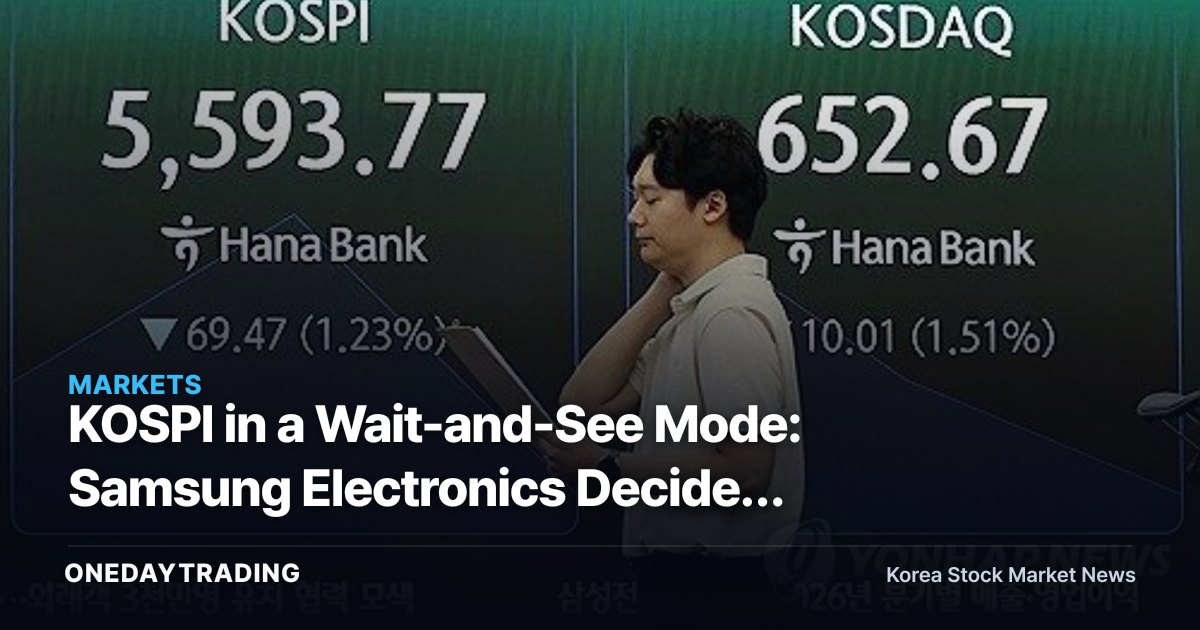
- The KOSPI alternated between gains and losses on the 30th. Volatility rose before direction became clear.
- The key is Samsung Electronics (005930). As one of the KOSPI's twin-top stocks, its moves represent risk appetite for the index as a whole.
- Investors should watch foreign investor flows, the relative strength of large-cap semiconductor stocks, and the exchange rate — not just the index level.
What's Changing
The KOSPI isn't simply oscillating — the market is re-pricing. The fact that gains and losses alternated intraday on the 30th isn't just noise within a flat range. It means the expectations concentrated in large-cap semiconductor stocks are now being put to the test against earnings, interest rates, and the exchange rate.
In a bull market, the same news pushes multiples higher. In a wait-and-see market, it works differently. Investors buy stocks (tickers) whose earnings are set to improve while simultaneously calculating how much of that expectation is already priced in. This is why Samsung Electronics is cited as one of the KOSPI's twin-top stocks. The rise and fall of this single stock (ticker) is read as a signal of foreign investors adjusting their Korean equity weighting — well beyond the electronics industry sector alone.
In this phase, interest rates form the floor for valuation. When market rates stabilize, the discount rate applied to future earnings falls, and multiples for semiconductor and growth stocks hold up. Conversely, when dollar strength and a renewed rise in rates coincide, foreign investors weigh the risk of currency losses ahead of earnings outlooks. Ultimately, the KOSPI's swings trace a path from interest rates to multiples, and from multiples down to supply-demand (order flow) in bellwether stocks (tickers) like Samsung Electronics and SK Hynix.
Reading the Numbers in Context
The concrete figures confirmed in this report are the trading day of the 30th and Samsung Electronics (005930) as the subject. The fewer the data points, the stricter the interpretation must be. The mere fact that the index moved up and down doesn't in itself signal a trend reversal. That said, an intraday move that experienced both gains and losses signals that buyers and sellers clashed at the same price levels.
What matters is the nature of the KOSPI's twin tops. Samsung Electronics and SK Hynix are effectively the axis driving earnings estimates for the Korean stock market. When both stocks (tickers) rise together, an index rally is framed as an earnings-driven rally. If only one holds up, or if both falter, the market reads it not as sector rotation but as profit-taking. Right now, that latter possibility must be kept in mind as well.
Stocks (Tickers) to Watch: Winners and Losers
- Samsung Electronics Directly cited as one of the KOSPI's twin-top stocks. Its greater significance lies in serving as a barometer for foreign spot-market supply-demand (order flow) rather than for index direction itself.
- SK Hynix Forms the other pillar of large-cap semiconductor stocks alongside Samsung Electronics. As long as AI memory expectations hold, supply-demand (order flow) should stay resilient, but volatility could increase further during a profit-taking phase.
- KB Financial Group If expectations for rate cuts are delayed, financial stocks (tickers) could stand out relatively as an alternative to the multiple pressure facing growth stocks.
- Hyundai Motor A continued weak won provides a defensive rationale for exporter stocks (tickers). However, if broader risk aversion across the index intensifies, the benefit from the exchange rate would also be diluted.
Risk Check
- First, if supply-demand (order flow) weakens simultaneously for both Samsung Electronics and SK Hynix, the KOSPI's volatility would spread into a risk for the index as a whole.
- Second, if the pullback in interest rates is delayed, the already-elevated multiples of growth stocks would come under renewed pressure.
- Third, if the won-dollar exchange rate spikes upward, foreign investors may weigh currency losses ahead of earnings.
- Fourth, an intraday swing alone shouldn't be taken as confirmation of a bottom. The closing price, trading value, and whether foreign net buying continues must all be confirmed together.
Bottom Line
The KOSPI's wait-and-see stance looks more like a price-verification process than a bearish signal. That said, if Samsung Electronics and SK Hynix fail to defend the index's multiple, the next checkpoint will be the exchange rate and the continuity of foreign net buying.
Samsung Electronics: Real-Time Data Snapshot
The latest closing price for Samsung Electronics is 209,750 won (+0.60% vs. the previous day), and the composite signal combining foreign/institutional investor flows with news and momentum is 🟡 Neutral / Wait-and-See. With positive and negative signals mixed, this is a phase to watch closely.
- ▼ Flow continuity — Foreign investors net sold for a 4th straight day (−724.3 billion won)
Recent related news is mixed, with 11 positive catalysts and 11 negative catalysts.
※ Price and foreign/institutional investor flow data are provided by Korea Investment & Securities (KIS) and are as of the time of publication.
This article is automatically summarized and analyzed content based on the original news report. View original (Yonhap News Agency – Securities)