
What a Daily Savings of 170,000 Tons Means for Investors
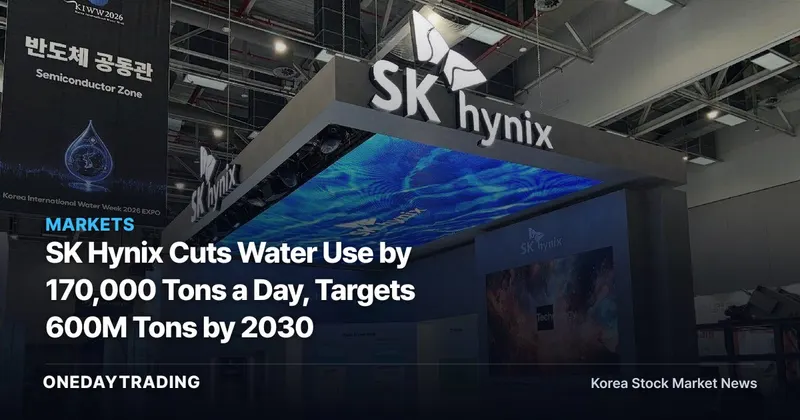
SK Hynix cut water use at its domestic plants by an average of 170,000 tons per day last year. According to Maeil Business Newspaper's corporate desk, that volume is roughly equivalent to the daily water consumption of about 550,000 people. The key point of the announcement is that reducing and reusing water — an essential resource for semiconductor manufacturing — has become a core part of how the company runs its production facilities. Still, it is difficult to determine from the disclosed materials alone whether these savings translate directly into higher profit.
On the 10th, the company presented its achievements and plans at International Water Week Korea 2026, held at EXCO in Daegu from the previous day through the 11th. About 50 countries and 80 companies and institutions are taking part in this year's event. Investors should look past the scale of the event itself and focus separately on SK Hynix's cumulative results and future facility-operation metrics.
Cumulative Savings Surpass the Original Target
According to Maeil Business Newspaper's corporate desk, SK Hynix's cumulative water savings through last year totaled 303.37 million tons, exceeding the company's own target of 264 million tons for the same period. This year's target is 329 million tons cumulative, and the company also unveiled a long-term goal of saving 600 million tons by 2030.
To manage this goal, the company has run a water and wastewater reduction task force since 2018. It is confirmed that the task force is responsible for cutting water use in manufacturing processes and reusing treated water, but the materials do not disclose a year-by-year implementation plan or investment amount. Assessing the pace toward the target will require confirming that future disclosures continue to report cumulative figures on the same basis.
How Expanded Water Reuse Has Shaped Actual Operations
Maeil Business Newspaper's corporate desk reported that water reuse volume rose about 54%, from 47.88 million tons in 2022 to 73.59 million tons last year. The Icheon plant's wastewater reuse facility produces 94,400 tons of reused water per day, which is supplied to air-pollution prevention facilities and other equipment. This is an example of expanding the scope of reuse by treating used water and then feeding it into non-process equipment.
The Cheongju plant introduced reused water from an external sewage treatment facility in 2023. The company said it manages the entire process — intake, use, reuse and discharge — and applies ozone oxidation units, activated carbon, and multi-stage coagulation and sedimentation systems to wastewater treatment. Because it is not disclosed whether these facilities reduce production disruptions or how they change treatment costs, environmental performance should not be read as equivalent to a profit-and-loss effect.
Limited Impact on SK Hynix's Share Price
- SK Hynix: Reduced water use and expanded reuse are non-financial indicators of the company's resource-management capability at its production facilities. However, the investment amount for water management, the resulting cost savings, and water intake by plant are not disclosed, so there is insufficient basis to recalculate operating profit or valuation.
- Semiconductor sector: The broader trend of expanding water recycling in large-scale manufacturing processes raises the importance of environmental data disclosure. However, this material contains no figures from other companies or industry averages, so relative competitive advantage cannot be calculated.
The more direct drivers of the share price are earnings-related metrics such as memory shipments, customer orders, and yield rather than water savings. For water-resource performance to factor into investment decisions, environmental indicators would need to be disclosed alongside production stability or cost-structure data.
Metrics Investors Should Watch Next
- Whether the next earnings release presents plant-by-plant intake, use, and reuse figures — and cumulative savings — on the same measurement basis.
- Whether the company hits this year's cumulative target of 329 million tons, and whether a year-by-year plan toward the 2030 goal of 600 million tons is disclosed.
- How the Icheon plant's daily supply of 94,400 tons of reused water expands to other facilities and uses, checked alongside production-operation metrics.
- Whether the Cheongju plant's adoption of externally treated reused water expands to other sites, and the related investment amount.
Durability and Limits of the Results
The optimistic scenario is one where continued growth in reuse volume and process improvements let the company build up its cumulative savings target as planned. Greater operational resilience to fluctuations in water supply would also help with environmental risk management at production facilities. An SK Hynix official said the company will upgrade its management system to reduce water use and reuse as much used water as possible.
Conversely, if expanded investment in reuse facilities does not translate into cost savings or improved utilization rates, the case for a share-price re-rating weakens. With the savings-calculation methodology and total water use by plant still unconfirmed, it is premature to raise earnings expectations based on environmental performance alone. Whether future disclosures maintain consistent figures and link them to profit-and-loss information will be the deciding factor.
Frequently Asked Questions
How much water did SK Hynix save per day last year?
According to Maeil Business Newspaper's corporate desk, SK Hynix reduced water use at its domestic plants by an average of 170,000 tons per day last year — a volume described as equivalent to the daily household water consumption of about 550,000 people.
What is SK Hynix's 2030 water-savings target?
At International Water Week Korea 2026, SK Hynix announced a goal of saving a cumulative 600 million tons of water by 2030. Cumulative savings through last year reached 303.37 million tons, surpassing the company's own target of 264 million tons for that period.
How do the Icheon and Cheongju plants reuse water?
The Icheon plant's wastewater reuse facility produces 94,400 tons of reused water per day, supplying it to air-pollution prevention facilities and other equipment. The Cheongju plant introduced reused water from an external sewage treatment facility in 2023 and now reuses the treated water as industrial water.
SK Hynix Key MetricsAs of 2026-09-10
| Period Return | 1W +14.04% 1M +27.72% |
|---|---|
| Trading Value · Trading Volume | ₩1.8469 trillion · 996,436 shares |
| Supply-Demand (Order Flow) | Foreign Investors +₩81.4B net buying (4 straight days) Institutional Investors +₩139.2B net buying |
| Recent News Tone | Positive catalysts: 4 · Negative catalysts: 0 |
Price and order-flow data are real-time figures from Korea Investment & Securities (KIS); order-flow and news-tone aggregates are calculated independently by OneDayTrading.
Supply-Demand & Momentum Signal🟢 Buy-Side Bias
Positive signals are showing up across foreign investor, institutional investor, and news indicators.
- ▲Order-Flow ContinuityForeign investors net-bought for 4 straight days (+₩81.4B)
- ▲Dual BuyingForeign investors +₩81.4B and institutional investors +₩139.2B buying together
- ▲News FlowPositive catalysts 4 vs. negative catalysts 0 — positive catalysts dominate
Upcoming Events to Watch
- 09.10Futures & Options Simultaneous ExpirationMediumQuadruple witching — watch for volatility and order-flow disruption
- 09.16FOMC Policy Rate DecisionHighUS Federal Reserve monetary policy announcement — direction for rates and the dollar
- 10.08Index Options ExpirationLowKOSPI200 options expiration
- 10.22Bank of Korea Monetary Policy Board MeetingHighBenchmark interest rate decision meeting
This article was automatically summarized and analyzed based on the original news report. View original (Maeil Business Newspaper)