
Key Takeaways
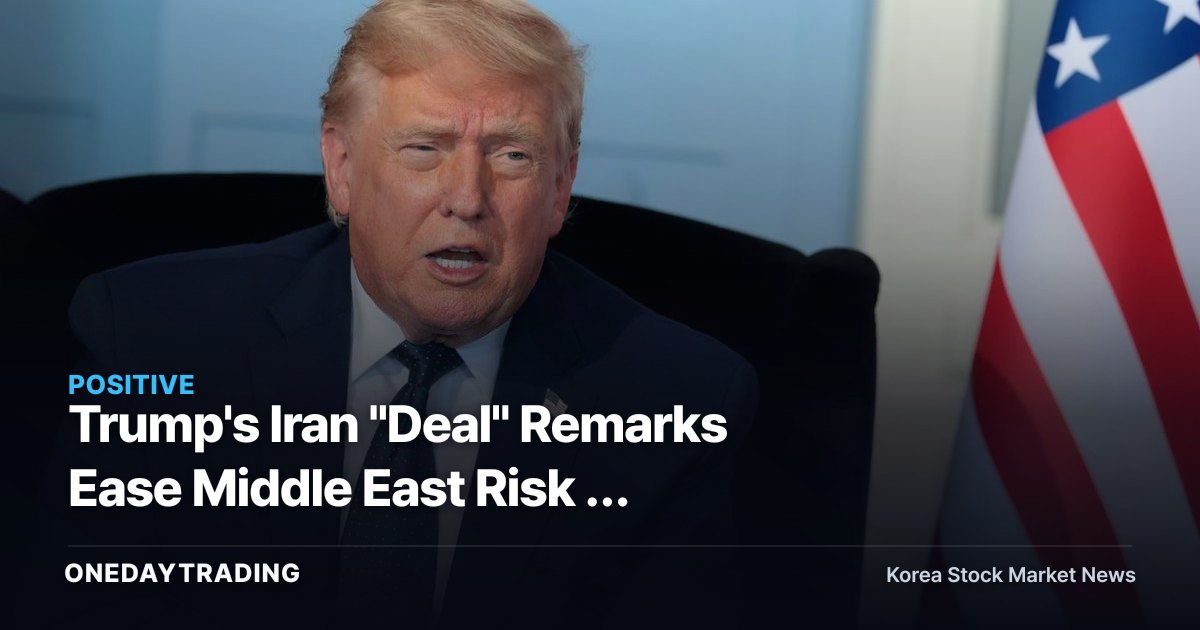
U.S. President Trump characterized the agreement with Iran as an unconditional surrender, saying it was a negotiation aimed at preventing the conflict from triggering a global recession. The crux is the signal that the scenario of an escalating armed conflict in the Middle East has stepped back a notch. In that case, part of the geopolitical risk premium embedded in oil prices unwinds, sending the profit-and-loss direction of Korea's refining, airline, and defense sectors in diverging ways.
What Happened
In an interview with Axios, President Trump described the agreement surrounding Iran as an unconditional surrender and made remarks to the effect that there are no limits to his authority. He cited blocking the risk of an intensifying conflict dragging the global economy into recession as the rationale for this negotiation.
What the market is focused on in these remarks is not the political rhetoric but the implications for the energy supply chain. The Middle East is a critical artery for global crude oil and seaborne cargo, and whenever extreme scenarios such as a blockade of the Strait of Hormuz or strikes on oil production facilities have been floated, a fear premium has been layered onto oil prices. As escalation fears ease, prices tend to move toward unwinding that premium.
Background and Context
Korea relies entirely on imports for its crude oil, making it sensitive to Middle East variables. Oil prices have a cascading effect on refiners' refining margins and inventory valuation gains and losses, on fuel costs for airlines and shipping companies, and—through import prices—on consumer inflation and the exchange rate. As a result, the same piece of news can be a remedy for one industry sector and a poison for another.
Impact on the Market and Individual Stocks
- Refiners (S-Oil, SK Innovation, GS): Falling oil prices are, in the short term, a source of valuation losses on crude inventory held. If refining margins weaken in tandem, earnings momentum could slow, so the directional tilt leans toward a headwind.
- Airlines (Korean Air, Asiana): Fuel costs are a major pillar of operating expenses. A downward stabilization in oil prices eases the cost burden, while reduced geopolitical uncertainty also works favorably for passenger demand sentiment.
- Defense (Hanwha Aerospace, LIG Nex1): An easing of short-term tensions is a momentum-weakening factor, but the variable is that the structural trends of Middle East reconstruction demand and global military buildup will not be reversed by a single agreement.
- Large-cap exporters (Samsung Electronics, Hyundai Motor): Falling oil prices and a recovery in risk appetite lower inflation and interest-rate burdens, creating a favorable environment for export stocks. That said, the effect could be offset depending on the direction of the exchange rate.
Investor Checkpoints
- Substance and durability of the agreement: Check follow-up diplomatic reporting on whether this is merely at the remarks stage or is followed by verifiable documents and an implementation timeline.
- Oil price levels: Watch how far Brent and WTI reflect the unwinding of the risk premium and whether they settle without a rebound.
- Refiners' quarterly earnings: Examine how inventory valuation gains/losses and refining-margin trends register in the next earnings release.
- Exchange rate and foreign investor order flow: Gauge the authenticity of the risk-appetite recovery through the won-dollar exchange rate and the trend in foreign net buying on the KOSPI.
Outlook
If the de-escalation leads to actual implementation, the two pillars of oil-price stability and a recovery in risk appetite have room to work favorably for export and airline stocks. Conversely, if the agreement ends up as a mere political declaration or cracks emerge during implementation, oil prices could swing again, and refiners could see heightened volatility caught between inventory gains/losses and margins. Rather than betting on a single remark, a reasonable approach is to verify follow-up implementation and whether oil prices settle, step by step.
This article is content automatically summarized and analyzed based on the original news report. View original (CNBC)