
Summary
Microsoft's earnings surprise is more than just a rebound story for U.S. Big Tech. The more important signal for Korean investors is that cloud and AI infrastructure spending is still translating into semiconductor orders.
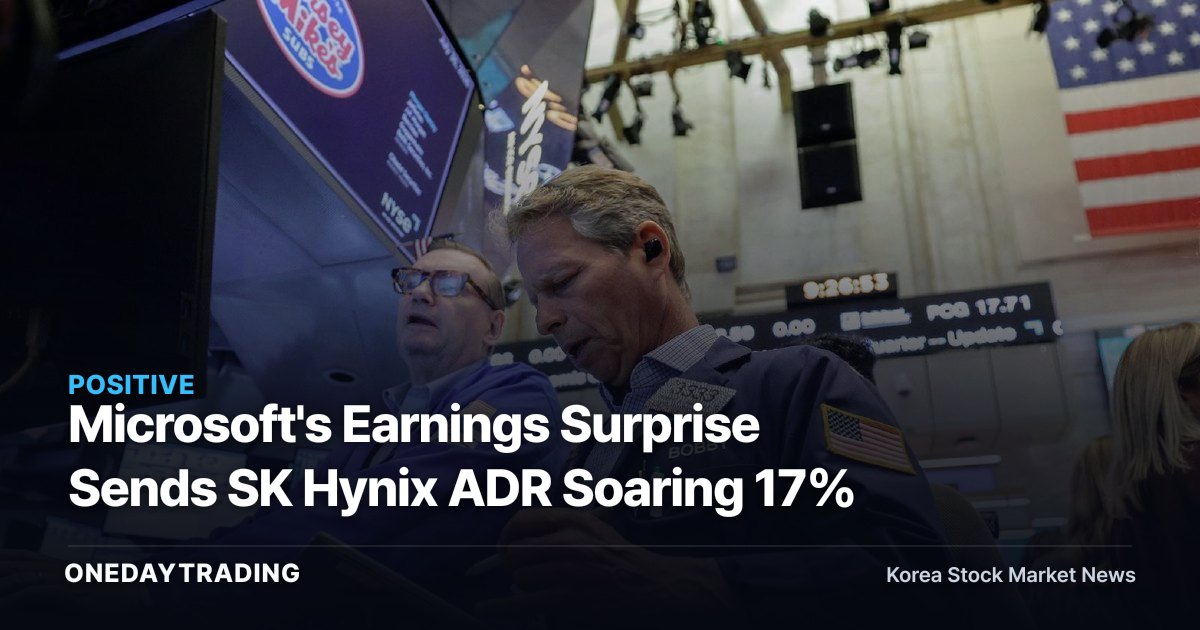
On Wall Street, the Nasdaq rose 2.8% and the semiconductor sector saw an 8% sharp gain. SK Hynix's ADR soaring 17% shows that the market read these earnings as reconfirmation of demand for AI server memory — HBM in particular.
What Happened
This rally's starting point was Microsoft's earnings. Big Tech earnings are usually viewed through the lens of software revenue, but the market is now looking past cloud revenue to the capex, GPU, and HBM orders that follow it. Selling more AI services requires expanding data centers, and expanding data centers means buying more high-performance chips.
So the reaction wasn't confined to Microsoft's stock price alone. An even stronger number than the Nasdaq's 2.8% gain was the semiconductor sector's 8% surge — the supply chain moved harder than the index itself that day. In particular, SK Hynix (000660)'s 17% ADR gain looks less like a reflection of the broader memory market and more a reflection of AI memory's outsized earnings sensitivity.
What the market bought wasn't a single line item on an earnings report. Microsoft's strong results eased concerns about slowing AI investment, and as a result, a premium has been attached to the sustainability of semiconductor orders. That premium could migrate into the domestic market — into SK Hynix, Samsung Electronics (005930), and the broader HBM equipment and materials value chain.
Structural Backdrop
The AI supply chain runs downstream from software to cloud, data centers, accelerators, and HBM. Microsoft beating earnings expectations signals that end demand hasn't cooled yet. As long as end demand holds up, cloud providers will find it hard to delay server investment, and as long as server investment continues, the bottlenecks in high-bandwidth memory and advanced packaging won't ease easily.
Still, narrative and numbers need to be kept separate. The semiconductor sector's 8% surge and SK Hynix ADR's 17% gain are price reactions that have already pulled forward a considerable amount of expectations. What's needed at the next stage isn't excitement but shipment volumes, yield rates, and the durability of customer orders. For HBM, it's deliverable volume — not price — that ultimately determines earnings.
Stock and Sector Impact
- Microsoft: Its strong earnings were interpreted as evidence that AI services and cloud investment will continue. As long as server investment holds, revenue visibility improves across the semiconductor supply chain.
- SK Hynix: The 17% ADR surge illustrates the premium attached to HBM leaders. The longer AI server demand persists, the more earnings contribution shifts toward high-value-added products rather than commodity memory.
- Samsung Electronics: It should benefit from the warmth of the broader semiconductor rally. That said, the market is likely to scrutinize HBM competitiveness and the pace of customer qualification more strictly than a simple memory-market recovery narrative.
- Semiconductor equipment and materials: The more HBM capacity expansion becomes concrete, the greater the order expectations for packaging, inspection, and materials suppliers. However, if share prices move first and actual orders lag, volatility will increase.
Bullish vs. Bearish Scenarios
The bullish scenario is clear: Microsoft's earnings knock down the narrative of slowing AI demand, cloud providers' capex continues, and an HBM supply shortage supports both price and margins simultaneously. In this case, Korea's leading semiconductor stocks could be reassessed with upward earnings-estimate revisions, not just a short-term bounce.
The bearish scenario emerges from the same setup. A single day's reaction — Nasdaq up 2.8%, semiconductors up 8%, SK Hynix ADR up 17% — represents expectations pulled forward quickly. If the pace of AI investment or semiconductor orders fails to keep up with market expectations at the next earnings report, share prices could stall even on good news. Valuations that move ahead of earnings tend to see sharper pullbacks.
Investor Action Points
- At Microsoft's next earnings report, check both cloud growth and whether AI-related investment is continuing.
- For SK Hynix, the key variables are rising HBM shipments, sustained customer orders, and the shifting mix toward high-value-added products. Also watch whether the ADR surge feeds through into supply-demand (order flow) for the locally listed shares.
- For Samsung Electronics, look for signs of recovering HBM competitiveness and clues on customer qualification progress. A sector-wide rally alone doesn't complete a change in market leadership.
- In the domestic market, use trading value to check whether strength in large-cap semiconductor stocks is lifting supply-demand (order flow) across the whole KOSPI, or is limited to rotation within the AI value chain.
This article was automatically summarized and analyzed based on the original news report. Read original (Maeil Business Newspaper)