
Summary
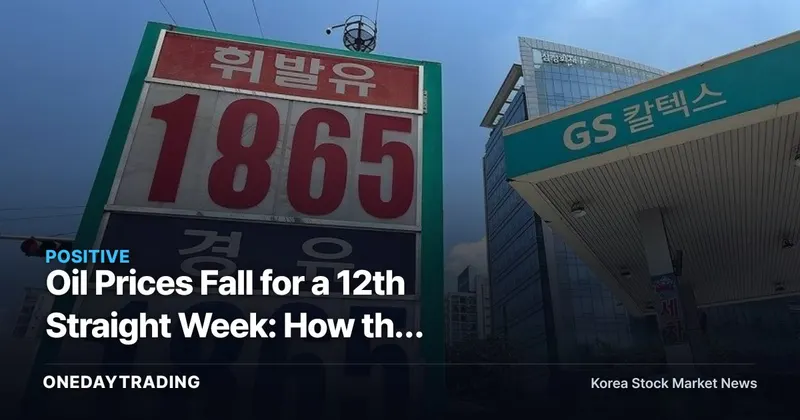
It's not that oil prices have fallen on their own — rather, the market has stripped out part of the Middle East risk premium. According to Opinet, domestic gasoline prices have declined for 12 consecutive weeks, with the average price per liter dropping into the 1,800-won range.
This figure really tells us two things. Refiners are seeing weaker expectations for inventory valuation gains, while airline and transport stocks have entered a phase of easing cost burdens.
Background
According to Opinet, the oil price information system run by the Korea National Oil Corporation, domestic gasoline prices fell again as of the 8th. The decline has now stretched to 12 weeks. The average price per liter that consumers feel is in the 1,800-won range.
The immediate driver is hope that the United States and Iran could negotiate over passage through the Strait of Hormuz. The Strait of Hormuz is a bottleneck for crude oil shipments. When the market judges that military tension along this route is easing, the risk premium attached to crude oil prices is the first thing to come out.
Domestic gasoline and diesel prices move through a combination of international crude prices, the exchange rate, refining margins, and the tax structure. This decline looks less like a signal that demand has suddenly collapsed and more like a price adjustment reflecting a lower probability of supply disruption. Investors should therefore look at consumer inflation and industry sector earnings separately.
Structural Background
Falling oil prices also open a path for interest rates. When energy prices decline, inflation pressure eases. Lower inflation raises the market's odds of a rate cut, and falling rates push up equity valuation multiples. However, this link is conditional. If the won-dollar exchange rate rises again, the decline in imported crude prices will be reflected less in domestic consumer prices.
The refining industry's profit and loss isn't simply a function of whether oil prices are high or low. There's a time lag between buying crude and selling the finished product. When oil prices fall, valuation gains on inventory holdings can shrink or turn into losses. Airlines and logistics, by contrast, carry a large fuel-cost weighting, so the same price decline registers as margin improvement.
Impact on Stocks (Tickers) and Industry Sectors
- S-Oil: A decline in international crude prices weighs on revenue per unit and inventory valuation. However, if refining margins hold up, the impact on the share price could be limited.
- SK Innovation: Its refining segment is sensitive to falling oil prices. But since it also runs non-refining businesses such as batteries, oil prices alone can't determine the stock's direction.
- GS: Both oil prices and refining margins affect its refining subsidiary's earnings simultaneously. Dividend expectations may hold up, but short-term earnings momentum could slow.
- Korean Air: Easing jet fuel costs feed through to lower operating expenses. The effect is more pronounced when passenger demand holds steady.
- CJ Logistics: Falling diesel prices lower the cost of ground logistics. However, if freight-rate competition is intense, the cost savings won't fully flow through to profit.
Bullish vs. Bearish Scenarios
The bullish scenario is straightforward. If Strait of Hormuz tensions ease further and international crude prices stabilize, the decline in domestic fuel prices will positively affect consumer sentiment and inflation readings. If rate-cut expectations revive, valuation multiples for airline, transport, and consumer stocks are likely to react first.
The bearish scenario plays out if negotiation hopes fall apart. If Strait of Hormuz risk reignites, crude prices will once again carry a risk premium. If the exchange rate rises on top of that, domestic fuel prices could quickly reverse. Refiner stocks might show some resilience on the inventory-valuation side in that case, but it would weigh on inflation and interest rates.
Investor Action Points
- Watch Opinet's weekly price data to see whether the decline in gasoline and diesel prices continues past the 12th week.
- Track the won-dollar exchange rate alongside international crude prices. A rising exchange rate dilutes the effect of falling domestic prices.
- For refiner stocks, look beyond the direction of oil prices and separate refining margins from inventory valuation gains/losses in the next earnings report.
- For airline and transport stocks, check whether fuel-cost savings are absorbed by lower freight rates/fares or retained as operating margin.
The next trigger is the exchange rate, more than international crude prices. If the won-dollar rate jumps again, the relief effect of 1,800-won-range fuel prices will be short-lived. How much the Monetary Policy Board and inflation data acknowledge this price decline will change the order of sector-leading stocks.
Korean Air: A Look at the Real-Time Data
Korean Air's most recent closing price is 27,150 won (-1.27% from the previous day), and the signal light combining foreign/institutional investor supply-demand (order flow) with news and momentum reads 🟡 Neutral / Wait-and-see. With positive and negative signals mixed, this is a stock (ticker) to watch.
- ▲ Supply-Demand Continuity — Foreign investors have been net buyers for 3 consecutive days (+1.9 billion won)
Recent related news shows 1 positive catalyst and 0 negative catalysts, a favorable mix.
※ Price and foreign/institutional investor supply-demand (order flow) data are provided by Korea Investment & Securities (KIS) and are current as of publication.
This article is automatically summarized and analyzed based on the original news report. View Original (Maeil Business Newspaper)