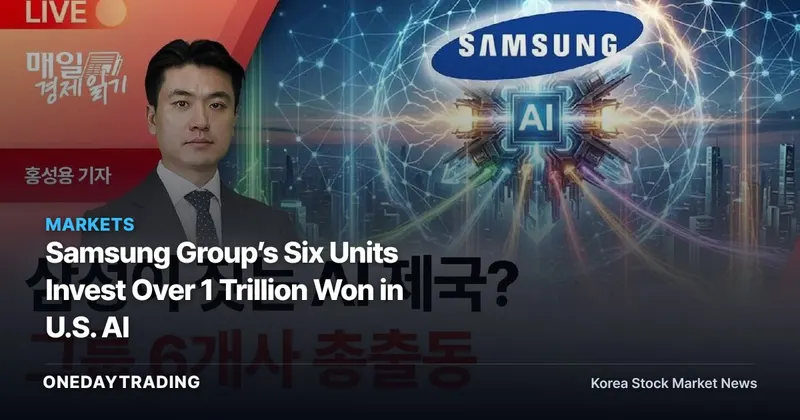

Samsung Group’s U.S. AI infrastructure investment should be viewed as a group-wide capital allocation decision rather than an expansion by a single affiliate. According to information released by Maeil Business Newspaper Securities on September 30, Samsung Group invested more than 1 trillion won in a U.S. AI infrastructure company through six affiliates. For investors, the immediate task is to look beyond the “AI investment” label and determine which affiliates’ valuations and earnings are exposed to the capital committed.
What the Joint Investment by Six Samsung Group Affiliates Means
AI infrastructure refers to the underlying businesses needed to operate artificial intelligence services. In this transaction, six Samsung Group affiliates—including Electronics, C&T, SDS, Life Insurance, and Fire & Marine Insurance—jointly pooled the investment capital. The participation of affiliates with different business profiles makes it difficult to interpret the investment solely as an independent decision by any one company.
Maeil Business Newspaper Securities reported that Samsung Group’s investment exceeds 1 trillion won, with six affiliates participating in the funding. These figures do not indicate the target company’s growth potential; rather, they show the breadth of the group’s capital allocation across multiple legal entities. To translate the deal into the valuations of the relevant listed companies, investors need to know how much each affiliate contributed and what rights each secured.
The investment can affect listed affiliates’ earnings only through their ownership interests and the deal terms. If a particular affiliate contributed more capital, both its investment risk and potential return would increase. Conversely, if its contribution was small or its direct rights were limited, the economic impact on that company could differ substantially from the headline impression of a “joint group investment.”
Why the Over 1 Trillion Won Investment Cannot Yet Be Quantified by Stock (Ticker)
What has been disclosed so far is limited to the fact that the target is a U.S. AI infrastructure company and that Samsung Group invested more than 1 trillion won. The target company’s name, the exact investment amount, the full names of all six participating affiliates, each company’s contribution and ownership stake, and the specific contract terms have not been provided. Without this information being disclosed together, it is impossible to rank which affiliates face the greatest direct benefits or burdens.
In particular, the inclusion of Electronics and SDS alone should not be taken as confirmation of product supply agreements or business partnerships. The available information establishes only that they jointly pooled capital. The participation of C&T, Life Insurance, and Fire & Marine Insurance likewise does not clarify each company’s investment objective or exit structure, leaving no basis for calculating changes in revenue or costs for any individual stock (ticker).
The key to converting the narrative into numbers will be the investment amount and ownership stake acquired by each affiliate. A larger commitment by a particular affiliate would increase that company’s capital exposure, while any operational impact can be assessed separately only if a business relationship with the target is confirmed. At this stage, the market can price in Samsung Group’s commitment to AI infrastructure, but not the specific economic interest attributable to each listed company.
Samsung Group Disclosures Investors Should Watch Next
- Investment target: The U.S. AI infrastructure company’s name must be disclosed before investors can verify the links between its business areas and Samsung Group affiliates.
- Contribution by affiliate: The full names of all six affiliates and their respective investment amounts are needed to determine where the financial impact is concentrated.
- Rights secured: The ownership stakes acquired and contract terms must be confirmed to distinguish a purely financial investment from one accompanied by a separate business relationship.
- Conditions that would enable a clearer assessment: A stock (ticker)-level assessment will become possible once the investment structure is disclosed and each affiliate’s rights and obligations are clarified. If disclosure remains at the current level, there will be limited grounds for pricing in anything beyond the group’s broader strategic direction.
The video was recorded on September 30, 2026 (Wednesday), and the content was made available only to paid subscribers. The next investment judgment will hinge not on the prominence of the term AI, but on disclosures identifying the investment target, each affiliate’s contribution, ownership stakes, and contract terms.
This article was automatically summarized and analyzed from the original news report. View original article (Maeil Business Newspaper Securities)