
Summary
The Chungbuk school meal hygiene inspection is an issue that draws attention to quality-control costs at food distribution and institutional catering companies before any recovery in meal demand.
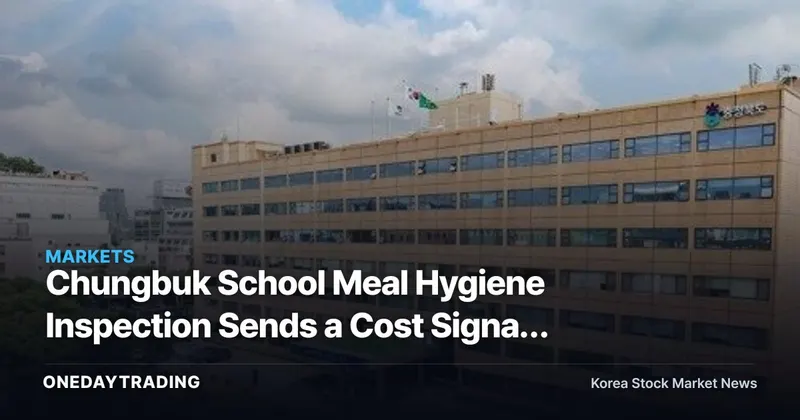
A school meal hygiene inspection is an administrative check that local governments carry out at the start of the school term to review how meal facilities and food-handling businesses near schools manage storage, cooking, and sales. According to Yonhap News Agency's industry coverage, Chungcheongbuk-do (Chungbuk) province will examine hygiene management at school meal facilities and food-handling businesses near schools from August 24 to September 11, 2026.
Details of the Inspection
The investment implications of this inspection extend beyond Chungbuk alone. School meals at the start of the term represent seasonal demand where food-supply deliveries, institutional catering operations, and cold-chain logistics all converge at once. When an administrative inspection comes in, operational quality factors such as inspection procedures, storage temperatures, expiration dates, and kitchen hygiene are evaluated before delivery unit prices.
Chungbuk province will conduct intensive inspections of food-handling sites in and around schools for about three weeks, from August 24 to September 11. The one key figure in the report is the schedule itself. This timeline overlaps with the period when demand resumes right after the start of the second semester. For food companies, this means that just as revenue returns, hygiene risk rises in tandem.
Consider this the way Park Se-ra would. The press release speaks of stronger hygiene management. But the data will show something different — the point where the number of violations found after inspection, the severity of administrative sanctions, and whether meal deliveries are suspended actually flow through to profit and loss. If no violations are found, the impact on share prices is weak. Conversely, if a problem is confirmed in a specific supply chain, damage to trust — more than the scale of revenue — will be priced in first.
Structural Background
Institutional catering is an industry sector where managing incident probability matters more than sheer scale. Once a food-poisoning incident or a substandard-ingredient issue occurs, its effects on contract renewals, new bids, and brand trust linger far longer than any short-term revenue loss. That is why, in the school meal market, large food distributors cannot win on economies of scale alone. Cold-chain logistics, supplier management, and on-site inspection systems are the conditions for defending margins.
Consumer-sector investors need to filter out an optical illusion here. The start of the school term is a positive for meal demand, but hygiene inspections raise both cost and risk at the same time. It also matters that the inspection targets school meal facilities and businesses near schools. Local small and midsize suppliers and small business owners are more likely to be directly affected than large listed companies. Large companies, in fact, stand to gain relative trust when their management systems prove superior.
Stock and Sector Impact
- CJ Freshway: A company that runs both institutional catering and food distribution. If the school meal issue spreads into nationwide tightening of regulations, its inspection and logistics management capabilities could stand out as a competitive edge. That said, the Chungbuk inspection alone is not enough to change earnings estimates.
- Hyundai Green Food: Its strengths are meal-operation experience and a supply-chain management system. As hygiene standards tighten, large operators' relative defensive strength grows, but if on-site staffing and management costs rise, short-term margins come under pressure.
- Samsung Welstory: An unlisted company, but it serves as a benchmark for the institutional catering market. Large caterers' incident-response systems and delivery quality management help raise the bar for the industry sector as a whole.
- Food distribution industry: For companies with a high share of deliveries to schools, violation risk matters more than seasonal revenue. Whether delivery suspensions, client changes, or administrative sanctions follow the inspection translates directly into real costs.
- Food retail near schools: Local snack shops and convenience-style food outlets are direct inspection targets. The impact on listed companies is limited, but consumer trust and the local business environment face short-term pressure.
Bullish vs. Bearish Scenarios
The bullish scenario is one in which the preventive effect, rather than violations, is confirmed. If no major violations emerge after the inspection concludes on September 11, 2026, large catering and food-distribution companies' quality-control systems will be re-rated. In a market where hygiene issues recur, a low incident rate itself is bid competitiveness.
The bearish scenario is one in which a substandard case surfaces in a specific supply chain. Because parents are highly sensitive to school meal issues, the cost of public backlash outweighs administrative sanctions. Even if the revenue share is small, if delivery suspension, contract termination, and disadvantages in re-bidding pile up together, it becomes a valuation-discount factor rather than merely a short-term earnings hit.
Investor Action Points
- Investors should check whether violation cases are disclosed during the Chungbuk inspection period, from August 24 to September 11, 2026.
- After the inspection ends, investors should verify through local government announcements whether administrative sanctions, delivery suspensions, or improvement orders for school meal facilities are issued.
- For CJ Freshway and Hyundai Green Food, next quarter's earnings should be assessed by tracking the cost ratio and SG&A trends alongside institutional catering revenue growth, not revenue growth alone.
- If similar inspections spread to local governments nationwide, the gap will widen — not as a short-lived theme, but between large companies that can afford quality-control investment and small local suppliers that cannot.
Frequently Asked Questions
When is the Chungbuk school meal hygiene inspection taking place?
According to Yonhap News Agency's industry coverage, Chungbuk province's school meal hygiene inspection runs from August 24 to September 11, 2026. The targets are school meal facilities and food-handling businesses near schools.
Why does the school meal hygiene inspection matter for food distribution stocks?
The school meal hygiene inspection draws attention to quality-control costs and incident risk at food distribution stocks, rather than revenue. If a problem emerges in the supply chain, bid credibility and client retention are shaken more severely than any short-term revenue loss.
Is this an immediate positive catalyst for CJ Freshway's share price?
It is hard to view Chungbuk province's inspection as an immediate positive catalyst for CJ Freshway's share price. That said, in an environment of tightening hygiene standards, large food distributors' inspection and logistics management systems could function as a competitive advantage over small and midsize companies.
CJ Freshway: A Real-Time Data Snapshot
CJ Freshway's most recent closing price was 23,350 won (-2.71% versus the previous day), and the sentiment gauge combining foreign investors' and institutional investors' supply-demand (order flow) with news and momentum reads 🟡 Neutral / Wait-and-see. With bullish and bearish signals mixed, this is a range to watch closely.
※ Price and foreign/institutional investor supply-demand (order flow) data are provided by Korea Investment & Securities (KIS) and reflect figures as of publication time.
This article is automatically summarized and analyzed content based on the original news report. View original (Yonhap News Agency, Industry)