
Key Takeaways
The mixed close on Wall Street was driven by two distinct forces: selling pressure in technology stocks and a sharp plunge in international oil prices. Tech-stock weakness weighs on the KOSPI, given its heavy semiconductor weighting, while the oil plunge sends opposite signals — easing cost pressure for airlines but squeezing margins for refiners. For Korean investors, this is a phase to focus on sector-by-sector divergence rather than the overall index direction.
What Happened
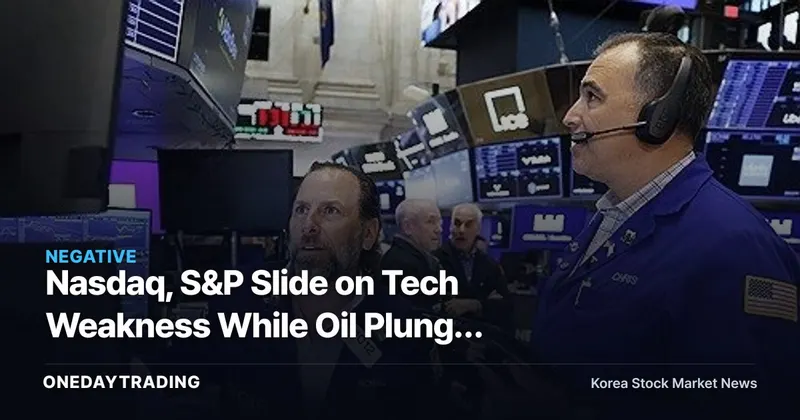
On the 24th (local time), the Nasdaq and S&P 500 fell as tech-led selling pressure weighed on U.S. markets, while the Dow Jones Industrial Average was the lone gainer, buoyed by strength in transportation and consumer-related stocks tied to the sharp drop in international oil prices. The divergence among the indices shows that the market is digesting multiple variables — interest rates, earnings, and commodities — rather than reacting to a single theme.
The tech-stock weakness appears to reflect a combination of profit-taking and valuation scrutiny in large-cap tech names that had rallied sharply on artificial intelligence (AI) expectations. Conversely, the plunge in oil prices eased energy-cost burdens and worked in favor of the transportation and airline sectors, underpinning the Dow's relative strength.
Background and Context
The decoupling between the Nasdaq and the Dow — rather than a synchronized decline — suggests the market has entered a phase of sector rotation rather than moving in a single direction. If capital exiting tech stocks continues flowing into defensive and consumer names, Korean markets could likewise see interest broaden beyond semiconductors into domestic demand, transportation, and consumer goods stocks.
Impact on the Market and Individual Stocks
- Samsung Electronics (005930) and SK Hynix (000660): Weakness in U.S. tech stocks is directly tied to global semiconductor investment sentiment, weighing on foreign investor supply-demand (order flow). However, the key variable is not the memory chip cycle itself but whether these stocks move in sync with the broader tech valuation correction.
- Airline stocks such as Korean Air (003490) and Asiana Airlines (020560): The oil price plunge directly reduces the burden of jet fuel costs, which make up a large share of operating expenses, raising expectations for margin improvement. The longer the decline in oil prices persists, the greater the benefit.
- Refiners such as S-Oil (010950) and SK Innovation (096770): The oil plunge is a near-term negative for refining margins and inventory valuation. If crude price volatility widens further, earnings visibility could weaken.
- Exporters such as Hyundai Motor (005380): If tech-stock weakness spreads into broader risk aversion, exposure to exchange rate and foreign investor supply-demand (order flow) volatility increases. Conversely, the drop in oil prices is somewhat favorable in terms of logistics costs.
Investor Checkpoints
- Check whether the plunge in international oil prices (WTI and Brent) is a temporary correction or a trend reversal by watching where prices settle over the coming days.
- Monitor whether U.S. tech weakness spreads to Korea's semiconductor sector bellwethers by tracking foreign net buying/selling flows and the Philadelphia Semiconductor Index (SOX).
- Watch whether tech-stock valuation concerns resurface around upcoming major earnings releases and U.S. inflation and interest-rate events.
- Track how changes in the won-dollar exchange rate level affect supply-demand (order flow) for exporter stocks.
Outlook
If falling oil prices translate into easing inflation pressure, that could reduce interest-rate burdens and foster a favorable environment for risk assets broadly, in which case the tech-stock correction may prove short-lived. On the other hand, if the tech weakness expands into a fundamental reassessment of AI investment expectations, volatility could rise for the KOSPI given its heavy semiconductor weighting. As oil prices and tech stocks pull the market in different directions for the time being, it is reasonable to focus on sector differentiation rather than the overall index.
Samsung Electronics (005930): Real-Time Data Snapshot
Samsung Electronics (005930)'s most recent closing price was KRW 340,500 (0.00% vs. previous day), and the composite signal — combining foreign/institutional investor supply-demand (order flow) with news and momentum — reads 🟡 Neutral / Wait-and-See. With positive and negative signals mixed, this is a segment worth watching closely.
- ▼ Supply-Demand Continuity — Foreign investors have posted net selling for 4 consecutive days (−KRW 181.9 billion)
- ▲ 52-Week Range Position — 89% of the 52-week range — in record-high territory
Recent related news comprises 23 positive-catalyst items versus 20 negative-catalyst items, a favorable skew.
※ Price and foreign/institutional investor supply-demand (order flow) data are provided by Korea Investment & Securities (KIS) and are current as of the time of publication.
This article is automatically summarized and analyzed content based on the original news report. View Original Article (Yonhap News, Securities)