Summary
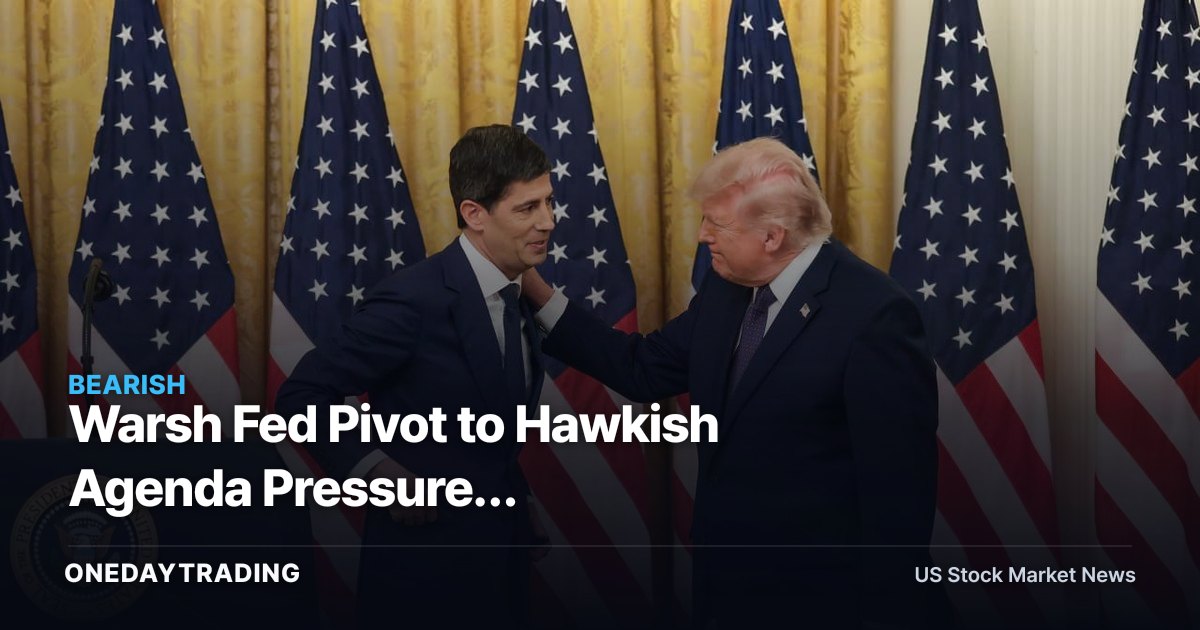
President Trump installed Kevin Warsh at the Federal Reserve expecting aggressive rate cuts, but the incoming chair is publicly steering toward a hawkish, inflation-first agenda instead. For investors, the takeaway is a potential repricing of the entire rate path: less easing than the market and the White House assumed, with direct consequences for borrowing-cost-sensitive equities and Treasury yields.
The Full Story
The friction here is between political expectation and central-bank framing. Warsh was widely read as a dovish appointment in spirit — a Fed leader who would deliver the cheaper money the administration wants. His own messaging points the other way, emphasizing credibility and price stability over rapid accommodation.
That gap matters because markets had partly priced a faster easing cycle into valuations. If the Fed under Warsh prioritizes anchoring inflation expectations rather than cutting on demand, the front end of the rate path gets repriced higher, and the discount rate applied to long-duration equity cash flows stays elevated for longer.
The political dimension adds a second layer: a chair who openly diverges from the person who appointed him signals a defense of Fed independence, which can itself steady longer-term inflation expectations even as it frustrates near-term cut hopes.
Structural Background
Rate expectations are a primary input for equity valuations. A hawkish hold compresses the multiples investors will pay for future growth, while supporting net interest margins at lenders. Currency and credit channels reinforce this: a firmer policy stance tends to support the dollar and tighten financial conditions at the margin.
Stock & Sector Ripple
- Banks (JPM, BAC): A higher-for-longer rate plateau supports net interest income and steepens the reinvestment yield on loan books, a direct earnings tailwind.
- Megacap and growth tech (NVDA, AAPL): Long-duration cash flows are most sensitive to the discount rate; fewer cuts pressure valuation multiples even if fundamentals hold.
- Small caps (IWM): Floating-rate and refinancing-heavy balance sheets make smaller firms acutely exposed to a delayed easing cycle.
- Rate-sensitive yield plays: Utilities and REITs compete with higher Treasury yields for income-seeking capital, capping relative appeal.
Bull vs Bear Scenarios
Bull case: a credible, independent Fed that resists political pressure can lower the inflation risk premium, ultimately stabilizing long yields and rewarding quality balance sheets. Bear case: if hawkish rhetoric collides with slowing growth, the combination of tight policy and softening demand squeezes both multiples and earnings — the classic policy-error risk. The key variable is whether incoming inflation data validates the hawkish framing or undercuts it.
Investor Action Points
- Track the 10-year Treasury yield and Fed funds futures for how much easing the market actually unwinds after Warsh's messaging.
- Watch the next FOMC statement and dot-plot framing for confirmation of the hawkish tilt versus the prior cut expectations.
- Monitor upcoming CPI and PCE prints — they will determine whether the inflation-first stance is data-supported.
- Compare bank net-interest-margin guidance against growth-stock multiple compression as the rate path resets.
📊 Analysis
Signal Bearish
Why A hawkish, fewer-cuts Fed stance keeps the discount rate elevated, pressuring rate-sensitive growth equities and broad multiples even as it modestly helps banks.
Tickers$JPM$BAC$NVDA$AAPL$IWM
This article was independently written by OneDayTrading from public reporting. Read the original (MarketWatch)