At a Glance
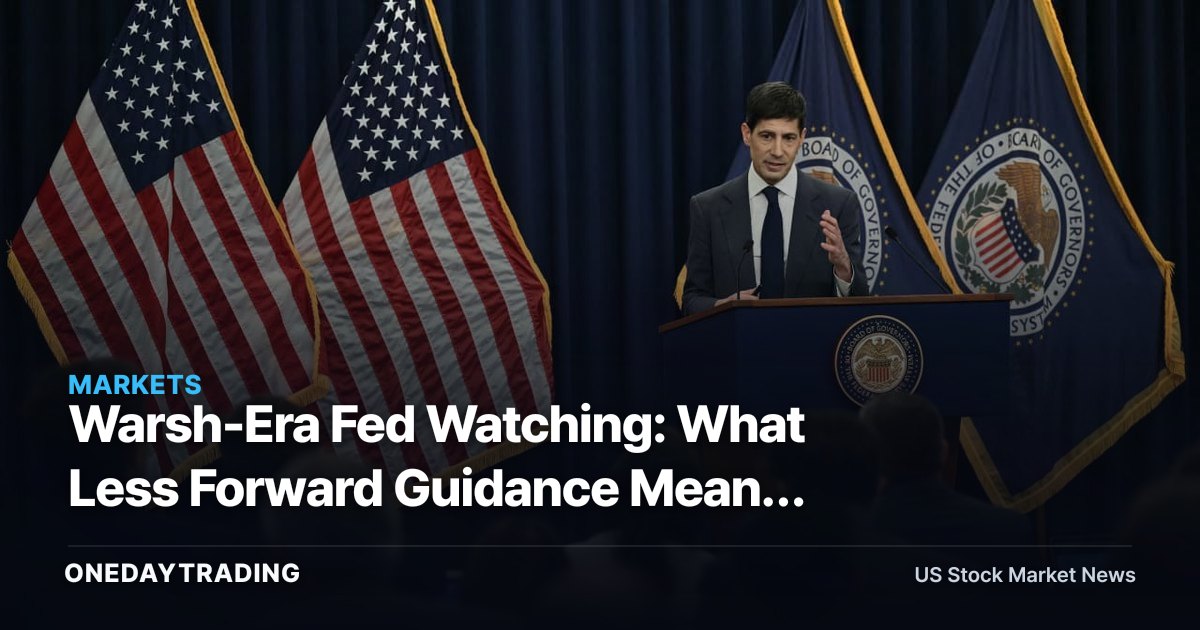
The framing around Kevin Warsh marks a shift in how investors should read Federal Reserve signals: less explicit forward guidance, and more responsibility on Wall Street to price the path of rates itself. For markets, the variable that changes is not the level of rates but the amount of uncertainty embedded in them.
Why It Matters Now
Modern Fed watching has leaned heavily on the central bank pre-committing to a direction, which compressed volatility because traders simply followed the script. A Warsh approach that forces the Street to do the heavy lifting removes part of that script. When the Fed narrates less, term premium and day-to-day rate volatility tend to rise, because price discovery moves from official communication back to the bond market.
That distinction matters for equities. Higher rate uncertainty raises the discount rate applied to far-off cash flows, which weighs most on long-duration growth names whose valuations depend on profits years out. The same regime can favor banks and other rate-sensitive lenders if it keeps front-end yields firm and the curve from collapsing, supporting net interest income.
The practical takeaway is process, not prediction: investors lose a crutch. Instead of parsing one guidance sentence, the job becomes tracking the benchmarks the market uses to set expectations on its own.
FAQ
- Who is Kevin Warsh? A former Fed governor frequently cited in the debate over future Fed leadership and policy communication style.
- What actually changes? The emphasis shifts from explicit forward guidance to letting markets price the rate path, raising the premium on independent analysis.
- Is this bullish or bearish? It is mainly a volatility and regime story, not a directional rate cut or hike, so the impact depends on positioning and duration exposure.
- Why do two charts matter? Without heavy Fed narration, benchmark rate and expectations gauges become the reference points investors lean on.
Related Stocks and Sectors
- Banks (JPM, BAC, GS): firmer front-end yields and a non-inverted curve support net interest margins and trading desks that profit from rate volatility.
- Long-duration tech and growth: more sensitive to a higher, choppier discount rate that pressures valuations built on distant earnings.
- Long Treasuries (TLT): a direct gauge of term premium; rising rate uncertainty typically pressures long-bond prices.
- Rate-sensitive sectors (REITs, utilities): bond-proxy income plays that struggle when yields stay elevated and volatile.
What to Watch
- The shape and slope of the Treasury curve, especially the 10-year yield, as the market's primary self-pricing benchmark.
- Market-based inflation and rate-expectation measures that replace explicit Fed guidance.
- Each FOMC statement and press conference for how much directional language is intentionally withheld.
- Bank earnings commentary on net interest margin and the rate environment.
Overall Outlook
A guidance-light Fed can be healthy if it lets prices reflect real conditions rather than official scripting, and it can reward rate-sensitive lenders and active risk managers. The bull case is cleaner price discovery; the risk is that thinner communication widens term premium and amplifies swings, punishing crowded long-duration trades and investors who still wait to be told the direction.
📊 Analysis
Signal Neutral
Why The story is about a shift to less Fed forward guidance and higher rate uncertainty rather than a clear directional easing or tightening catalyst.
This article was independently written by OneDayTrading from public reporting. Read the original (MarketWatch)