Summary
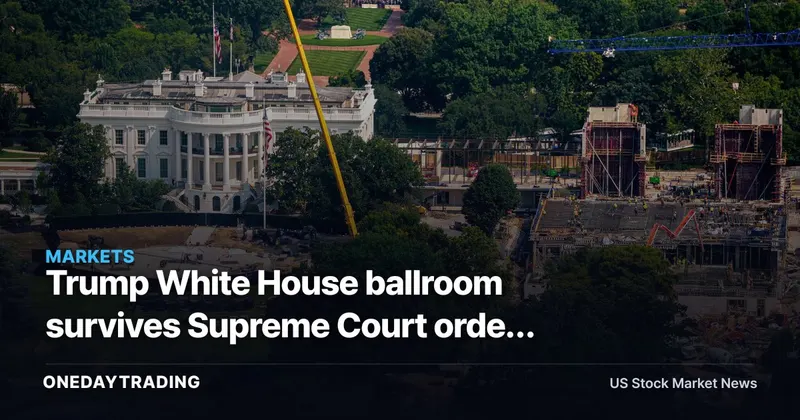
The Supreme Court let the White House ballroom project move ahead while the lawsuit continues, even after Chief Justice John Roberts and three liberal justices said the construction is likely unlawful. For investors, the read-through is simple: procedural relief can keep a project alive even when legal risk is unresolved, which matters for contractors, designers and suppliers tied to federal work.
CNBC reported Monday that the court did not settle the merits. It only allowed the work to proceed for now, which leaves the bigger question intact: whether a later ruling can still unwind the project or force a different outcome.
The Full Story
The Supreme Court's action is not a full endorsement of the ballroom project. The court let construction continue while the underlying lawsuit moves forward, which means the legal fight is still open. Roberts dissented with three liberal justices, and that split tells investors the case is still carrying real judicial friction.
The practical market lesson is that timing matters as much as the final ruling. A project can consume labor, materials and political capital before the court settles whether the work is valid, and that sequence can shape how suppliers, contractors and advisers price risk.
Structural Background
White House renovation fights rarely trade on one headline alone. They sit at the intersection of public procurement, legal process and political discretion, so the risk is not just whether work starts, but whether it can be defended after money and time have already been committed.
That makes the case a useful proxy for policy uncertainty. When the court allows work to proceed under a cloud, the market usually prices speed first and legal finality second. The unresolved part is whether the eventual merits ruling changes the economics of the project after contractors have already mobilized.
Stock & Sector Ripple
- Federal contractors: project timing can improve near-term revenue visibility, but a later adverse ruling can still reset scope, schedules and change orders.
- Construction and engineering firms: legal uncertainty raises execution risk, especially when work is politically sensitive and tied to public approval.
- Materials suppliers: demand can advance before legal clarity, but order durability depends on whether the project remains intact after the case finishes.
- Policy-driven real estate and infrastructure names: the ruling is a reminder that court process can move slower than capex commitments, which affects valuation of long-dated public work.
Bull vs Bear Scenarios
The bullish read is that the court's order keeps the project moving and reduces immediate stop-work risk. That helps anyone upstream of the build cycle who needs visibility on labor, sourcing and billings.
The bearish read is that Roberts' dissent undercuts the idea that the legal risk is gone. If the merits ultimately go against the project, the market can be left with sunk costs, schedule disruption and another round of political backlash.
Investor Action Points
- Track whether the lawsuit changes the project timeline, not just the legal commentary.
- Watch federal construction and public-works exposure for any shift in backlog tone.
- Look for supplier or contractor guidance that references timing, change orders or scope risk.
- Use the next court filing as the main catalyst, not the headline order alone.
FAQ
What did the Supreme Court decide about the White House ballroom?
The Supreme Court let the White House ballroom construction continue while the lawsuit continues. CNBC reported Monday that the court did not decide the merits of the dispute. The legal question remains open even though work can proceed for now.
Why did Chief Justice John Roberts dissent?
Chief Justice John Roberts dissented with three liberal justices. CNBC reported that Roberts said the construction is likely unlawful. That dissent signals that at least four justices saw enough legal concern to push back on the order.
Why does this matter to investors?
The case shows how a project can advance before legal risk is fully resolved. For investors, that affects how they think about federal contractors, materials suppliers and other businesses tied to public work. The key variable is whether the lawsuit eventually changes scope, timing or economics after work has already begun.
📊 Analysis
Signal Neutral
Why The court let construction continue, but the lawsuit is still live and the merits remain unresolved, so the market signal is procedural rather than directional.
This article was independently written by OneDayTrading from public reporting. Read the original (CNBC)