At a Glance
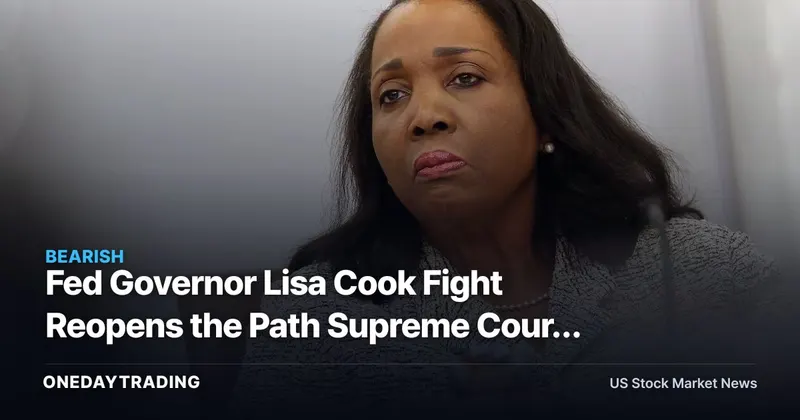
Fed Governor Lisa Cook is back at the center of a Federal Reserve independence fight because Trump renewed a threat to remove Lisa Cook after the Supreme Court blocked an earlier firing attempt in late June, per CNBC’s reporting. For investors, the issue is not one governor’s seat alone; the risk channel runs through confidence in the Fed’s rate-setting autonomy, Treasury yields, bank stocks and equity multiples.
Federal Reserve independence means monetary policy decisions are expected to be insulated from direct political pressure, and any credible challenge to that norm changes how investors price future Fed decisions. The tape can absorb legal noise; the harder question is whether the market must price a higher policy-risk premium.
Why It Matters Now
Trump’s renewed threat to oust Fed Governor Lisa Cook matters because the Supreme Court in late June blocked Trump from firing Cook but left the president with a path to try again, per CNBC. That distinction is the investable point: the court did not end the dispute, so rate-sensitive assets cannot treat the governance risk as fully retired.
Fed credibility affects the discount rate investors use for U.S. equities, especially long-duration growth stocks whose valuations depend heavily on future cash flows. If investors believe the Federal Reserve could face more direct political pressure, the market may demand more compensation in Treasury yields before extending multiples.
Banks sit on the other side of the same mechanism. JPMorgan Chase and Bank of America can benefit from higher rates through net interest income, but a politically charged Fed fight can also unsettle credit, capital planning and yield-curve expectations. The sector likes rate clarity more than institutional drama.
Key Debates
- Legal boundary: CNBC reported that the Supreme Court blocked Trump from firing Fed Governor Lisa Cook in late June, but CNBC also reported that the court left Trump a path to try again.
- Policy credibility: The market must decide whether the renewed threat is procedural noise or a durable challenge to Federal Reserve independence.
- Rates channel: A higher perceived risk premium can pressure equity multiples even when no immediate Fed decision changes.
- Counter-scenario: If the renewed ouster threat fails to advance legally, investors may fade the story as another headline rather than a rate-setting event.
Related Stocks & Sectors
- JPMorgan Chase (JPM): Large banks are exposed because Fed credibility shapes the rate path, the yield curve and net interest income expectations.
- Bank of America (BAC): Bank of America is sensitive to Treasury yields and deposit spread assumptions, so policy uncertainty can move the earnings narrative.
- Goldman Sachs (GS): Market volatility tied to Fed governance can support trading activity, but unstable policy signals can weigh on risk appetite.
- Technology and growth stocks: Long-duration equities are vulnerable if Fed independence concerns lift discount rates and compress valuation multiples.
What to Watch
- Watch whether Trump formally uses the path the Supreme Court left open in late June, per CNBC’s reporting.
- Track Treasury yield reaction around each legal filing or White House statement tied to Fed Governor Lisa Cook.
- Monitor bank-stock leadership versus growth-stock leadership; the split will show whether investors are pricing a rates shock or a governance headline.
- Listen for Federal Reserve communication that reinforces institutional independence without escalating the legal dispute.
Overall Outlook
The base market read is cautiously negative because the renewed Lisa Cook threat adds uncertainty to the institution that anchors U.S. rate expectations. The risk is not an immediate policy change; the risk is that investors start treating Fed governance as another variable inside the valuation model.
The bull case for markets is straightforward: the Supreme Court already blocked the late-June firing attempt, and a failed second effort would let investors refocus on inflation, employment and earnings. The bear case is that each new attempt keeps a governance premium alive, and that premium is paid through rates before it shows up in earnings estimates.
FAQ
Why does the Lisa Cook Fed fight matter for stocks?
The Lisa Cook Fed fight matters for stocks because Federal Reserve independence affects how investors price interest rates and equity multiples. CNBC reported that Trump renewed a threat to oust Fed Governor Lisa Cook after the Supreme Court blocked an earlier firing attempt in late June.
What did the Supreme Court do in the Lisa Cook case?
The Supreme Court blocked Trump from firing Fed Governor Lisa Cook in late June, per CNBC’s reporting. CNBC also reported that the Supreme Court left Trump with a path to try again to remove Fed Governor Lisa Cook.
Which stocks are most exposed to Fed independence risk?
JPMorgan Chase, Bank of America and Goldman Sachs are exposed because Federal Reserve credibility shapes rates, the yield curve and risk appetite. Growth stocks are also exposed because higher policy-risk premiums can raise discount rates and pressure valuation multiples.
📊 Analysis
Signal Bearish
Why The renewed threat to remove Fed Governor Lisa Cook raises policy-governance uncertainty around the Federal Reserve, a negative risk premium for rate-sensitive assets.
This article was independently written by OneDayTrading from public reporting. Read the original (CNBC)