Key Takeaways
Samsara is extending its connected operations platform from the cab into the cargo hold, aiming tracking labels at a $35 billion annual theft market. For IOT investors, the move tests whether the company can deepen attach rates with existing fleet customers rather than hunting net-new logos — a fundamentally cheaper growth vector. The read-through reaches large-load carriers, freight brokers, and cargo insurers who absorb theft losses spread invisibly across supply chain income statements.
What Happened
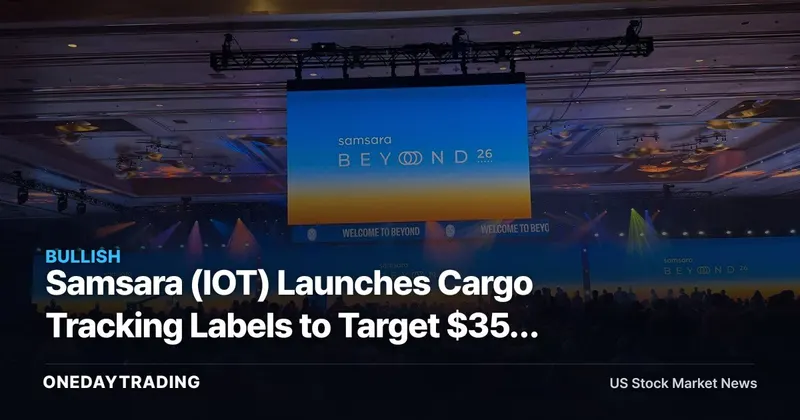
Samsara announced a tracking label product targeting the $35 billion cargo theft problem — a product-line expansion beyond the dashcams, GPS fleet trackers, and environmental sensors anchoring its existing connected operations cloud. Labels would monitor individual shipments, pallets, or containers rather than the transporting vehicle, a distinction that matters because a driver can be GPS-tracked while cargo is still diverted during a dock transfer or layover, where cab-based coverage goes dark.
The timing reflects a real escalation in freight crime. Strategic theft — where organized groups pose as legitimate carriers to pick up loads directly — has become the dominant method, circumventing vehicle telematics entirely. A label embedded in the shipment itself is the logical countermeasure, and no single player with Samsara's fleet-operator brand recognition currently owns that niche.
Background and Context
Samsara built its business on a subscription model monetizing IoT data from fleets in trucking, construction, utilities, and food distribution — industries where physical asset visibility is a direct P&L lever. The $35 billion cargo theft figure represents losses diffused across shipper self-insurance, carrier liability caps, and freight insurance premiums, making it invisible on any single balance sheet but structurally embedded in the economics of physical logistics. That diffuse cost structure also means the addressable market is real but not easily concentrated — capturing even a fraction requires both product adoption and insurance or contractual mandates to drive volume.
Market and Stock Impact
- Samsara (IOT): Direct beneficiary with near-zero incremental customer acquisition cost if labels attach to the existing installed fleet base. The critical variable is whether average contract value rises enough to move the needle on net revenue retention, the metric IOT investors weight most heavily.
- J.B. Hunt Transport (JBHT): One of the largest U.S. intermodal carriers absorbs meaningful cargo liability exposure; in-shipment tracking that accelerates recovery or deters theft lowers operating cost and shortens insurance renegotiation cycles.
- XPO (XPO): Less-than-truckload freight with multi-stop routing is disproportionately exposed at transfer points — exactly where cab GPS loses coverage and label tracking adds the most marginal value.
- Old Dominion Freight Line (ODFL): ODFL markets its claims ratio as a competitive differentiator; technology further reducing in-transit loss reinforces that moat and supports premium pricing with shippers.
- CalAmp (CAMP) / Powerfleet (PWFL): Adjacent asset-tracking players who face direct competitive pressure if Samsara captures the cargo-label segment with its larger distribution footprint.
Investor Checkpoints
- Attach rate at next earnings: Watch for any Samsara disclosure on label adoption as a percentage of existing fleet accounts — the land-and-expand thesis only works if the installed base converts without heavy sales spend.
- Gross margin trajectory: Hardware-first products typically carry lower margins than software subscriptions; monitor whether label economics compress Samsara's blended gross margin or remain accretive through high-ASP subscription overlays.
- Insurance carrier mandates: If a major cargo insurer conditions premium discounts on Samsara label use, that creates pull-through demand bypassing direct sales entirely — a structural accelerant worth watching for in earnings commentary or industry press.
- Competitive product response: A CalAmp or Powerfleet label announcement within two quarters would signal that pricing pressure is coming and that Samsara's first-mover window is shorter than bulls assume.
Outlook
The bull case is structurally clean: Samsara already holds IT approval and sales relationships across a large fleet-operator base, making label upsell expansion revenue at low marginal cost. A $35 billion theft market implies demand for a reliable solution that no incumbent telematics player has definitively answered, and Samsara enters with category recognition that startups cannot replicate quickly.
The countervailing risk is that scaling a physical-goods product at volume — supply chain, manufacturing, field installation — demands operational muscle that is genuinely different from software deployment. If hardware subsidies are required to drive adoption, near-term gross margin dilution could disappoint investors who have priced IOT on software-like economics. The $35 billion figure is also an industry-wide loss estimate, not a serviceable slice Samsara can capture immediately; realistic penetration curves matter more than TAM arithmetic when sizing the opportunity.
Market data check: IOT
IOT last traded near $29.17 (+0.66%). Our composite signal — blending price momentum and news flow — reads 🟡 neutral. Price momentum scores 55/100.
Data as of publication. Price via market feeds; for reference only, not investment advice.
📊 Analysis
Signal Bullish
Why Cargo tracking labels open a large incremental TAM with low customer acquisition cost through Samsara's existing fleet install base, supporting net revenue retention expansion.
Tickers$IOT$JBHT$XPO$ODFL$CAMP
This article was independently written by OneDayTrading from public reporting. Read the original (Yahoo Finance)