Summary
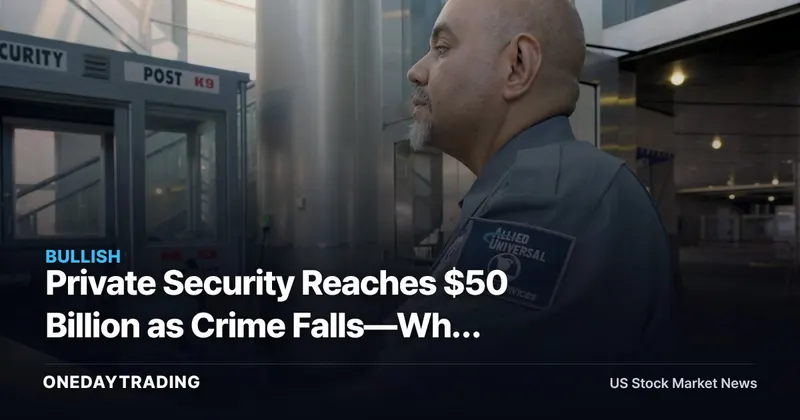
Private security has become a $50 billion industry because companies and communities are buying protection against highly visible attacks, even while violent crime declines. The divergence matters for investors: demand is being shaped less by aggregate crime rates than by perceived exposure, reputational risk and the cost of a single security failure.
Guard employment is rising alongside spending, signaling a labor-intensive market whose growth depends on contracts, staffing and risk assessments rather than a simple crime cycle.
The Full Story
The central investment question is not whether violence is broadly increasing; the source reports that violent crime is falling. The sharper read is that high-profile attacks reset the financial consequences of insecurity, encouraging businesses, property owners and local communities to purchase visible deterrence and response capacity.
Private security means paid protection supplied outside the public police system, including guards and related services. The source provides no company-level revenue, margin or market-share data, so the $50 billion figure should be treated as an industry scale marker rather than proof that every listed security business is growing at the same rate.
Higher guard employment shows that the response is operational, not merely technological. More personnel can support access control, patrols and incident response, but labor availability and wage pressure determine how much of each new contract reaches operating profit.
Structural Background
Public safety spending and private protection are not interchangeable. Falling violent-crime statistics can coexist with higher private budgets when executives and community leaders price low-frequency, high-impact events more heavily than average incident counts.
That creates a demand stream with asymmetric economics: one attack can trigger a new security contract, while a long period of calm does not automatically cancel it. The counterweight is budget scrutiny; if perceived risk fades, customers can reduce guard hours or defer expansion.
Stock & Sector Ripple
- ADT (ADT): Residential and commercial security exposure gives ADT a potential read-through from stronger protection budgets, although the source does not establish a direct revenue link to guard services.
- The Brink's Company (BCO): BCO operates in physical-security services, so sustained institutional demand could support activity; labor and contract costs remain the key margin variable.
- Industrials: Guard employment growth benefits staffing-intensive providers only when contract pricing keeps pace with recruiting and retention costs.
- Commercial real estate: Building owners may preserve security spending to protect occupancy, tenants and reputation, even when local crime indicators improve.
Bull vs Bear Scenarios
The bullish case is a durable risk-premium shift. Repeated high-profile attacks could make security a standard operating expense, sustaining the $50 billion market and supporting recurring contracts.
The bear case is normalization. If violent crime continues to fall and no new attacks reset public attention, customers may challenge vendors on price, cut staffing levels or move toward lower-cost systems. Investors also lack source data on industry profitability, so scale does not equal attractive returns.
Investor Action Points
- Track guard employment and private-security spending for evidence that demand is broadening beyond isolated incidents.
- On the next ADT and BCO earnings reports, compare contract growth with labor costs and operating margins.
- Watch whether high-profile attacks produce new, recurring customer commitments or only short-term deployments.
- Use local crime trends as a stress test: falling violence with stable budgets supports a perception-driven thesis; falling budgets would challenge it.
FAQ
Why is private security spending rising while violent crime falls?
Private security spending is rising because companies and communities are responding to high-profile attacks and their potential financial and reputational damage. Lower aggregate violent crime does not remove concern about rare but severe events.
How big is the private security industry?
The source describes private security as a $50 billion industry. The figure covers industry spending, while the source does not provide a breakdown by guards, technology, geography or individual companies.
What should investors watch in private security stocks?
Investors should monitor guard employment, contract demand, pricing and labor costs. ADT and The Brink's Company are relevant listed names, but company-specific exposure and profitability require confirmation in their next filings.
Market data check: ADT
ADT last traded near $7.48 (-0.47%). Our composite signal — blending price momentum and news flow — reads 🟡 neutral. Price momentum scores 46/100.
Data as of publication. Price via market feeds; for reference only, not investment advice.
📊 Analysis
Signal Bullish
Why Rising private-security spending and guard employment create a positive demand signal, although labor costs and uncertain company-level exposure limit conviction.
This article was independently written by OneDayTrading from public reporting. Read the original (CNBC)