UK Inflation’s 3.1% Print Keeps Rates on a Narrow Line
U.K. inflation reached 3.1% in August, and the investor signal is less about an immediate rate increase than about whether an energy shock begins spreading through the wider economy. The reading, reported by the Office for National Statistics (ONS) and in line with economists’ expectations, was the first above 3% since March. Markets were still pricing more than an 80% chance that the Bank of England would hold its key interest rate at 3.75% at the policy update scheduled for Thursday.
The transmission mechanism is clear: fuel and household-energy costs raise the bills facing consumers and businesses, while higher rates would further pressure borrowing and demand. That leaves gilt investors balancing a temporary headline surge against the risk of a more persistent inflation cycle. Wednesday’s market reaction leaned toward the former, with long-dated gilt yields easing even after the previous day’s 30-year yield reached a 28-year high.
Fuel and Household Energy Drive the Headline
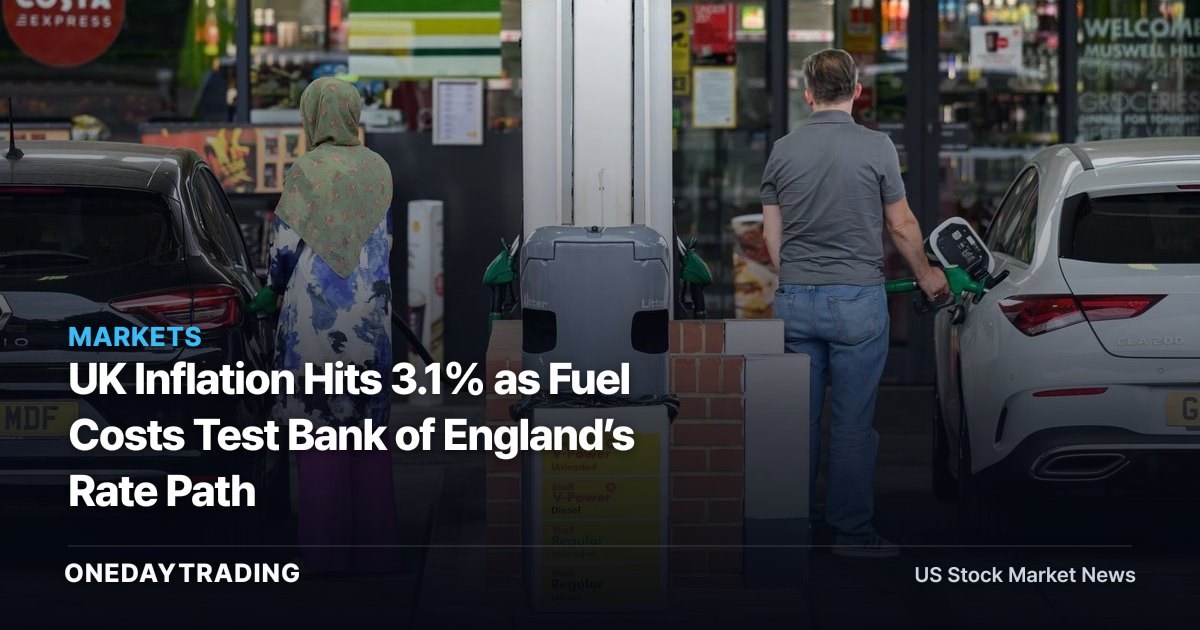
Motor-fuel costs rose 23% year on year in August, according to the ONS. Average gasoline prices increased by 9.1 pence per liter, or $0.12 per liter, between July and August, reaching their highest level since November 2022. Average diesel prices rose by 14.2 pence per liter in August. The source also reports that gasoline and diesel prices are now at levels not seen in four years.
Household energy added a second channel of pressure. Electricity, gas and other household-fuel costs rose 6% year on year in August. Crude oil prices were hovering above $100 per barrel, leaving the U.K.—a net importer of energy—exposed to external cost movements. Inflation had been 2.9% in July, so the August increase reflects a sharp change in the energy contribution rather than a smooth acceleration across every category.
Food and non-alcoholic-beverage inflation, by contrast, slipped to 1.1% year on year in August. That divergence matters for policy interpretation: headline inflation is elevated, but one major household spending category is not showing the same acceleration. The data therefore describe an energy-led squeeze, not yet a confirmed broad-based repricing of the basket.
Why the Bank of England Faces a Difficult Trade-Off
The Monetary Policy Committee’s scheduled Thursday update follows the inflation release, but the outcome is not confirmed in the available evidence. LSEG data showed markets assigning more than an 80% chance to a hold at 3.75%, while the next meeting is in November. Investors are therefore separating the near-term decision from the possibility that persistent energy costs could change the later policy debate.
James Smith, a developed-markets economist at ING, said there was “nothing in the latest UK inflation numbers that screams a need to hike interest rates.” He framed the central question as whether “the energy shock is broadening out to other parts of the inflation basket.” His point is reflected in the category split: food inflation eased, while fuel and household energy climbed.
Scott Gardner, an investment strategist at J.P. Morgan Personal Investing, said the increase was “unlikely to convince the Bank of England to hike interest rates just yet,” but could renew policymakers’ concerns about the inflation outlook. He highlighted the possibility that higher costs could pass into business prices and household spending. That is a risk channel, not an established outcome in the August data.
Gilts Signal Relief, Not Resolution
Gilt yields moved lower after the inflation print. The 30-year gilt yield was 5.907%, almost 2 basis points below its prior level, after reaching a 28-year high on Tuesday. The benchmark 10-year gilt yield was 5.365%, nearly 3 basis points lower, a decline of almost 3 basis points.
The combination of a hotter headline number and lower yields suggests that the market treated the energy impulse as compatible with a near-term policy hold. That interpretation can change if subsequent evidence shows firms passing fuel costs into goods and services or households cutting spending more sharply. The yield move is therefore a snapshot of policy expectations, not proof that inflation pressure has ended.
The pound was flat against both the U.S. dollar and the euro in the source’s account. Currency stability offers no separate confirmation of a new rate regime; it simply shows that the inflation release did not produce a decisive sterling repricing in that session.
Consumer and Retail Pressure Builds Into the “Golden Quarter”
Higher fuel and energy bills reduce the cash available for discretionary purchases. Bogdan Toma, a partner at McKinsey & Company, described an uncertain “golden quarter” for consumers and retailers. He linked the pressure to households absorbing back-to-school costs while facing the possibility of higher interest rates.
For retailers, the mechanism is a competition for fewer or smaller baskets. If shoppers trade down or defer non-essential purchases, sales volume and pricing power can weaken at the same time. Toma said that this could intensify margin pressure for non-food and some grocery retailers from an already challenged starting point. The fact sheet does not identify individual listed retailers, so the implication is sector-wide rather than a company-specific earnings call.
Andy Burnham, identified as the new prime minister, has pledged to tackle the cost-of-living burden while also balancing public finances and placating the bond market. Those objectives can pull in different directions: household support may cushion demand, while fiscal concerns can keep gilt yields and financing costs sensitive. The available information does not establish which policy outcome will prevail.
Stock and Sector Ripple: Rates, Energy and Demand
- U.K. rate-sensitive sectors: A sustained rise in inflation expectations could keep borrowing costs higher for banks, real estate and consumer-finance businesses, while a confirmed energy-only shock would limit the effect. The August data alone do not establish a new rate path.
- Retail and consumer discretionary: Higher gasoline, diesel and household-energy bills reduce disposable income. The risk is weaker fourth-quarter demand and tighter margins if retailers compete for smaller baskets.
- Transport and energy-intensive operators: Motor fuel costs rose 23% year on year, and household energy costs rose 6%. Businesses with significant fuel or power exposure may face cost pressure if they cannot pass it through, although the fact sheet provides no company-level cost structures.
- Gilts and sterling: Wednesday’s lower 30-year and 10-year yields, alongside a flat pound, indicate limited immediate market disruption. A broader inflation shock would challenge that calm through renewed expectations for tighter policy.
Bull and Bear Paths for the Policy Outlook
The constructive case is that August’s rise remains concentrated in energy. Food inflation eased to 1.1%, and James Smith reported little sign that energy-intensive categories were accelerating broadly. If that pattern persists, the Bank of England could hold at 3.75% while monitoring whether fuel effects fade from the annual comparison.
The adverse case is second-round inflation. Scott Gardner pointed to renewed cost pressures in manufacturing and services and the possibility that businesses pass higher inputs to customers. A prolonged period of crude oil above $100 per barrel could keep fuel and household-energy costs elevated, weakening real spending while increasing pressure on policymakers to respond.
Retail investors should also account for the demand downside. Bogdan Toma’s warning about an uncertain golden quarter means that even a rate hold would not remove the earnings risk created by smaller household budgets. Lower yields can support valuations, but they do not automatically restore consumer volumes.
Investor Action Points Before the November Meeting
- Read the Bank of England’s Thursday policy update for how policymakers characterize the energy shock and the conditions for a November move. The outcome of that meeting is not confirmed in the available evidence.
- Track whether motor-fuel inflation remains the dominant contributor or begins appearing in food, goods and services. The August split—23% year-on-year motor-fuel inflation versus 1.1% food inflation—is the baseline.
- Watch the 10-year and 30-year gilt yields. The reference levels are 5.365% and 5.907%, respectively; a renewed rise would signal tighter financial conditions for borrowers and public finances.
- Assess consumer-facing companies through traffic, basket size and margin commentary during the “golden quarter.” The central question is whether higher fuel and energy bills reduce demand faster than retailers can adjust prices or costs.
📊 Analysis
Signal Neutral
Why Higher energy costs lift headline inflation, but muted food inflation and limited evidence of broader price pressure leave the immediate policy signal mixed.
This article was independently written by OneDayTrading from public reporting. Read the original (CNBC Markets)