Key Takeaways
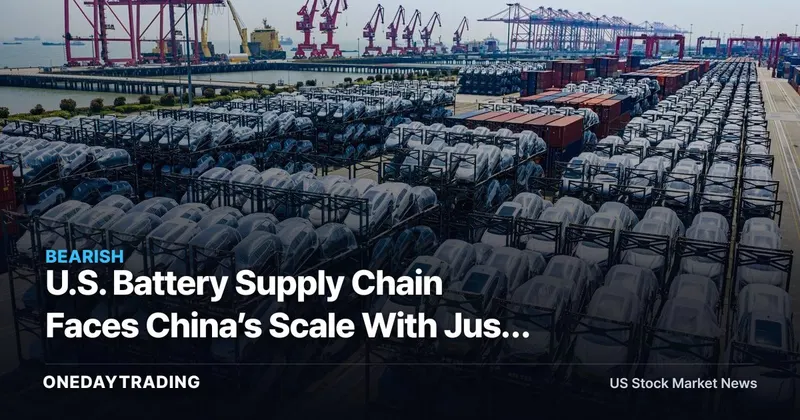
The U.S. battery supply chain has an innovation pipeline but not yet the industrial scale to challenge China, leaving American automakers, energy-storage developers and materials producers exposed to a concentrated source of processed inputs and finished cells. The Department of Energy’s $500 million awarded in August targets genuine bottlenecks, but it sits against nearly $24 billion of announced U.S. battery projects canceled since January 2025.
The investment case therefore turns on conversion, not invention. Domestic technologies must move from grants and prototypes to repeatable, high-volume production while U.S. electric-vehicle demand—the largest commercial outlet for battery technology—remains far below China’s market penetration.
What Happened
According to CNBC’s Sept. 8 reporting, the Trump administration awarded $500 million to seven companies involved in battery minerals, materials, manufacturing or recycling. The awards represent the first funding round under two separate $3 billion DOE battery technology and materials programs created by the Infrastructure Investment and Jobs Act during the Biden administration.
A battery supply chain is the sequence that converts mined or recovered materials into refined chemicals, anodes, cathodes, cells and ultimately battery packs for vehicles or stationary energy storage. China’s advantage spans almost that entire sequence, but the hardest U.S. gap lies in the middle: refining raw material and manufacturing active components consistently at commercial scale.
The grants address selected links rather than the full chain. Coreshell Technologies received $50 million to develop anodes from domestically sourced silicon instead of Chinese-sourced graphite. Lilac Solutions received $100 million for technology that extracts lithium from salt-water brine and produces battery-grade lithium carbonate or hydroxide at the production site, potentially bypassing hard-rock processing concentrated in China.
Background & Context
China produces about 85% of global electric-vehicle battery cathode active material, more than 90% of anode active material and 80% of battery cells, according to International Energy Agency figures cited in the report. Its position is not simply a consequence of mineral ownership. Refining capacity, manufacturing expertise and the ability to reproduce quality across millions of units create a cost and execution barrier that a laboratory breakthrough cannot erase.
Lithium illustrates the mismatch. The global market expanded tenfold, from about 150,000 metric tons in 2015 to 1.5 million metric tons in 2025, according to Lilac CEO Raef Sully. Much of that growth came from spodumene, a hard-rock mineral that must be processed, and Sully said China handles 95% of global spodumene processing. A domestic extraction method can remove one dependency, but downstream cathode and cell capacity must also exist to keep that material inside a U.S.-based production system.
China also built demand alongside capacity. New-energy vehicles—including hybrids, battery-electric vehicles and extended-range EVs—accounted for 65% of Chinese new-car sales in July. In the U.S., EVs, hybrids and plug-in vehicles represented about 24% of second-quarter 2026 sales. China sold 23.7 million new cars in 2025 versus about 16.3 million in the U.S., giving its battery manufacturers both a larger market and a much higher electrified share over which to spread plant, engineering and supplier costs.
Market & Stock Impact
- U.S. battery-material developers: The grants can reduce the capital burden of proving domestic silicon-anode and direct-lithium-extraction processes. The benefit remains conditional on yield, product qualification and customers committing enough volume to support commercial plants.
- U.S. automakers: Limited domestic cell and processed-material capacity can preserve dependence on a supply chain exposed to Chinese export policy. China used its processing position in 2025 by imposing strict export controls on rare earths, other minerals and processing equipment, demonstrating that concentration can become an operating constraint rather than a theoretical geopolitical risk.
- EV manufacturing: The removal of federal EV tax credits and other vehicle and battery support weakens the demand signal needed to finance factories. Nearly $24 billion in announced battery projects have been canceled since January 2025, suggesting that policy support for selected technologies is not offsetting the broader retreat in committed capacity.
- Energy storage: Demand has averaged 70% growth since 2022, according to the Energy Information Administration, providing a second outlet for battery production. Yet EVs still represent more than 70% of total lithium-ion battery deployment, according to the IEA, so stationary storage cannot yet replace a weak vehicle market as the industry’s principal scale engine.
Why $500 Million Does Not Close the Capacity Gap
China’s lead was built through cumulative investment, supplier density and production learning. Sino Auto Insights founder Tu Le estimated that recreating comprehensive scale would require decades and tens, if not hundreds, of billions of dollars, while the U.S. has only five to seven years to become competitive. Against that requirement, the August grants function as targeted risk capital, not a full industrial-policy answer.
The critical distinction is between technical feasibility and bankable manufacturing. A process may produce the intended material in a prototype and still fail commercially if yields fluctuate, equipment uptime disappoints or unit costs remain above imported alternatives. Customers also must qualify new materials before using them in vehicles or storage systems, making scale-up a chain of technical and commercial approvals rather than a single construction decision.
China’s largest manufacturers benefit from integrated supply networks and existing volume. Voya Energy CEO Richard Wang pointed to CATL’s manufacturing and supply-chain capabilities as the foundation of its revenue and profitability. U.S. entrants face the reverse sequence: they must attract capital and customers before volume lowers costs, while competing against suppliers that already possess scale.
Investor Checkpoints
- Grant conversion: At the next DOE funding update, check whether the remaining money in the two $3 billion programs produces additional awards and whether recipients disclose commercial milestones rather than only research progress.
- Factory execution: In recipients’ next project updates, focus on pilot output, repeatable quality, customer qualification and plans for mass production. Grant size alone does not establish viable capacity.
- Demand formation: At the next U.S. quarterly vehicle-sales release, compare the electrified share with the 24% recorded in the second quarter of 2026. A sustained increase would improve utilization prospects for domestic battery investments.
- Project cancellations: Track whether the nearly $24 billion cancellation total stabilizes or continues rising. New grants lose industrial significance if larger manufacturing commitments keep disappearing.
Outlook
The constructive case rests on selective technologies that bypass concentrated processing stages. Domestic silicon anodes could reduce graphite dependence, while lithium-from-brine production could avoid the spodumene route in which China controls 95% of processing. Continued 70% average growth in energy-storage demand also broadens the potential customer base.
The risk is that isolated successes never form an integrated supply chain. The U.S. is trying to build materials and manufacturing capacity while weakening some of the policies that supported the end market, and China already controls dominant shares in active materials and cells. The next decisive evidence will not be another award announcement; it will be whether funded processes secure customers, hold quality at volume and support factories that remain financed through construction.
FAQ
Why does China dominate the global battery supply chain?
China combines mineral processing, active-material production, cell manufacturing and large domestic EV demand. It produces about 85% of global EV battery cathode active material, more than 90% of anode active material and 80% of battery cells.
How much U.S. battery funding was awarded in August?
The Department of Energy awarded $500 million to seven battery-related companies. The money came in the first Trump-administration round under two $3 billion programs established through the Biden-era infrastructure law.
Can U.S. energy-storage growth compensate for slower EV adoption?
Energy-storage demand has averaged 70% growth since 2022, creating a meaningful additional market for batteries. However, EVs still account for more than 70% of lithium-ion battery deployment, so vehicle demand remains central to achieving manufacturing scale.
📊 Analysis
Signal Bearish
Why Targeted federal grants support promising domestic technologies, but canceled projects, weaker EV demand and China’s midstream scale constrain U.S. competitiveness.
This article was independently written by OneDayTrading from public reporting. Read the original (CNBC)