Meta and Google Face the Slopaganda Test
Meta and Google enter Tuesday’s midterm elections with a platform-control problem: more than $187 million was spent during the cycle on nearly 300 advertisements generated or enhanced by AI, according to a Wesleyan Media Project analysis reported by CNBC. For investors, the immediate read-through is not a demonstrated revenue or earnings hit. It is a test of whether Instagram, YouTube and other large platforms can identify synthetic political media, apply disclosures consistently and operate across fragmented rules without broader restrictions.
“Slopaganda” means political propaganda or misinformation produced with low-quality generative AI content. The term was used by a group of AI experts in a paper early last year, while the current election cycle has put the concept into campaign advertising through generated clips and images.
The $187 Million Metric Is Large but Incomplete
The strongest available measure is also the clearest warning against false precision. CNBC reported that the Wesleyan Media Project counted more than $187 million in spending on nearly 300 AI-generated or AI-enhanced advertisements during the midterm election cycle. The organization said that tally was almost certainly incomplete because many advertisements did not carry disclaimers.
The same analysis found that more than 90% of the spending came from Republican candidates, a Republican party committee or a Republican-leaning group. That figure identifies where measured spending originated; it does not establish the total amount spent across all synthetic political advertising or the total number of such advertisements.
This distinction matters for platform analysis. A political-ad library or disclosure system can document content that is declared or detected, while unlabeled material creates a blind spot in the observable dataset. The resulting investor question is operational: whether platform controls capture enough synthetic content to make their transparency systems credible.
Disclosure Rules Diverge Across YouTube, Meta and X
No comprehensive federal law governs the use or disclosure of AI in political advertisements. CNBC identified some 30 state laws with differing requirements, leaving platforms and advertisers to navigate rules that are not uniform.
YouTube requires advertisers to disclose election advertisements containing synthetic or digitally altered people or events. The company told CNBC that it applies “prominent labels to realistic AI content” and said political candidates can request removal of organic videos in which their faces appear altered or AI-generated. Parent company Google also requires political advertisers to complete election-ad verification and include “paid for by” disclosures.
Meta mandates “paid for by” labels, maintains a political-ad library and restricts the use of political advertisements during the 1 week prior to the election. In June, it added an “about this ad” tool for advertisements that the company detects were made with third-party AI tools. Detection is therefore central to the control: the tool addresses advertisements Meta identifies, not an independently verified universe of all synthetic content.
X says advertisers must comply with applicable laws, placing responsibility on the advertiser. The article describes leading internet sites as being run by Meta, Google and Elon Musk’s SpaceX, giving investors distinct policy models to compare: platform-directed disclosure and detection on one side, advertiser-directed legal compliance on the other.
Campaign Examples Expose the Enforcement Gap
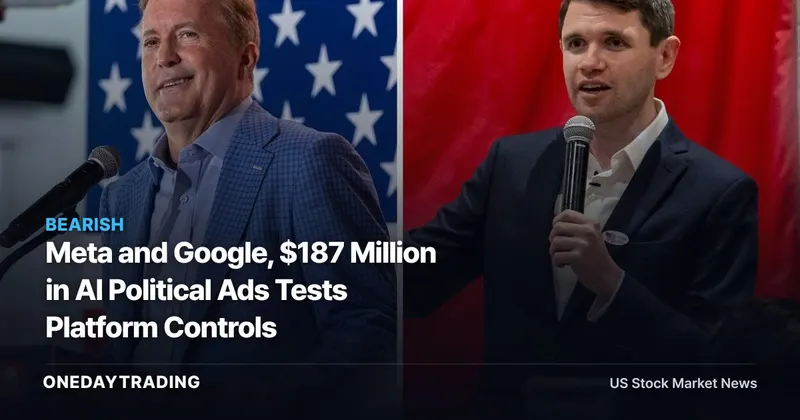
CNBC found AI-generated advertisements running online without disclosures. Bruce Blakeman posted a fake video of Kathy Hochul, while Ken Paxton created an AI-generated video depicting James Talarico making controversial statements. The Paxton video carried a 3-second disclosure in the middle and circulated as organic content on YouTube and X.
Those examples show why formal advertising rules cannot answer every moderation question. Paid placement, organic distribution, a label’s presence and a label’s prominence are separate control points. Platform exposure could increase if policies cover one route while synthetic political material continues through another, although the supplied evidence does not quantify any financial consequence.
Model behavior adds another layer. An August Brennan Center for Justice study tested ChatGPT, Gemini, Grok, Claude, Perplexity and DeepSeek and found that many models could avoid familiar conspiracies while still being manipulated into producing misleading material. An October retest found progress from ChatGPT, including refusals and redirection of harmful election-image prompts toward comic-like illustrations.
Meta’s Wider Trust Context Raises the Stakes
Last month, a New Mexico court ordered Meta to pay $25 billion in penalties in a data-privacy case stemming from the Cambridge Analytica scandal. Cambridge Analytica, a political consulting firm, allegedly accessed information belonging to 87 million Facebook users improperly nearly a decade ago.
The data-privacy case and AI-ad disclosure are different issues, so one should not be treated as proof of the other. Their connection for investors is narrower: both put Meta’s systems for political content, user information and platform accountability under scrutiny. That makes execution evidence more useful than policy language alone.
A bearish interpretation rests on the possibility that incomplete detection, inconsistent labeling or divergent state requirements increase oversight and operating demands. The countercase is that Meta’s ad library, labeling requirements and detection tool, alongside Google’s verification and disclosure processes, provide established controls that can be strengthened without a demonstrated material effect on the businesses.
Federal Proposals Have Not Changed the Rulebook
The Protect Elections from Deceptive AI Act would prohibit knowingly distributing materially deceptive AI-generated video or audio about federal candidates. Other proposed measures described in the reporting also seek to address generative AI in campaign communications.
None of the proposed bills had advanced out of committee. Investors should therefore distinguish proposal risk from enacted obligations: the policy direction is visible, while the timing, final scope and probability of passage are unknown.
Investor Checkpoints After Tuesday’s Elections
- Disclosure coverage: Check whether Meta, Google, YouTube or X identify additional unlabeled AI-generated advertisements after the election and whether those findings change platform practices.
- Policy execution: Compare stated requirements with visible labels, verification records, political-ad libraries and treatment of organic campaign content.
- Legislative movement: Watch whether the Protect Elections from Deceptive AI Act or other proposals advance out of committee. No advancement had occurred in the supplied record.
- Model safeguards: Track future tests of ChatGPT, Gemini, Grok, Claude, Perplexity and DeepSeek for evidence that refusals, redirections or other controls become more consistent.
Platform Risk Without a Quantified Earnings Impact
The central thesis is negative for platform risk but neutral on measured financial damage. AI-generated political advertising has reached a documented scale, disclosures are incomplete, and the governing framework spans differing state laws rather than one comprehensive federal standard. Those conditions can pressure monitoring and transparency systems at Meta and Google.
The evidence does not establish the total spending, total advertisement count, number of missing disclosures or any revenue, cost or earnings effect. The next useful signal is therefore not another broad claim about AI misinformation. It is verifiable evidence after Tuesday’s elections showing how much synthetic content platforms identified, how they labeled it and whether lawmakers move any proposal beyond committee.
Market data check: Meta Platforms, Inc.
Meta Platforms, Inc. last traded near $622.25 (+2.56%). Our composite signal — blending price momentum and news flow — reads 🟡 neutral. Price momentum scores 70/100 (firm).
Data as of publication. Price via market feeds; for reference only, not investment advice.
📊 Analysis
Signal Bearish
Why Uneven disclosures and fragmented state requirements create monitoring and policy risk for internet platforms, while the financial impact remains unquantified.
This article was independently written by OneDayTrading from public reporting. Read the original (CNBC)