Summary
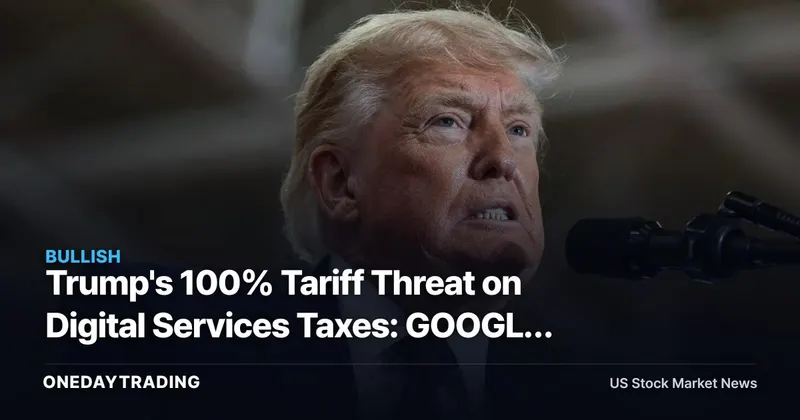
President Trump's threat to impose a 100% tariff on any country levying a Digital Services Tax on American companies reframes international tax risk for U.S. mega-cap internet platforms overnight. Alphabet, Meta, and Amazon — the primary DST targets across Europe, the UK, and Canada — stand to benefit if the threat accelerates rollbacks. The wrinkle: Trump explicitly states the tariff will supersede existing trade deals, injecting structural uncertainty into allied economic relationships that markets have largely priced as stable.
The Full Story
Digital Services Taxes, typically assessed at 2–7% of local digital revenue, were designed by foreign governments to capture tax from U.S. platforms that book large local revenues but report minimal taxable profit domestically. France, the UK, Spain, Italy, Austria, Canada, and India are among the jurisdictions that have enacted or proposed DSTs — all of them targeting the advertising auction and marketplace models that drive Alphabet and Meta's international segments and Amazon's third-party seller ecosystem. A credible 100% tariff threat transforms the DST calculus for foreign finance ministries: the cost of maintaining a DST suddenly includes a potential 100% levy on that country's exports to the U.S., a trade-off most export-dependent economies cannot absorb.
The Truth Social post's most operationally significant language is the clause that the tariff supersedes trade deals whether implemented, signed, or not. That phrasing attempts to pre-empt legal challenges under existing WTO and bilateral frameworks, though enforcement in practice would face immediate dispute-resolution proceedings. For investors, the relevant mechanism is not the tariff itself but the negotiating pressure it creates: countries facing 100% levies have strong incentive to suspend DSTs and seek exemptions, reducing the direct tax drag on U.S. platform revenues from European and Commonwealth operations.
Structural Background
DSTs emerged from a decade-long impasse in OECD Pillar One negotiations, which were meant to reallocate taxing rights over digital revenues to market jurisdictions and render DSTs unnecessary. Pillar One has repeatedly stalled over U.S. opposition to scope and safe-harbor provisions. Without a multilateral framework, individual countries acted unilaterally — producing a patchwork of national DSTs that U.S. platforms have absorbed as a cost of market access. The 100% tariff threat effectively uses trade leverage to accomplish what OECD diplomacy could not: forcing DST-imposing countries back to the negotiating table on U.S. terms.
Stock & Sector Ripple
- GOOGL (Alphabet) — Largest single DST exposure globally through Google Search and YouTube advertising; European and UK revenue segments face the highest effective DST rates. A broad DST rollback flows directly to international operating margin.
- META (Meta Platforms) — Facebook and Instagram advertising revenue in DST jurisdictions represents a meaningful share of international monetization. Meta has also faced DST-linked regulatory scrutiny in France and the UK simultaneously, making the threat doubly relevant.
- AMZN (Amazon) — Both the AWS cloud segment and the third-party marketplace are DST targets in multiple markets; European marketplace take-rate economics improve if DST costs are eliminated or reduced.
- MSFT (Microsoft) — Azure cloud and commercial software services are subject to DSTs in several markets; less acute than advertising-model peers but still a margin variable in international cloud growth.
- AAPL (Apple) — App Store commissions in European markets have been subject to DST treatment in some jurisdictions; regulatory overlap with the EU Digital Markets Act makes Apple's exposure more complex than a pure DST play.
Bull vs Bear Scenarios
Bull: Foreign governments, unwilling to absorb a 100% tariff on their exports, suspend DSTs within 60–90 days, directly reducing the international tax burden for Alphabet, Meta, and Amazon. International segment margins expand in the back half of 2026, and OECD Pillar One negotiations restart on terms more favorable to U.S. platforms. The market re-rates international revenue quality higher, narrowing the valuation discount that DST-exposed revenue has historically carried.
Bear: The supersede-trade-deals language triggers immediate WTO dispute filings and retaliatory measures against non-digital U.S. export sectors — agriculture, manufacturing, aerospace — creating broader macro headwinds that offset any tech margin benefit. Allies frame the threat as economic coercion rather than tax fairness, hardening DST policies and expanding them. Elevated geopolitical tension also pressures advertising budgets in the very markets where DST relief was expected to flow. Separately, a 100% tariff escalation with G7 partners would be historically unprecedented, raising legal enforceability questions that dilute the negotiating leverage the announcement was designed to create.
Investor Action Points
- Track whether EU finance ministers or the UK Treasury issue formal responses within 30 days — speed and tone of reaction will signal whether the threat achieves negotiating traction or hardens into a trade standoff.
- On Alphabet and Meta next earnings calls, probe international revenue growth against segment-level margin commentary for any DST cost relief disclosure; analysts should request quantified DST burden as a line item.
- Monitor OECD Pillar One negotiation status — a U.S.-driven revival of Pillar One talks would be the cleanest resolution and most durable positive for U.S. platform international margins.
- Watch WTO dispute filings: if any DST-imposing country initiates formal dispute resolution against a 100% tariff, the timeline extends materially and the negotiating pressure dissipates — that is the key signal that the bull case stalls.
Market data check: GOOGL
GOOGL last traded near $340.7 (-0.88%). Our composite signal — blending price momentum and news flow — reads 🟡 neutral. Price momentum scores 43/100.
Data as of publication. Price via market feeds; for reference only, not investment advice.
📊 Analysis
Signal Bullish
Why Credible 100% tariff threat creates strong incentive for DST-imposing countries to suspend digital taxes, directly reducing the international tax burden on U.S. platform companies and improving margin quality in their overseas segments.
Tickers$GOOGL$META$AMZN$MSFT$AAPL
This article was independently written by OneDayTrading from public reporting. Read the original (CNBC)