Key Takeaways
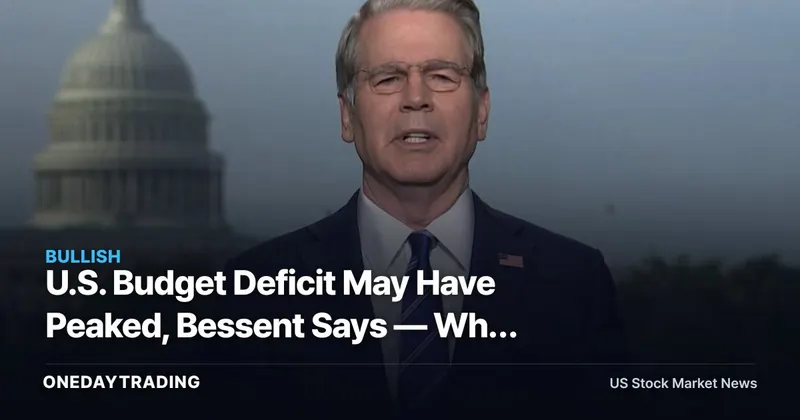
U.S. budget deficit expectations matter for investors because Treasury supply feeds bond yields, bond yields feed equity multiples, and equity multiples decide whether rate-sensitive sectors can lead. Treasury Secretary Scott Bessent told CNBC on Thursday that there is a very good chance the U.S. budget deficit under President Donald Trump has peaked, per the source's reporting.
The market read-through is constructive but not self-executing: lower deficit pressure can support Treasurys and long-duration equities only if bond investors see borrowing needs, auction demand and inflation data move in the same direction.
What Happened
CNBC reported Thursday that Treasury Secretary Scott Bessent said there is a very good chance the U.S. has already seen its budget deficit peak under President Donald Trump. The source did not provide a dollar amount, a deficit-to-GDP ratio, a formal Treasury forecast or a new fiscal plan.
A budget deficit is the gap between federal spending and federal revenue, and deficit peaks matter because the Treasury must finance that gap through debt issuance. If the deficit path improves, investors usually test whether that means less Treasury supply, lower term premium and more room for equity valuations to hold.
The phrase very good chance is not the same as a budget print. The tape can price the possibility of easing fiscal pressure, but the bond market will demand confirmation through Treasury borrowing estimates, auction coverage and incoming economic data.
Background & Context
Fiscal policy sits inside the rates trade because larger federal borrowing can push investors to demand higher yields for holding longer-dated Treasurys. Higher yields pressure price-to-earnings multiples most directly in technology, software, utilities, real estate and other long-duration segments.
The deficit discussion also matters for the Federal Reserve channel. If investors believe fiscal pressure is cresting while inflation does not reaccelerate, the hurdle for lower yields is easier; if inflation data stay firm, deficit optimism alone does not carry the equity market.
Market & Stock Impact
- Treasurys and rate-sensitive equities: A confirmed U.S. budget deficit peak would reduce one source of upward pressure on yields, which would support long-duration cash flows and valuation-sensitive growth stocks.
- Banks such as JPMorgan Chase and Bank of America: Lower long-end yield volatility can help market confidence, but a flatter or lower rate structure can also compress the net interest income debate.
- Utilities and REITs: These sectors compete with bonds for income investors, so lower Treasury yield pressure would improve relative appeal if the deficit signal becomes visible in rates.
- Software and internet platforms: Long-duration earnings streams benefit when discount rates fall, but the multiple response depends on whether growth metrics justify the valuation lift.
- Federal contractors and defense suppliers: A deficit peak narrative can sharpen scrutiny of spending priorities, even without a specific cut in the CNBC report.
Investor Checkpoints
- Watch the next Treasury borrowing update for whether expected issuance confirms Bessent's Thursday deficit comment.
- Track 10-year Treasury yield direction after major inflation and jobs data, because rates will decide the equity multiple impact.
- Check Treasury auction demand through bid-to-cover and indirect buyer participation, because deficit relief must translate into real demand for U.S. debt.
- For stocks, compare rate-sensitive sector leadership with financials; broad confirmation requires more than one-day rotation.
Outlook
The bullish case is straightforward: if the U.S. budget deficit has peaked under President Trump, Treasury supply pressure can ease at the margin, yields can stabilize, and equity leadership can broaden beyond the narrowest growth trade. That path helps sectors whose valuations are most sensitive to discount rates.
The risk is that investors treat a probability statement as fiscal evidence. Without a deficit figure, borrowing schedule or revenue-spending bridge in the source's CNBC report, the next move belongs to the bond market, not the headline.
FAQ
Why does the U.S. budget deficit affect stock prices?
The U.S. budget deficit affects stock prices because larger federal borrowing can lift Treasury yields, and higher Treasury yields reduce the present value of future corporate earnings. Growth stocks, utilities and REITs usually feel that discount-rate channel faster than cash-rich defensive companies.
What did Scott Bessent say about the U.S. budget deficit?
Treasury Secretary Scott Bessent told CNBC on Thursday that there is a very good chance the U.S. budget deficit under President Donald Trump has peaked, per the source's reporting. CNBC did not report a new deficit dollar figure or formal Treasury forecast in the supplied summary.
Which sectors benefit if the U.S. budget deficit has peaked?
Rate-sensitive sectors benefit first if a U.S. budget deficit peak lowers Treasury yield pressure. Utilities, REITs, software and other long-duration equities get the clearest valuation support when bond yields fall for fiscal reasons rather than recession reasons.
📊 Analysis
Signal Bullish
Why A credible peak in the U.S. budget deficit would be modestly bullish for rate-sensitive equities and bonds, but the signal needs confirmation from Treasury issuance and yields.
This article was independently written by OneDayTrading from public reporting. Read the original (CNBC)